
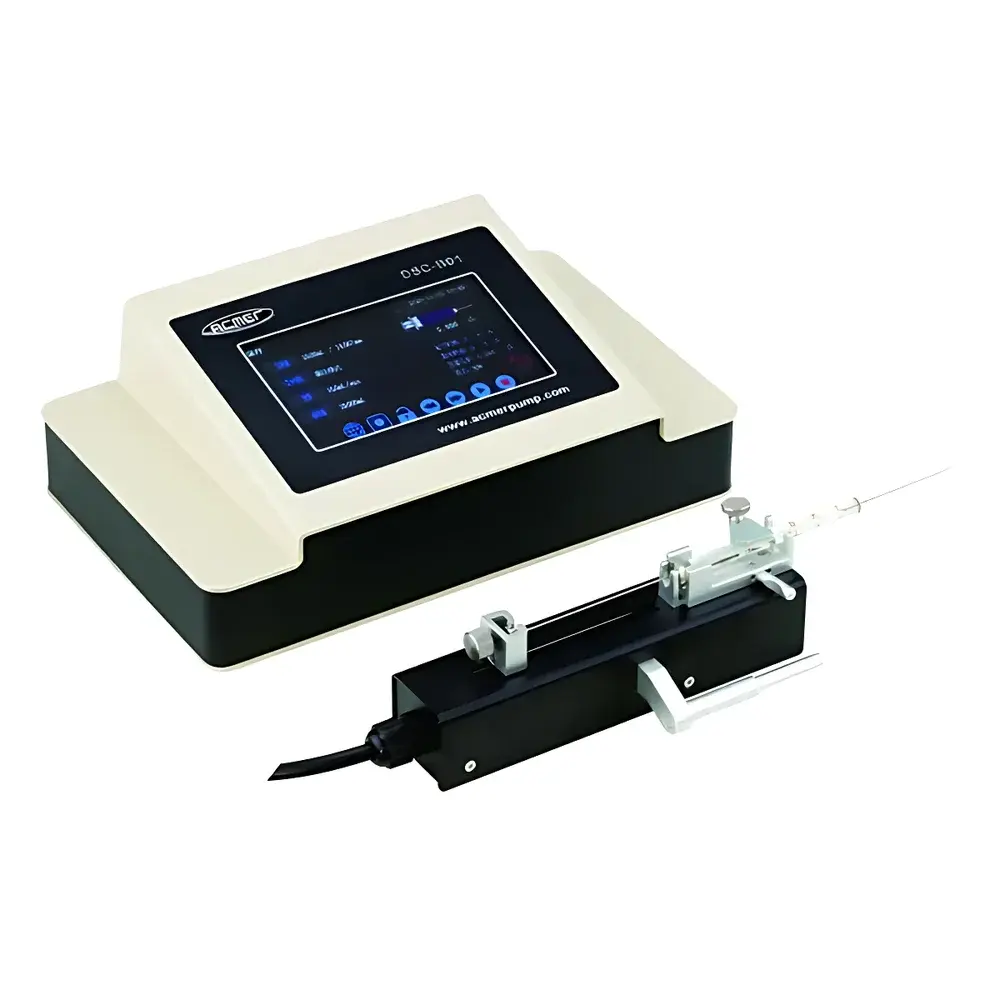
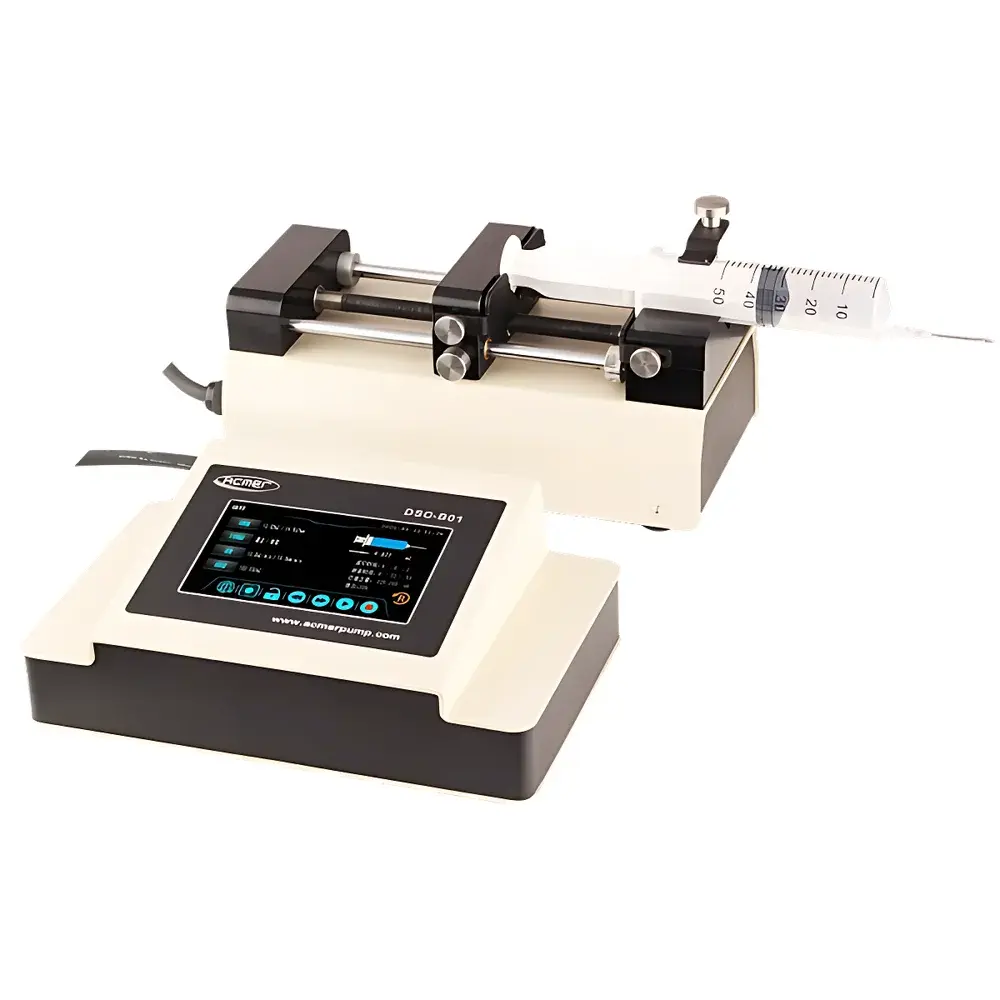
Acmer DSC Split-Design Touchscreen Syringe Pump
| Brand | Acmer |
|---|---|
| Origin | Hebei, China |
| Manufacturer Type | Authorized Distributor |
| Product Origin | Domestic (China) |
| Model | DSC |
| Instrument Type | Micro-volume Syringe Pump |
| Flow Rate Range | 0.96 pL/min to 2035.01 µL/min |
| Accuracy | ±0.5% |
| Repeatability | ±0.05% |
Overview
The Acmer DSC Split-Design Touchscreen Syringe Pump is an engineered solution for precise, low-flow liquid delivery in research and analytical laboratory environments. Based on stepper motor-driven linear actuation and calibrated syringe displacement, the DSC implements closed-loop microstepping control to achieve high-resolution volumetric dispensing across a wide dynamic range—from picoliter-per-minute neurochemical infusion to microliter-per-minute reagent dosing. Its split architecture physically decouples the drive unit from the control interface, minimizing mechanical coupling noise and enabling flexible integration into confined or vibration-sensitive setups such as stereotaxic rigs, microfluidic platforms, and automated assay workstations. Designed for continuous operation under GLP-aligned workflows, the pump supports traceable parameter logging and deterministic runtime behavior—critical for reproducible preclinical pharmacokinetic studies and microscale reaction monitoring.
Key Features
- 5-inch high-resolution capacitive touchscreen interface with intuitive icon-based navigation and real-time graphical feedback of flow status, elapsed time, and remaining volume.
- Split mechanical design: motorized pusher unit mounts remotely (up to 2 m via shielded cable), while the control panel remains accessible at bench level—ideal for cleanroom-compatible or space-constrained installations.
- Comprehensive syringe library supporting over 80 standard models from BD, Hamilton, SGE, and Ito; user-definable syringe geometry parameters (barrel ID, plunger travel) enable accurate conversion between linear displacement and volumetric flow.
- On-device calibration routine with dual-point verification (low- and high-flow endpoints), storing up to 16 calibrated syringe profiles with timestamped metadata.
- Full operational parameter programmability: target volume, flow rate, infusion/withdrawal cycle timing, inter-cycle delay, and repeat count—all persistently saved per protocol.
- Real-time flow rate adjustment during active infusion without interrupting motor motion—enabling adaptive dosing protocols in response to external sensor triggers.
- Power-loss resilience: non-volatile memory retains current position, flow state, and active protocol settings; automatic resumption upon power restoration ensures uninterrupted long-duration experiments.
- Dual-mode external control interface: TTL-compatible digital input (5–24 V logic or dry contact) for hardware-triggered start/stop, plus configurable RS485 or USB virtual COM port for SCADA or LabVIEW integration.
Sample Compatibility & Compliance
The DSC accommodates glass, plastic, and metal syringes ranging from 1 µL to 100 mL capacity, including luer-lock, luer-slip, and cemented-tip configurations. Its adjustable pusher force (0.1–12 N range, software-limited by syringe barrel integrity) prevents seal rupture or barrel deformation during high-viscosity fluid delivery (e.g., polymer solutions, cell suspensions). The device complies with IEC 61000-6-3 (EMC emission limits) and IEC 61000-6-2 (immunity to electrostatic discharge and RF fields). While not certified for clinical use, its parameter audit trail, firmware version logging, and deterministic execution model support alignment with ISO/IEC 17025 documentation requirements for accredited testing laboratories.
Software & Data Management
Local operation requires no PC—full functionality is accessible via the embedded Linux-based HMI. For networked deployment, optional Acmer PumpLink™ software (Windows/macOS) provides remote configuration, multi-pump synchronization, and CSV-exportable runtime logs with millisecond timestamp resolution. All parameter changes—including calibration updates and flow rate modifications—are recorded in an immutable internal event log compliant with ALCOA+ principles (Attributable, Legible, Contemporaneous, Original, Accurate, Complete, Consistent, Enduring, Available). Audit trail export supports FDA 21 CFR Part 11 readiness when paired with institutional electronic signature policies.
Applications
- Neuroscience: Chronic intracerebral microinfusion in rodent stereotaxic surgery using 1–10 µL Hamilton syringes with sub-nL precision.
- Microfluidics: Continuous reagent loading into PDMS chips with pulseless flow (<0.1% ripple) for droplet generation and laminar mixing validation.
- Materials science: Controlled deposition of nanomaterial dispersions (e.g., quantum dot inks, perovskite precursors) onto substrates at <100 nL/s rates.
- Environmental analysis: Automated standard addition in ion chromatography sample loops or low-flow dialysis probe perfusion.
- Bioprocessing: pH/DO correction agent delivery in miniature bioreactors where volumetric accuracy directly impacts metabolic modeling fidelity.
FAQ
Does the DSC support bidirectional operation (infusion and withdrawal)?
Yes—the DSC executes fully reversible linear motion with independent parameter sets for infusion and withdrawal phases, including distinct flow rates and dwell times.
Can multiple DSC units be synchronized via RS485?
Yes—RS485 daisy-chaining supports up to 32 addressable units on a single bus; master-slave triggering and phase-aligned start commands are supported through Modbus RTU protocol.
Is firmware upgrade possible in-field?
Yes—firmware updates are performed via USB stick using signed .bin files; update integrity is verified via SHA-256 checksum before installation.
What safety mechanisms prevent syringe over-pressurization?
The system monitors real-time motor current draw and automatically halts motion if torque exceeds user-defined thresholds—configurable per syringe type to accommodate varying plunger friction and fluid viscosity.
How is calibration traceability maintained?
Each calibration session generates a unique identifier, records ambient temperature and syringe serial number, and stores raw step-count vs. gravimetric measurement data—exportable as PDF or CSV for QA review.



