
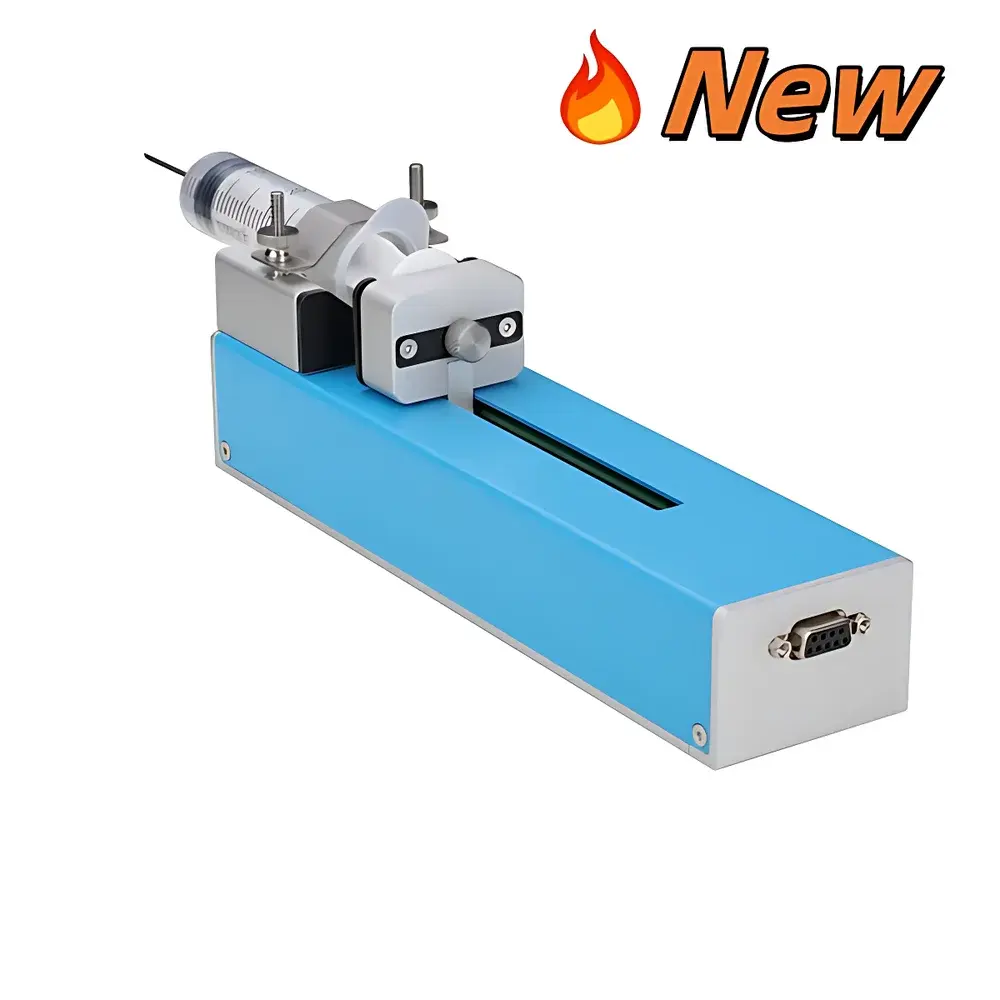
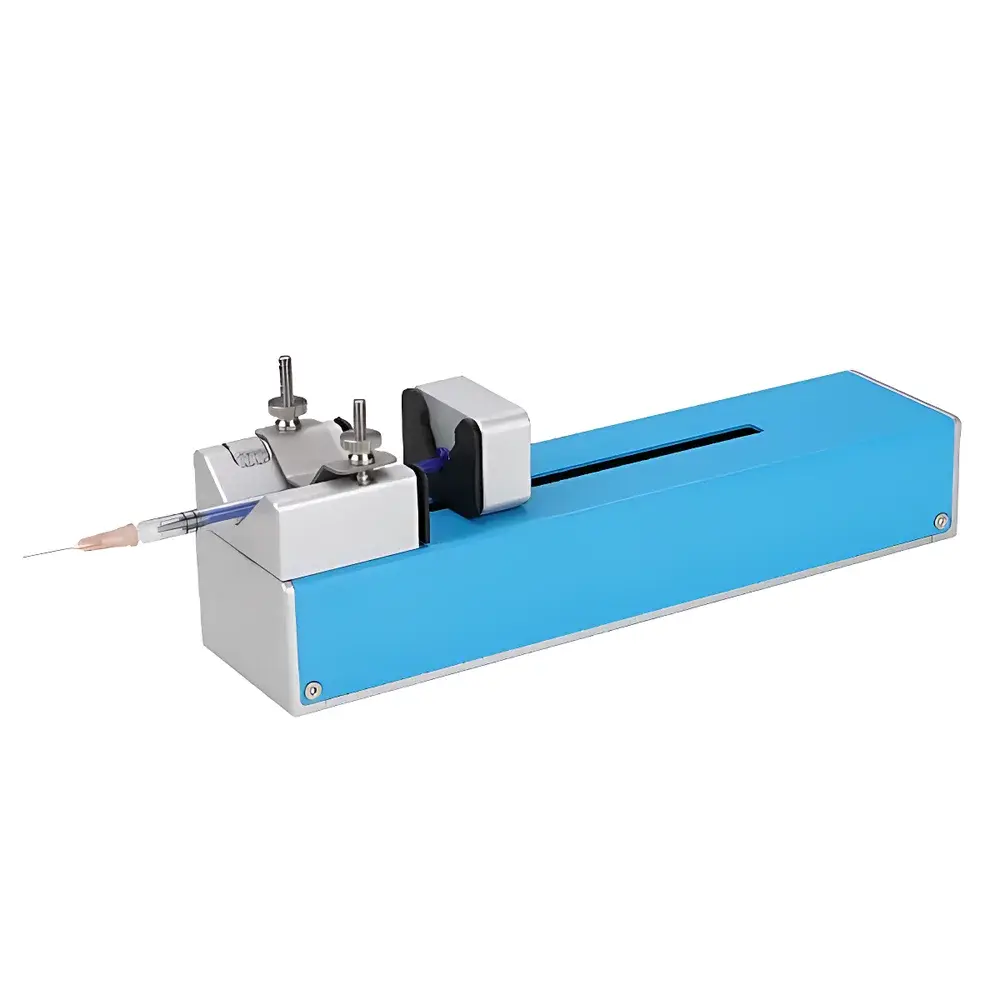
Acmer EW110B RS485-Controlled Micro-Syringe Pump (No Display)
| Brand | Acmer |
|---|---|
| Origin | Hebei, China |
| Model | EW110B |
| Pump Type | Micro-syringe Pump |
| Flow Rate Range | 1 pL/min – 173.25 mL/min |
| Accuracy | ±0.1% |
| Repeatability | ±0.05% |
| Maximum Linear Stroke | 110 mm |
| Plunger Force | >120 N |
| Linear Speed Range | 0.127 µm/min – 254 mm/min |
| Control Resolution | 0.198 µm per microstep |
| RS485 Address Range | 1–32 |
| Baud Rate | 9600 bps |
| Power Supply | DC 24 V |
| Operating Temperature | 0–40 °C |
| Relative Humidity | 20–80% RH (non-condensing) |
| IP Rating | IP31 |
| Dimensions (W×H×D) | 230 × 38 × 72 mm |
| Weight | 1.1 kg |
| Syringe Compatibility | 0.5 µL – 60 mL standard Luer-lock syringes |
Overview
The Acmer EW110B is a compact, display-free micro-syringe pump engineered for precise, programmable fluid delivery in automated laboratory and OEM integration environments. Unlike conventional benchtop syringe pumps with integrated user interfaces, the EW110B eliminates the front-panel display to prioritize minimal footprint, electromagnetic compatibility, and deterministic serial control—making it ideal for embedded applications such as microfluidic instrument modules, multi-axis liquid handling platforms, and regulated analytical systems requiring remote orchestration. Its operation is grounded in high-resolution stepper motor actuation coupled with closed-loop position feedback, enabling volumetric precision governed by syringe geometry and calibrated displacement per step. The pump adheres to fundamental principles of positive-displacement fluid mechanics: flow rate is derived from plunger cross-sectional area multiplied by linear velocity, while reproducibility is ensured through mechanical rigidity, thermal stability of the lead-screw assembly, and consistent motor torque delivery across its full speed range.
Key Features
- RS485 serial interface (Modbus RTU protocol compatible) for deterministic, noise-immune communication in industrial and multi-device networks
- Configurable device address (1–32) and fixed 9600 bps baud rate—optimized for stable long-cable runs in shielded lab environments
- Full command set supporting real-time parameter adjustment: volume, flow rate, infusion/extraction direction, cycle count, dwell intervals, and dynamic on-the-fly speed modulation during active operation
- Built-in syringe database covering common Luer-lock syringes from global manufacturers (BD, Hamilton, SGE, etc.), with support for user-defined inner diameter entry and custom calibration curve storage
- Adjustable plunger force profile—enabling optimal pressure matching for low-compliance microfluidic channels or high-viscosity reagents without stalling or backflow
- Ultra-compact form factor (230 × 38 × 72 mm) and lightweight design (1.1 kg), facilitating vertical mounting, rack integration, or space-constrained OEM chassis deployment
- IP31-rated enclosure provides protection against vertically falling drips and solid objects >2.5 mm—suitable for cleanroom-adjacent instrumentation zones
Sample Compatibility & Compliance
The EW110B accommodates standard Luer-lock syringes ranging from ultra-micro volumes (0.5 µL glass syringes with 0.103 mm inner diameter) up to clinical-scale plastic barrels (60 mL, 29.47 mm ID). Its mechanical architecture ensures compatibility with both polypropylene disposable and borosilicate glass syringes, provided they meet ISO 8536-4 and ISO 7886-1 dimensional tolerances. While the pump itself carries no regulatory certification (e.g., CE, UL, or FDA 510(k)), its design supports compliance pathways for end-user systems: traceable calibration procedures align with ISO/IEC 17025 requirements for measurement uncertainty; RS485 command logging enables audit-ready execution records; and deterministic behavior under defined environmental conditions (0–40 °C, non-condensing humidity) facilitates validation per ICH Q7 and ASTM E2500-13 guidelines for equipment qualification in GMP-relevant workflows.
Software & Data Management
The EW110B operates exclusively via external host control—no local firmware UI or onboard memory for method storage. All operational parameters are transmitted and retained within the supervisory system (e.g., LabVIEW, Python-based control suites, or custom PLC logic). Command packets include checksum validation, ensuring data integrity during transmission. For GLP/GMP-aligned deployments, integration architectures should implement timestamped command logging, electronic signature enforcement, and change history tracking at the host level. The pump supports asynchronous status polling (e.g., current position, running state, error flags), enabling real-time monitoring without interrupting infusion sequences. Firmware updates—when available—are delivered via UART bootloader mode, requiring physical access and validated binary verification prior to installation.
Applications
- Microfluidic chip priming and continuous reagent perfusion in organ-on-chip and droplet generation platforms
- OEM integration into automated ELISA washers, capillary electrophoresis injectors, and laser ablation sample introduction systems
- Controlled delivery of nanoliter-scale standards in mass spectrometry calibration workflows
- Multi-pump synchronization for gradient formation in HPLC pre-column derivatization or pH-controlled reaction quenching
- Long-duration cell culture media exchange with programmable pulsatile flow profiles mimicking physiological shear stress
- Low-flow solvent delivery in cryo-EM grid preparation robots where vibration isolation and spatial constraints dictate pump selection
FAQ
Does the EW110B support USB or Ethernet connectivity?
No. It features RS485 only—designed for robust, multi-drop serial networks in electrically noisy environments. USB or Ethernet interfaces require external protocol converters.
Can multiple EW110B units be synchronized for coordinated dispensing?
Yes—via master-slave RS485 addressing and time-stamped command scheduling at the host controller level. Sub-millisecond inter-unit timing skew is achievable with proper cable termination and latency compensation.
Is syringe calibration traceable to national standards?
Calibration is user-performed using gravimetric or volumetric reference methods. While Acmer provides calibration guidance aligned with ISO 8655-3, final traceability depends on the end user’s metrology infrastructure and documented SOPs.
What safety mechanisms prevent over-pressurization during occlusion?
The pump monitors motor current and position deviation. Upon detecting stall conditions exceeding configurable thresholds, it halts motion and reports an error code—though external pressure sensors or relief valves remain recommended for critical applications.
Is firmware source code or detailed register map available?
Acmer provides a complete ASCII command protocol specification (including error codes, response formats, and timing diagrams) under NDA for qualified OEM partners. Low-level register access is not exposed.



