
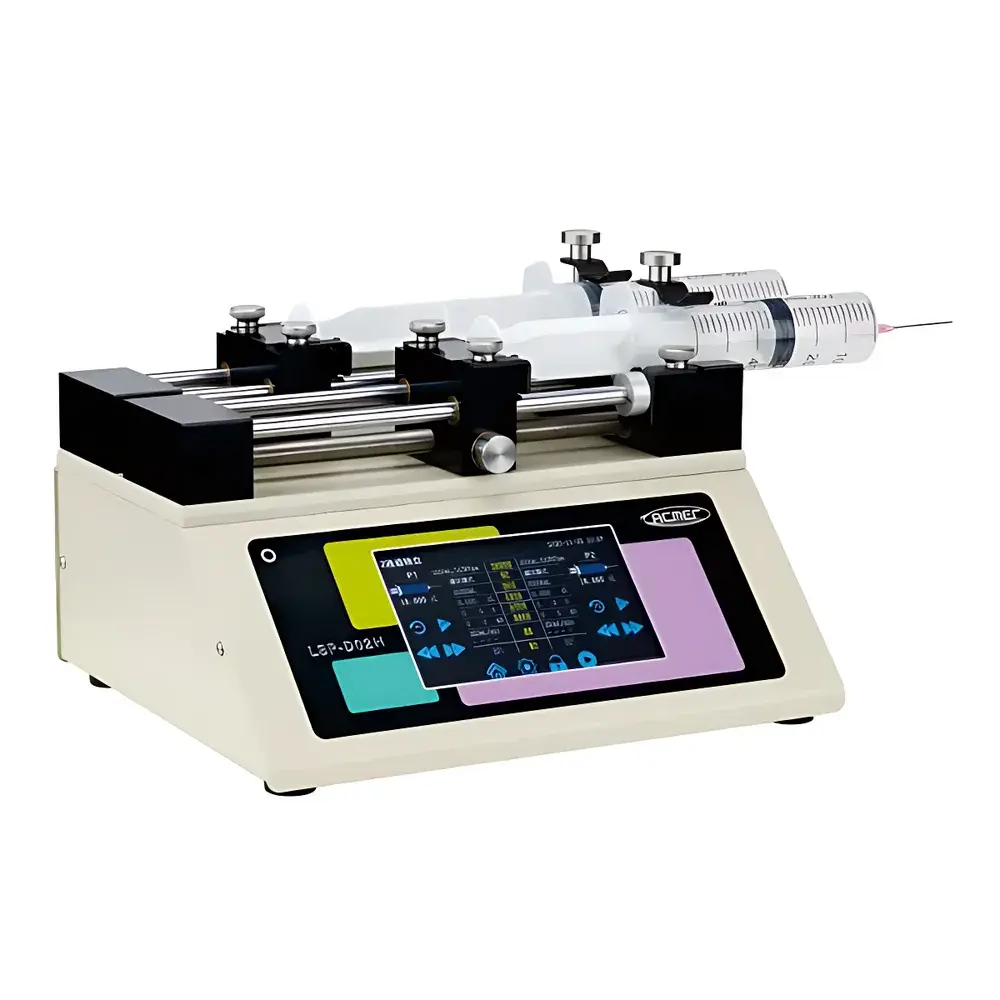
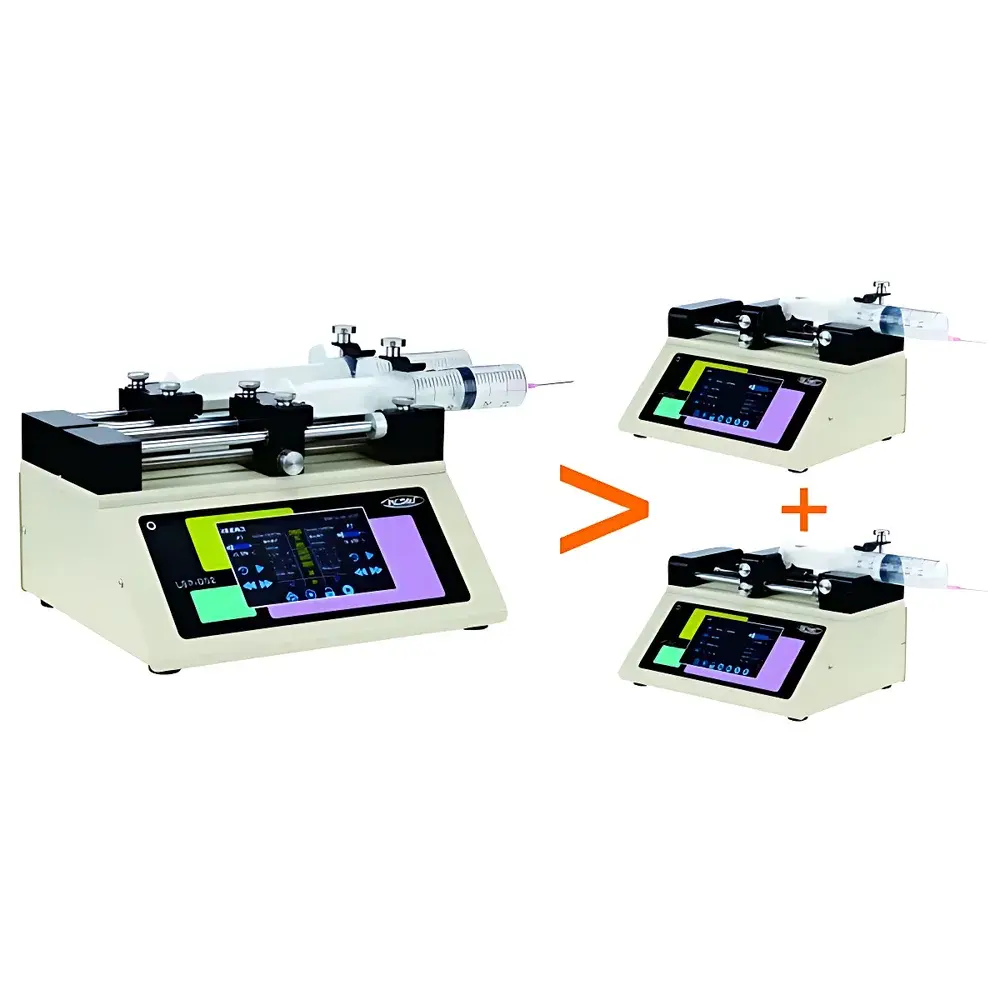
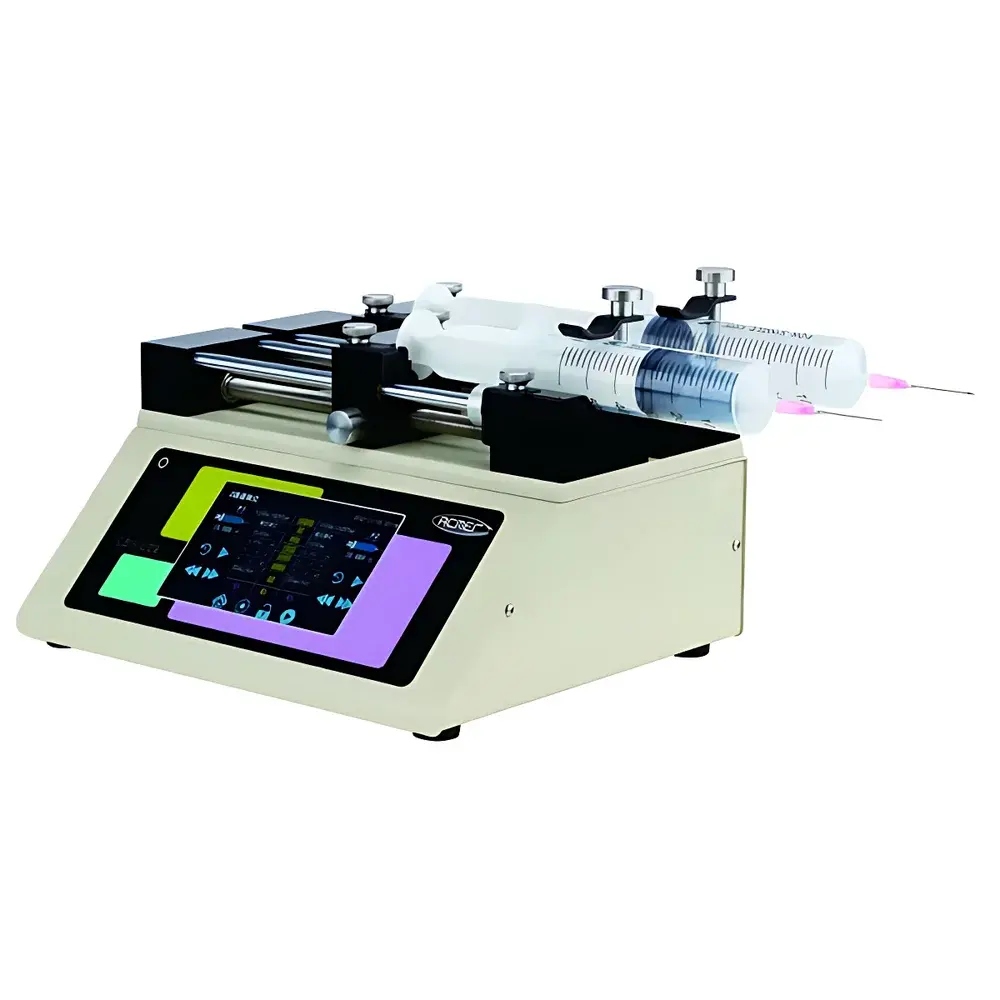
Acmer LSP-D02 Dual-Channel Independent-Control Syringe Pump
| Brand | Acmer |
|---|---|
| Model | LSP-D02 |
| Type | Microfluidic Syringe Pump |
| Flow Rate Range | 0.0001 nL/min to 109.136 mL/min |
| Accuracy | ±0.5% |
| Repeatability | ±0.05% |
| Display | 5-inch HD Color Touchscreen |
| Control Interface | RS485 / USB (configurable address & baud rate) |
| External Trigger | TTL-compatible 5–24 V logic level or dry contact |
| Force Adjustment | Per-channel programmable push force |
| Compliance | GLP-supporting operation log, audit-ready parameter storage |
Overview
The Acmer LSP-D02 is a dual-channel, independently controllable syringe pump engineered for precision microfluidic delivery in research laboratories, analytical instrumentation integration, and preclinical assay development. Based on high-resolution stepper motor actuation and closed-loop position feedback, the LSP-D02 delivers volumetrically accurate fluid displacement across an exceptionally wide dynamic flow range—from sub-nanoliter-per-minute infusion for single-cell electrophysiology or nanoliter-scale reagent dosing, up to over 100 mL/min for rapid buffer exchange or column priming. Its core architecture separates mechanical drive trains per channel, eliminating cross-talk and enabling true asynchronous operation—critical for applications requiring differential timing, opposing flow directions, or oscillatory perfusion protocols. Designed for ISO/IEC 17025-aligned lab environments, the system supports traceable operation through persistent parameter logging and user-accessible calibration records.
Key Features
- Dual independent drive systems with isolated microstepping control—no mechanical coupling between channels
- 5-inch capacitive touchscreen interface with intuitive icon-based navigation and real-time dual-channel status overlay
- Built-in injection library covering >120 syringe models from BD, Hamilton, SGE, Ito, Nanotemper, and other global manufacturers—with automatic volume/geometry mapping
- Per-channel force optimization: software-adjustable push force (0–50 N range) prevents syringe barrel deformation or plunger slippage
- Four operational modes: Independent (A/B run separately), Reciprocating (single channel alternates fill/dispense), Synchronized (identical timing/flow), and Synchronized Merging (combined output via Y-connector)
- Configurable alarm system: audible tone triggered at user-defined target volume completion per channel, with visual indicator retention
- RS485 Modbus RTU and USB CDC virtual COM port interfaces—both support remote command execution, status polling, and firmware updates
- Hardware-level external trigger inputs (5–24 V DC or dry-contact compatible) for synchronized start/stop with spectrometers, cameras, or environmental chambers
Sample Compatibility & Compliance
The LSP-D02 accommodates standard Luer-lock and Luer-slip syringes from 1 µL to 140 mL capacity—including glass, polypropylene, and stainless-steel variants. Each channel maintains full parameter independence: syringe diameter, target volume, flow profile, dwell time, and direction are stored separately with timestamped calibration metadata. The device complies with IEC 61010-1 for laboratory electrical safety and incorporates non-volatile memory for GLP/GMP-relevant data integrity—supporting 21 CFR Part 11–compatible audit trails when used with validated host software. All calibration coefficients are digitally signed and retained across power cycles without battery backup dependency.
Software & Data Management
Local configuration and real-time monitoring occur entirely via the embedded touchscreen UI; no PC dependency is required for basic operation. For automated workflows, the pump exposes a documented ASCII command set over USB or RS485—including commands for setting flow rate (e.g., “FR 1 0.00234”), initiating run (“GO 1”), querying position (“QP 2”), and retrieving calibration checksums (“CK 1”). Host-side integration examples (Python, LabVIEW, MATLAB) are provided in the technical documentation. Operational logs—including start/stop timestamps, executed parameters, error codes, and manual overrides—are written to internal flash memory and exportable via USB mass-storage mode as CSV files with ISO 8601 timestamps.
Applications
- Multi-step chromatography gradient formation with simultaneous solvent A/B delivery and precise dwell control
- Microfluidic organ-on-chip platforms requiring pulsatile or bidirectional perfusion of endothelialized channels
- Electrophysiology patch-clamp rigs where ultra-low-flow drug application (<1 nL/min) must be decoupled from bath perfusion
- Automated sample introduction into ICP-MS or LC-MS systems with programmable injection volume ramping
- Calibration standard delivery for flow cytometry or particle sizing instruments requiring certified volumetric accuracy
- Controlled reagent addition in kinetic enzyme assays where reaction initiation timing must be synchronized across parallel wells
FAQ
Can the two channels operate at different flow rates simultaneously?
Yes—each channel has fully independent motion control, allowing concurrent but dissimilar flow profiles, including opposite directions and staggered start/stop times.
Is syringe calibration traceable to national standards?
Calibration is performed using gravimetric verification per ASTM D3427; reference weights are NIST-traceable. Calibration coefficients are stored with operator ID and date stamp.
Does the pump support continuous oscillatory flow (e.g., sine-wave infusion)?
Yes—the reciprocating mode enables programmable fill/dispense cycles with adjustable dwell periods, effectively generating square-wave or pseudo-sinusoidal net flow when paired with passive dampening.
What happens during a power interruption?
All active parameters and calibration data persist in non-volatile memory. Upon reboot, the display returns to standby mode; no automatic restart occurs unless explicitly commanded.
Is USB communication compatible with Linux-based DAQ systems?
Yes—the USB interface enumerates as a CDC ACM device and responds to standard serial TTY commands; kernel drivers are included in all major Linux distributions post-2018.



