
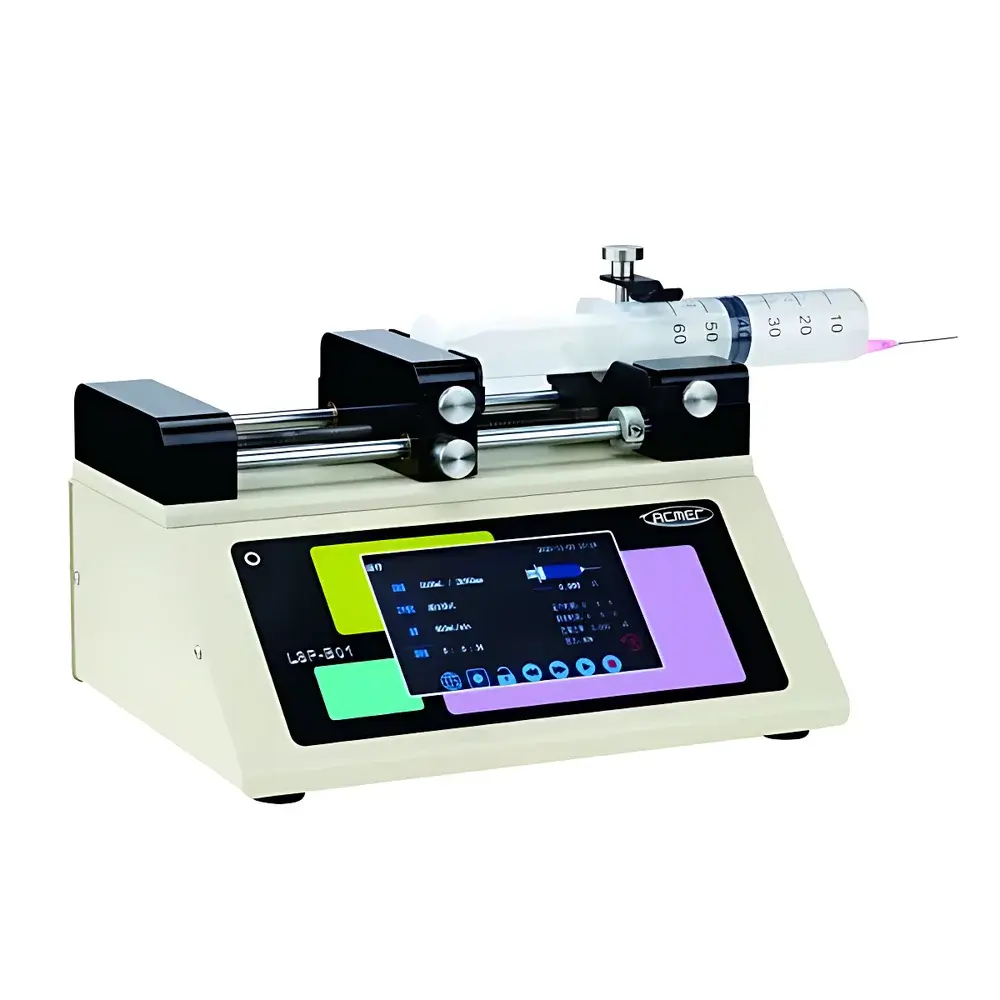
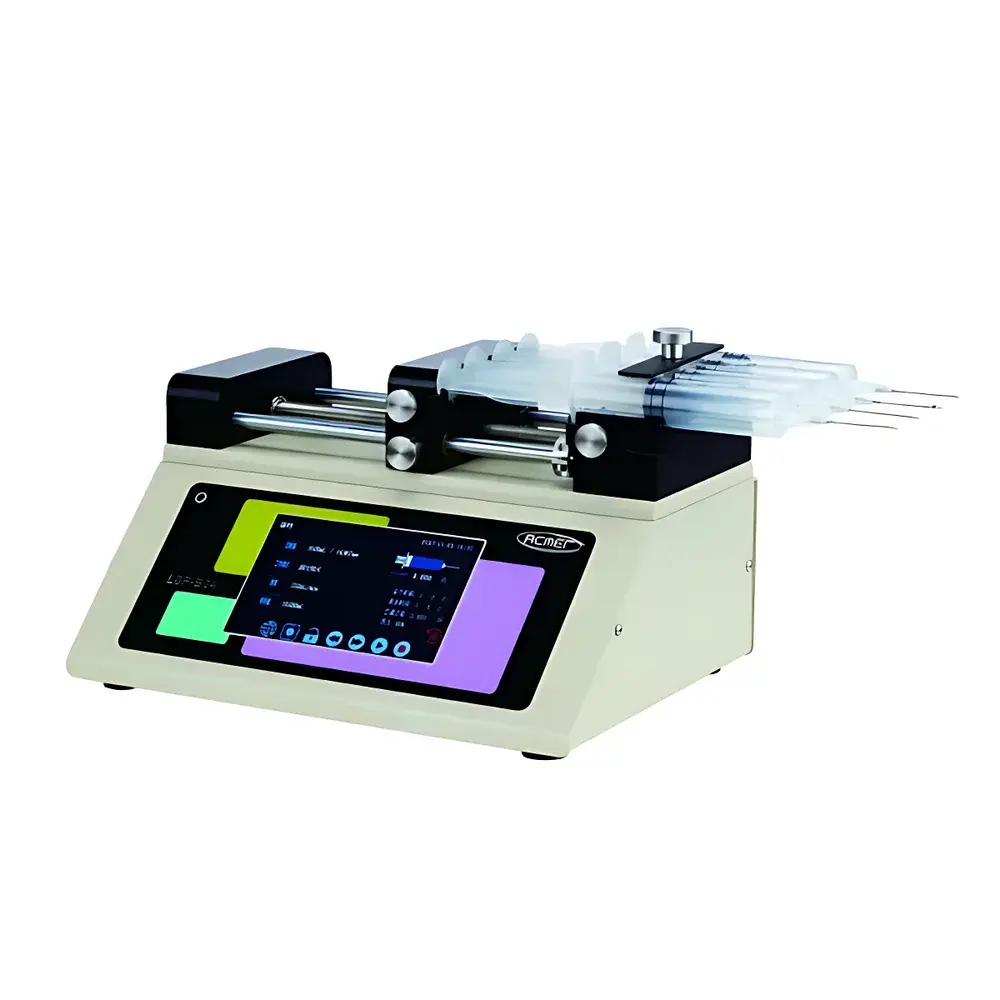
Acmer LSP-U High-Precision Touchscreen Syringe Pump
| Brand | Acmer |
|---|---|
| Model | LSP-U |
| Pump Type | Microfluidic Syringe Pump |
| Flow Rate Range | 0.0001 nL/min to 21.8273 mL/min |
| Accuracy | ±0.5% |
| Repeatability | ±0.05% |
| Display | 5-inch HD capacitive touchscreen |
| Control Interface | RS485 or USB (configurable address & baud rate) |
| External Trigger | TTL-compatible digital input (5–24 V logic level or dry contact) |
| Status Outputs | Real-time run/stop and direction signals |
| Syringe Calibration | Built-in calibration with user-defined profile storage |
| Power Recovery | Auto-resume operation with preserved runtime parameters after power interruption |
Overview
The Acmer LSP-U is a high-precision, microfluidic-grade syringe pump engineered for stable, low-pulse fluid delivery in demanding laboratory environments. Based on stepper motor-driven linear actuation and closed-loop position feedback, it delivers exceptional volumetric control across an ultra-wide flow range—from sub-nanoliter-per-minute regimes critical for single-cell manipulation and nanoliter-scale reagent dosing, up to milliliters per minute for scalable process development. Its architecture minimizes mechanical backlash and pressure transients, ensuring minimal flow pulsation (<0.5% peak-to-peak variation under steady-state conditions), a prerequisite for applications such as electrospinning, microfluidic chip priming, and continuous-flow synthesis where laminar stability directly impacts product uniformity.
Key Features
- 5-inch HD capacitive touchscreen interface: Intuitive graphical UI with real-time parameter visualization—including dynamic flow rate, elapsed time, remaining volume, and system status—designed for glove-compatible operation in biosafety cabinets and cleanrooms.
- Comprehensive syringe library: Preloaded profiles for >120 standard syringes from major global manufacturers (e.g., Hamilton, BD, Terumo, SGE, and Nanotemper), including glass, plastic, and stainless-steel variants; supports custom diameter/stroke-length entry with automatic volume and force calculation.
- User-calibrated actuator response: On-device calibration routine compensates for syringe plunger friction and mechanical hysteresis, storing correction coefficients per syringe model to maintain accuracy across repeated use cycles.
- Multi-stage programmable protocols: Configurable infusion/extraction sequences with independent settings for target volume, flow rate, dwell time, cycle count, and inter-step intervals—enabling complex delivery schemes such as pulsatile drug release or gradient mixing without external scripting.
- Real-time operational flexibility: Live flow rate adjustment during active operation, push-force optimization based on syringe barrel material and fluid viscosity, and audible end-of-delivery alert with configurable threshold.
- Robust industrial communication & integration: Dual-mode serial interface (RS485 Modbus RTU or USB CDC virtual COM port); configurable node address, parity, and baud rate (up to 115.2 kbps); isolated digital I/O for synchronization with external triggers, PLCs, or data acquisition systems.
Sample Compatibility & Compliance
The LSP-U accommodates syringes from 1 µL to 100 mL capacity, supporting both standard Luer-lock and custom-fit adapters. It is compatible with aqueous buffers, organic solvents (including DMSO, chloroform, and THF), viscous polymer solutions (e.g., PVP, PLA in DMF), and shear-sensitive biologics when operated within validated flow regimes. While not certified for clinical use, its firmware implements audit-trail-capable parameter logging (timestamped start/stop events, flow changes, and calibration records), aligning with GLP documentation requirements. Mechanical design complies with IEC 61010-1 for laboratory electrical equipment safety; CE marking applies for EMC and low-voltage directives.
Software & Data Management
The pump operates autonomously via onboard firmware but integrates seamlessly with third-party platforms through ASCII-based command protocols. Optional Acmer PC Utility (Windows/Linux/macOS) enables batch protocol upload, remote monitoring, and CSV export of runtime logs—including instantaneous flow, cumulative volume, and error codes—for traceability in regulated workflows. All configuration changes are non-volatile and persist across power cycles. Firmware updates are delivered via USB mass-storage mode, requiring no proprietary tools or drivers.
Applications
- Microfluidic device actuation and pressure-balanced flow control in organ-on-chip and droplet generation systems
- Precise precursor delivery in electrospinning and electrospraying setups for nanofiber morphology tuning
- Controlled reagent injection in automated analytical sample preparation (e.g., LC autosampler priming, SPE cartridge conditioning)
- Low-flow perfusion in 3D cell culture bioreactors and microphysiological systems
- Calibration fluid delivery in gravimetric or optical flow sensor validation rigs
- On-demand dispensing in R&D-scale continuous manufacturing of nanoparticles and liposomal formulations
FAQ
What syringe sizes and materials are supported?
The LSP-U supports syringes ranging from 1 µL glass microsyringes to 100 mL polypropylene barrels. Material compatibility includes borosilicate glass, polyethylene, polypropylene, PTFE, and stainless steel—subject to chemical resistance verification per fluid type.
Can the pump be integrated into a larger automated system?
Yes—via RS485 Modbus RTU or USB CDC, enabling bidirectional communication with PLCs, LabVIEW, Python-based controllers, or SCADA systems. Digital I/O lines support hardware-triggered start/stop and provide real-time status feedback.
Is calibration traceable to national standards?
While the LSP-U does not include NIST-traceable calibration certificates by default, its calibration procedure follows ISO 8655-3 principles for piston-type liquid delivery devices. Users may perform in-house verification using gravimetric or photometric methods compliant with ASTM E2795 or USP .
How does the pump handle power interruptions?
Upon power loss, the device saves current operational state—including elapsed time, delivered volume, and active flow rate—to non-volatile memory. When power is restored, it resumes execution from the exact point of interruption without manual reinitialization.
What maintenance is required for long-term accuracy?
No scheduled maintenance is required beyond periodic visual inspection of the lead screw and linear rail for dust accumulation. Stepper motor and driver electronics are solid-state with no consumable wear parts; accuracy drift remains within ±0.5% over 12 months under typical lab conditions (20–25°C, <60% RH).



