
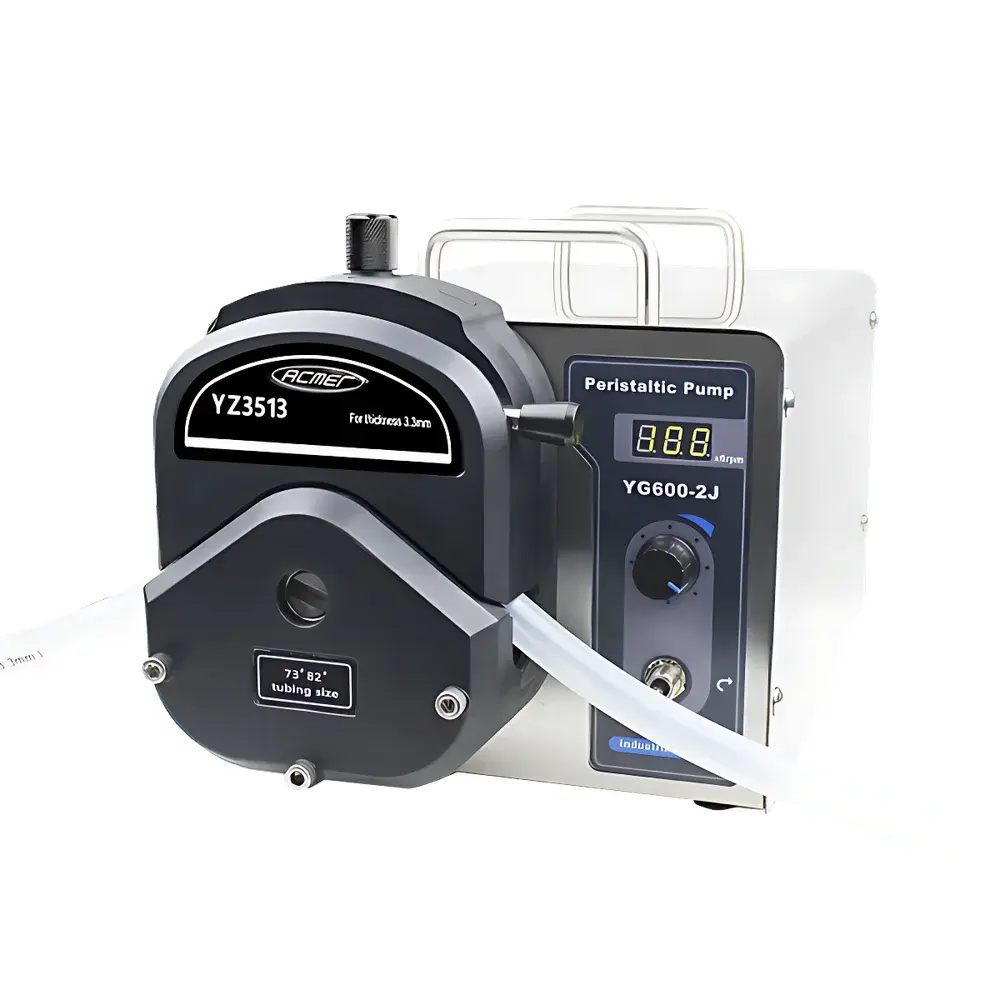
Acmer YG600-2J High-Flow Adjustable-Speed Industrial Peristaltic Pump
| Brand | Acmer |
|---|---|
| Origin | Hebei, China |
| Manufacturer Type | Authorized Distributor |
| Country of Origin | China |
| Model | YG600-2J |
| Pump Type | Peristaltic Pump |
| Flow Rate Range | 0–12,000 mL/min (dependent on tubing ID and fluid properties) |
| Speed Range | 0–600 rpm |
| Control Method | PWM-controlled DC motor |
| Reversibility | Yes, via toggle switch |
| Display | Digital speed indicator (0–100% scale, 100% = 600 rpm) |
| Power Consumption | <400 W |
| Input Voltage | AC 200–260 V, 50/60 Hz |
| Operating Environment | 0–40 °C, RH <80% non-condensing |
| Enclosure Rating | IP31 |
| Net Weight | 16 kg |
| Dimensions | Not specified in source data |
| Compliance | CE-marked per IEC 61000-6-3/6-2 |
Overview
The Acmer YG600-2J is a high-flow, digitally monitored industrial peristaltic pump engineered for continuous-duty fluid transfer in demanding laboratory and light-industrial settings. It operates on the principle of positive displacement via occlusion: rollers compress flexible tubing against a curved housing, creating a sealed fluid pocket that advances with rotation—ensuring zero contamination between drive mechanism and conveyed medium. Designed for applications requiring precise, repeatable flow control without valving or seals, the YG600-2J delivers stable volumetric delivery across a wide dynamic range (0–12,000 mL/min), contingent upon tubing inner diameter (ID), wall thickness, elasticity, and fluid rheology. Its robust aluminum-alloy chassis and thermally stable DC motor architecture support uninterrupted operation under variable load conditions, making it suitable for integration into automated sampling systems, bioreactor feed lines, chemical dosing skids, and wastewater pretreatment loops.
Key Features
- PWM-based DC motor control ensures smooth, low-noise speed regulation with minimal torque ripple—even at low rpm—enhancing long-term tubing life and flow stability.
- Digital LED display shows real-time speed as a percentage of maximum (0–100%), calibrated to 600 rpm; eliminates ambiguity in setting and replicating operational points.
- Reversible operation via front-panel toggle switch enables bidirectional priming, backflushing, and system validation—critical for cross-contamination-sensitive workflows in pharmaceutical QC or environmental analysis.
- Wide-input AC power supply (200–260 V, 50/60 Hz) accommodates fluctuating grid conditions common in manufacturing facilities and field-deployed labs, reducing need for external voltage regulators.
- IP31-rated enclosure provides protection against vertically falling drips and solid objects ≥2.5 mm, supporting use in controlled but non-classified environments such as analytical prep rooms, pilot-scale process labs, and utility corridors.
- Front-mounted illuminated power switch offers immediate visual status confirmation—essential for multi-pump installations where rapid fault identification is required during shift handovers or SOP execution.
Sample Compatibility & Compliance
The YG600-2J is compatible with standard peristaltic pump tubing materials including silicone, Viton®, Tygon® LFL, and PharmPure™, enabling safe handling of aqueous buffers, organic solvents, mildly corrosive reagents, and shear-sensitive biological suspensions. Tubing selection directly governs maximum pressure rating (up to 2.5 bar typical), pulse dampening, and chemical resistance—users must consult tubing manufacturer specifications for compatibility with specific fluids. While the pump itself carries no intrinsic regulatory certification (e.g., FDA 21 CFR Part 11), its analog control interface and deterministic mechanical behavior allow integration into validated systems when paired with compliant data acquisition hardware and software. It meets electromagnetic compatibility (EMC) requirements per IEC 61000-6-3 (emission) and IEC 61000-6-2 (immunity), facilitating installation in shared instrument racks without signal interference.
Software & Data Management
The YG600-2J operates as a standalone analog device with no embedded microprocessor or digital communication ports (e.g., RS-485, USB, or Ethernet). Flow rate is set exclusively via manual potentiometer adjustment, and operational parameters are not logged or exportable. For traceable, auditable operation in GLP or GMP environments, external data loggers or PLC-integrated analog I/O modules must be employed to record speed setpoints, runtime, and direction status. Optional third-party control interfaces (e.g., 0–10 VDC analog input modules) can be retrofitted to enable remote speed modulation from SCADA or LabVIEW-based supervisory systems—subject to user-configured calibration and linearity verification per ISO/IEC 17025 clause 5.5.2.
Applications
- Continuous feed of nutrient media or harvest streams in benchtop and pilot-scale bioprocessing units.
- Automated reagent addition in wet chemistry analyzers and ICP sample introduction systems.
- Effluent sampling and composite collection in EPA Method-compliant wastewater monitoring stations.
- Transfer of food-grade syrups, dairy emulsions, or flavor concentrates in R&D kitchens and pilot plants.
- Chemical metering in electroplating baths, pH control loops, and coagulant dosing for municipal water treatment.
- Recirculation of cell culture supernatants during tangential flow filtration (TFF) pre-concentration steps.
FAQ
What tubing sizes are supported by the YG600-2J?
The pump head accommodates tubing IDs from 1.6 mm to 16 mm, depending on the installed roller configuration and housing variant. Users must verify mechanical fit and occlusion force compatibility prior to deployment.
Can this pump handle abrasive slurries?
Not recommended for untreated particulate-laden fluids. Suspended solids >50 µm may accelerate tubing wear and cause premature occlusion failure. Use only with filtered or clarified streams, or integrate upstream bag filtration.
Is speed calibration traceable to national standards?
No factory calibration certificate is supplied. End users performing critical flow applications should validate speed-to-flow correlation using gravimetric or timed-volume methods per ASTM D3417 or ISO 4787.
Does the pump include overload or dry-run protection?
No. The unit lacks integrated current sensing or temperature cutoff. Continuous operation without fluid or under excessive backpressure may damage the motor or tubing—system-level interlocks are the user’s responsibility.
How often should tubing be replaced?
Replacement interval depends on operating speed, fluid chemistry, and pressure. As a general guideline: silicone tubing at 300 rpm under ambient conditions requires replacement every 100–200 hours; Viton® extends service life to 500+ hours under equivalent conditions. Visual inspection for cracking, flattening, or loss of elasticity remains the primary maintenance criterion.



