
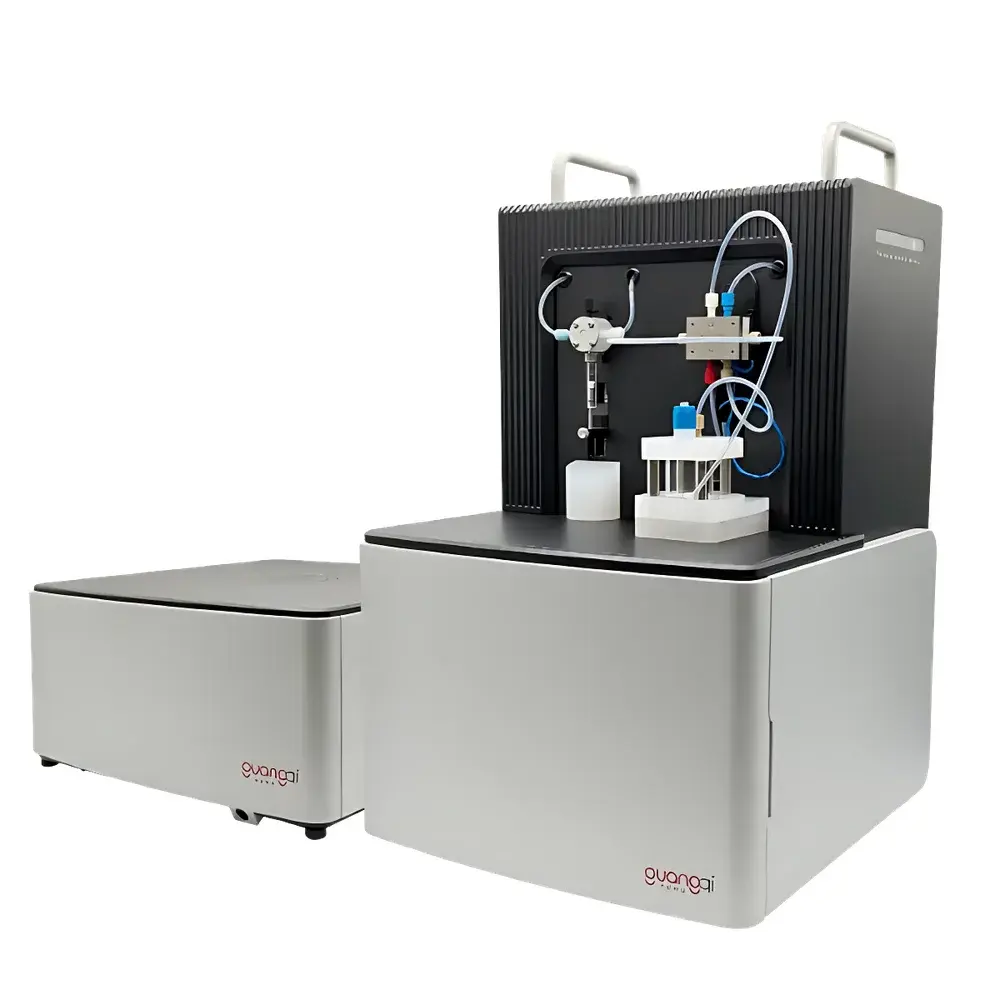
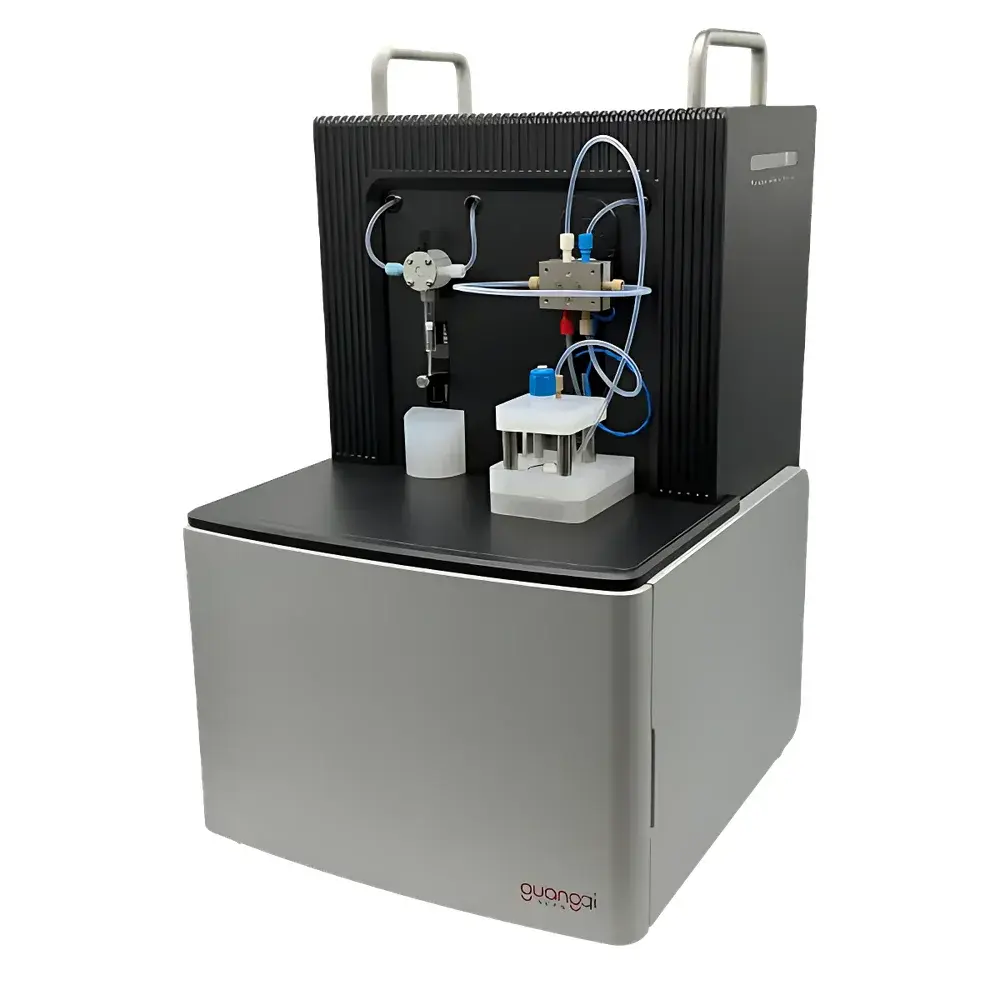
Acona Acona7000APS USP <729> Compliant Optical Particle Counter
| Brand | Acona |
|---|---|
| Origin | Shanghai, China |
| Manufacturer Type | OEM Manufacturer |
| Regional Category | Domestic (China) |
| Model | Acona7000APS |
| Instrument Type | Optical Particle Counter |
| Detection Principle | Single-Particle Optical Sensing (SPOS) with Dual-Mode Extinction & Scattering |
| Dynamic Range | 0.5 – 400 µm |
| Resolution | 0.01 µm (1024-channel binning) |
| Sensitivity | 10 ppt (particles ≥ 0.8 µm) |
| Max Sample Concentration | 10¹¹ #/mL (with patented two-step auto-dilution) |
| Regulatory Compliance | USP <729>, CP 2020 Vol IV, 21 CFR Part 11, cGMP/GLP-ready |
Overview
The Acona Acona7000APS is a high-precision optical particle counter engineered for regulatory-compliant particulate analysis in pharmaceutical, biotechnology, and advanced materials manufacturing environments. It implements Single-Particle Optical Sensing (SPOS) — a first-principles counting methodology where each particle passing through the sensing zone is individually resolved via simultaneous light extinction and light scattering detection. Unlike ensemble-averaging techniques such as laser diffraction (LD), SPOS delivers true number-based particle size distribution (PSD), enabling quantitative assessment of low-abundance, high-risk subpopulations — particularly large particles (>2 µm, >5 µm) critical to injectable safety and semiconductor slurry stability. The instrument is explicitly designed to meet USP <729> requirements for fat emulsion testing and supports automated PFAT5 calculation per pharmacopeial guidelines.
Key Features
- Dual-Physics SPOS Detection: Integrated LE400 sensor simultaneously acquires extinction and scattering signals from each particle, optimizing sensitivity for sub-micron particles (<1 µm) while maintaining counting accuracy for coarse particles up to 400 µm.
- Patented Two-Step Automatic Dilution System: Enables direct analysis of undiluted samples with concentrations up to 10¹¹ particles/mL. The system performs sequential dilution steps under closed-loop control, applies real-time concentration feedback, and automatically corrects raw counts using traceable dilution factors — eliminating manual pipetting variability and inter-operator bias.
- Ultra-High Resolution Binning: 1024 logarithmic data channels across the 0.5–400 µm range yield 0.01 µm effective resolution. This allows unambiguous discrimination of adjacent peaks (e.g., 0.8 µm, 2.0 µm, and 5.0 µm standards), preventing artificial peak broadening or merging observed in low-channel instruments.
- 10 ppt Sensitivity for Large Particle Counting (LPC): Achieves detection limits ~6000× lower than conventional LD systems for particles ≥0.8 µm, making it uniquely suited for monitoring tail-end contamination in CMP slurries, protein aggregates, and lipid nanoparticle formulations.
- Regulatory-Ready Architecture: Hardware and firmware comply with design controls per ISO 13485; software architecture conforms to FDA 21 CFR Part 11 requirements for electronic records and signatures.
Sample Compatibility & Compliance
The Acona7000APS accommodates aqueous and non-aqueous suspensions, including high-viscosity fluids (up to 500 cP with optional pump module), opaque emulsions (e.g., lipid injectables), and abrasive slurries (e.g., SiO₂, Al₂O₃ CMP formulations). Its flow cell geometry minimizes shear-induced aggregation and sedimentation artifacts. Preconfigured test protocols include USP <729> Method I (light obscuration) and Method II (membrane microscopy correlation), as well as Chinese Pharmacopoeia 2020 Edition Volume IV Annex IX Q. All calibration and verification procedures follow ISO 21501-4 and ASTM F2118 standards. Instrument qualification packages (IQ/OQ/PQ) are available upon request.
Software & Data Management
The embedded AconaControl Suite provides full 21 CFR Part 11 compliance through role-based access control (RBAC), audit-trail logging of all user actions (login, method execution, calibration, report generation), immutable database archiving, and electronic signature workflows. Audit trails record timestamps, operator IDs, parameter changes, and result modifications — exportable in CSV or PDF for regulatory inspection. Data integrity safeguards include automatic daily database backups, optional LIMS integration via ASTM E1467-compliant API, and encrypted local storage. Reporting modules generate Pass/Fail determinations against configurable acceptance criteria (e.g., PFAT5 ≤ 0.05% v/v), with customizable templates compliant with ALCOA+ principles.
Applications
- Pharmaceutical Quality Control: Quantitative PFAT5 assessment of intravenous fat emulsions and liposomal drug products per USP <729>; stability-indicating monitoring of large particle growth during accelerated aging studies.
- Semiconductor Process Monitoring: LPC tracking in chemical mechanical polishing (CMP) slurries; evaluation of slurry degradation kinetics under recirculation stress; formulation screening of acid-modified alumina abrasives.
- Biologics & Nanomedicine: Detection of subvisible protein aggregates (>0.5 µm) in monoclonal antibody formulations; characterization of lipid nanoparticle (LNP) heterogeneity in mRNA vaccine development.
- Advanced Materials: Particle shedding analysis in photoresists and conductive inks; quality assurance of ceramic dispersions and pigment suspensions.
FAQ
Does the Acona7000APS require annual recalibration?
No — it features NIST-traceable primary calibration using certified polystyrene latex (PSL) standards, with built-in verification routines that confirm optical alignment and fluidic performance before each run.
Can it analyze viscous or opaque samples without filtration?
Yes — its dual-mode SPOS design and optimized flow path enable direct measurement of undiluted, opaque emulsions (e.g., 20% soybean oil IVFE) and slurries up to 500 cP viscosity without pre-filtration or centrifugation.
Is method transfer supported between instruments?
Yes — standardized SOPs, identical sensor hardware, and shared firmware versioning ensure analytical equivalence across multiple Acona7000APS units in multi-site manufacturing networks.
How is data integrity ensured during long-term deployment?
Through hardware-enforced write-once database architecture, timestamped audit logs, and optional integration with enterprise-grade LIMS or ELN platforms supporting 21 CFR Part 11 and Annex 11 compliance.
What validation documentation is provided?
A comprehensive qualification package including Design Qualification (DQ), Installation Qualification (IQ), Operational Qualification (OQ), and Performance Qualification (PQ) protocols aligned with GAMP5 and ICH Q5C guidelines.



