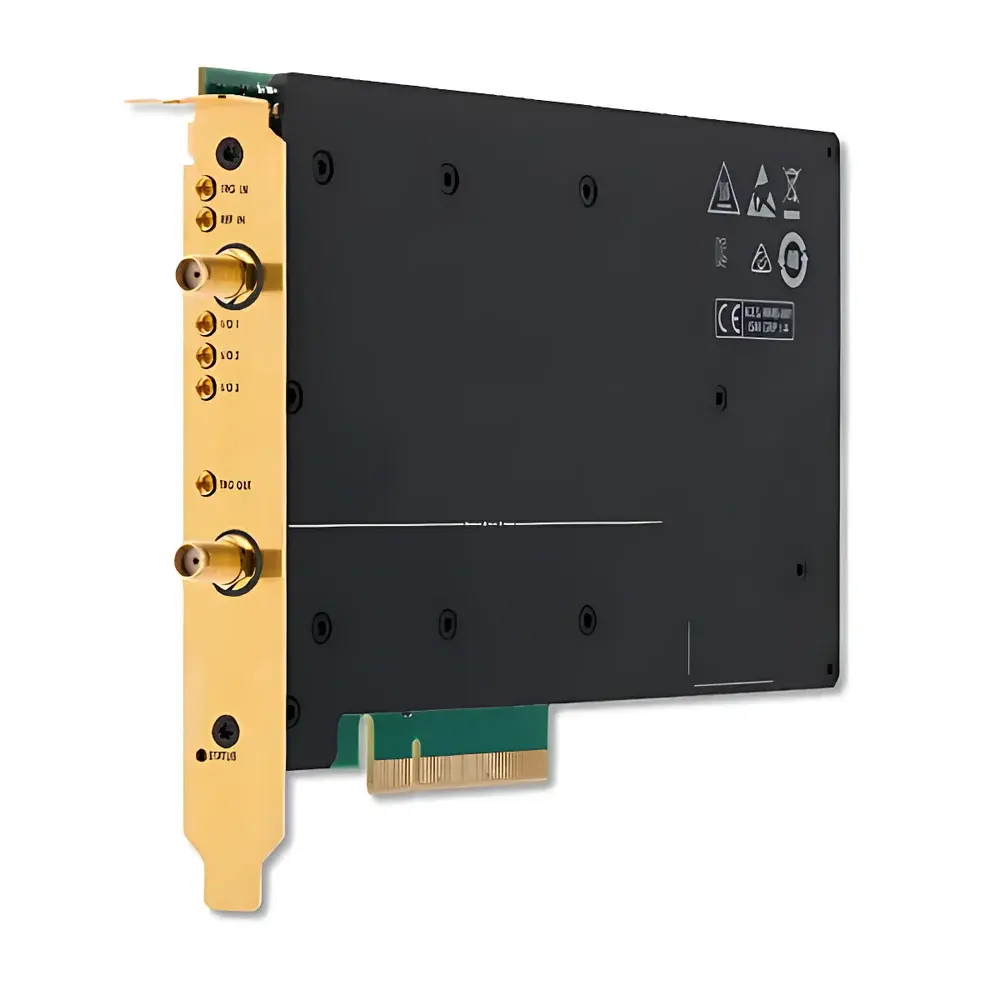
Acqiris High-Speed Data Acquisition Card
| Brand | Auniontech (HaoLiang Optoelectronics) |
|---|---|
| Origin | Shanghai, China |
| Manufacturer Type | Authorized Distributor |
| Product Category | Domestic |
| Model Series | SA108P, SA120P, SA217P, SA220P/SS-OCT, SA230P, SA240P/SS-OCT, SA248P |
| Sampling Rates | 1–8 GS/s |
| Resolution | 8-bit or 14-bit |
| Bandwidth | DC to 2.5 GHz |
| Input Range | 50 mV–5 V (configurable) |
| Onboard Memory | Up to 8 GB |
| Interface | PCIe 3.0 x8 |
| ENOB | 9-bit (8-bit models) |
| SFDR | 70 dBc (flat over analysis bandwidth) |
| Trigger Interpolation Accuracy | 15 ps RMS |
| Clock Jitter | 100 fs |
| Clock Accuracy | ±1 ppm |
Overview
The Acqiris High-Speed Data Acquisition Card is a precision-engineered digitizer platform designed for demanding time-domain signal acquisition in scientific research, industrial test systems, and OEM instrumentation. Built upon high-fidelity analog front-end architecture and ultra-low-jitter clock distribution, these cards implement real-time sampling using high-speed flash ADCs coupled with deterministic trigger interpolation and deep onboard memory buffering. The platform supports both single-shot transient capture and continuous streaming modes—enabling rigorous characterization of fast optical, RF, and pulsed electronic signals. Its design meets the stringent timing and spectral integrity requirements of phase-sensitive applications such as swept-source optical coherence tomography (SS-OCT), laser pulse diagnostics, quantum optics experiments, and high-energy physics detector readout.
Key Features
- Ultra-low-noise analog input stage with optimized impedance matching and broadband frequency response (DC to 2.5 GHz)
- High effective number of bits (ENOB): up to 9-bit at full bandwidth for 8-bit models; 14-bit resolution maintained across all high-speed variants
- Spurious-free dynamic range (SFDR) of 70 dBc over wide analysis bandwidths, ensuring accurate harmonic and intermodulation distortion measurement
- Precision trigger interpolation engine delivering 15 ps RMS timing resolution—critical for sub-picosecond synchronization in multi-channel or pump-probe setups
- Dedicated low-phase-noise clock distribution system minimizing jitter to 100 fs RMS and maintaining long-term stability within ±1 ppm
- PCI Express 3.0 x8 host interface enabling sustained data throughput up to 7.8 GB/s for real-time streaming or burst capture
- Onboard memory configurable up to 8 GB per channel, supporting deep record lengths without host bus bottlenecks
Sample Compatibility & Compliance
The Acqiris platform accommodates a broad range of signal sources—from low-amplitude photodetector outputs (50 mV full-scale) to high-voltage RF amplifiers (up to 5 V FS). Input ranges are software-selectable between low-voltage (LVR) and standard-voltage (SVR) modes, allowing optimal SNR adaptation across diverse transducer types. All models comply with CE, FCC Class A, and RoHS directives. The hardware architecture supports traceable calibration procedures aligned with ISO/IEC 17025 laboratory practices. For regulated environments—including medical device R&D and OCT system integration—the firmware implements deterministic latency behavior and supports timestamping with NTP or PTP synchronization when used in networked acquisition clusters.
Software & Data Management
Acqiris cards are supported by the Acqiris Software Development Kit (SDK), providing native C/C++, Python, MATLAB, and LabVIEW APIs. The SDK includes real-time DMA drivers, memory-mapped buffer management, and synchronized multi-card triggering capabilities. Data export formats include HDF5, TDMS, and binary raw files—each embedded with metadata describing sampling rate, trigger configuration, calibration coefficients, and acquisition timestamps. Audit trail functionality enables GLP/GMP-compliant workflows, logging all user-initiated parameter changes and acquisition events. Optional AcqirisScope GUI provides intuitive waveform visualization, FFT analysis, histogram-based noise evaluation, and automated pass/fail testing against user-defined thresholds.
Applications
- Swept-source optical coherence tomography (SS-OCT) system development and validation
- Laser pulse shape analysis and chirp characterization in ultrafast optics labs
- Time-of-flight mass spectrometry (TOF-MS) detector signal digitization
- RF component testing including S-parameter extraction and modulated signal analysis
- Quantum computing control electronics verification and qubit readout signal capture
- Particle accelerator beam diagnostics and kicker pulse monitoring
- High-speed non-destructive testing (NDT) using ultrasonic or eddy-current sensors
FAQ
What is the maximum sustained data transfer rate over PCIe 3.0 x8?
The theoretical bandwidth is 7.8 GB/s; practical sustained streaming rates reach ≥6.2 GB/s depending on host system memory controller performance and driver optimization.
Can multiple Acqiris cards be synchronized with sub-10 ps skew?
Yes—using the optional external reference clock input and programmable delay lines, inter-card timing skew can be calibrated to <5 ps RMS under controlled thermal conditions.
Is firmware upgrade supported in the field without hardware modification?
Yes—firmware updates are delivered via the SDK and applied through secure bootloader protocols; no JTAG or physical access is required.
Does the SDK support real-time processing pipelines on GPU-accelerated hosts?
Yes—CUDA-enabled modules are available for on-the-fly FFT, filtering, and peak detection; integration with NVIDIA RAPIDS cuSignal is documented in the advanced developer guide.
Are calibration certificates provided with each unit?
Each card ships with a factory calibration report traceable to NIST standards; accredited calibration services (ISO/IEC 17025) are available upon request.