
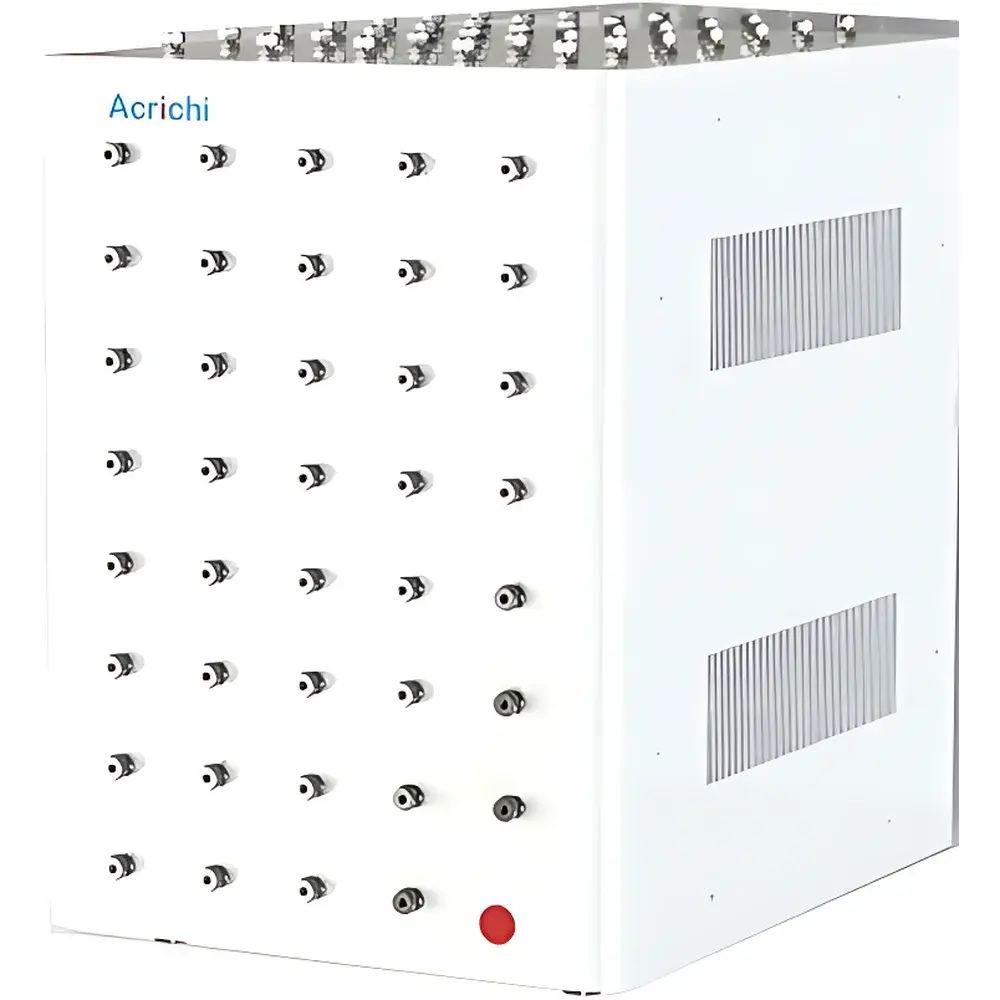
Acrichi AGS-36 Non-Methane Hydrocarbons (NMHC) Automatic Gas Sampler
| Brand | Acrichi |
|---|---|
| Origin | Beijing, China |
| Model | Acrichi AGS-36 |
| Valve System | 6-port rotary valve |
| Temperature Control Range (Valve, Quantitative Loop & Transfer Line) | Ambient to 220 °C |
| Temperature Control Accuracy | ±0.1 °C |
| Sample Volume | 1.0 mL (customizable from 50 µL to 5 mL via quantitative loop) |
| Sample Positions | 36 (expandable to 90 positions via modular 36+18N configuration) |
| Sampling Time | 0–99.9 s |
| Loop Equilibration Time | 0–99.9 s |
| Injection Channels | 1 (customizable) |
| Repeatability | <0.5% RSD (at 100 ppm total hydrocarbons or methane) |
| Power Consumption | 300 W |
| Electrical Supply | AC 220 V, 50 Hz |
| Dimensions (W×D×H) | 55 × 42 × 58 cm |
| Weight | ~25 kg |
| Sampling Pump | Corrosion-resistant diaphragm pump |
| Data Interfaces | USB, Ethernet (RJ45), RS-232 |
| Software | PC-based control with bilingual (English/Chinese) GUI, full audit trail, GLP-compliant event logging |
Overview
The Acrichi AGS-36 Non-Methane Hydrocarbons (NMHC) Automatic Gas Sampler is a purpose-engineered thermal-controlled gas sampling platform designed for precise, repeatable, and fully automated introduction of gaseous environmental or process samples into gas chromatographic (GC) systems. It operates on the principle of quantitative loop injection coupled with active temperature management across all critical fluidic pathways — including the 6-port rotary valve, stainless-steel quantitative loop, and heated transfer line — ensuring minimal adsorption, condensation, or memory effects during NMHC analysis. The system is optimized for compliance with regulatory methods such as EPA Method TO-14A, TO-15, and HJ 604–2017 (China), where accurate quantification of C2–C12 hydrocarbons excluding methane is required. Its architecture supports direct integration with commercial GC instruments via TTL/relay trigger signals or external event control, enabling synchronized start-up of chromatography acquisition and data logging without manual intervention.
Key Features
- Triple-zone independent temperature control (valve head, quantitative loop, and sample transfer line) up to 220 °C with ±0.1 °C stability — critical for preventing condensation of higher-boiling hydrocarbons and reducing carryover.
- Modular 36-position sample carousel expandable to 90 positions (36 + 18N configuration), accommodating Tedlar® bags, glass syringes, and SUMMA® canisters interchangeably without hardware modification.
- Integrated corrosion-resistant sampling pump capable of −55 kPa vacuum generation and 6 L/min flow rate — suitable for both negative-pressure and zero-pressure sampling in ambient air, stack, or fugitive emission monitoring.
- Automated high-concentration detection logic: system halts injection upon signal saturation and initiates optional dilution protocol (when configured with EPC/EFC module) to maintain linear detector response.
- Full internal purge cycle between injections: automatic flushing of all gas pathways using carrier or auxiliary purge gas, with programmable post-injection bag cleaning sequence.
- Bilingual PC software with GLP-compliant audit trail — records timestamped operator actions, method parameters, temperature logs, and error events in an encrypted relational database.
Sample Compatibility & Compliance
The AGS-36 accepts standard environmental sampling media including 6–10 L Tedlar® bags, 10–100 mL gas-tight glass syringes, and 6–10 L electropolished SUMMA® canisters. All wetted surfaces are passivated stainless steel or PFA-lined to minimize reactive surface area and ensure compatibility with oxidizing, acidic, or sulfur-containing matrices. The system meets mechanical and electrical safety requirements per IEC 61010-1 and supports method validation under ISO/IEC 17025:2017. When operated with certified calibration standards and paired with a GC-FID or GC-MS system meeting ASTM D6667 or USP , it fulfills data integrity expectations aligned with FDA 21 CFR Part 11 for electronic records and signatures.
Software & Data Management
The AGS-36 is controlled via Windows-based desktop software supporting English and Chinese language interfaces. Configuration includes method setup (sampling time, loop equilibration delay, injection count, purge duration), sequence definition (sample ID mapping, priority flags), and real-time status monitoring (temperature profiles, valve position, pump status). All operational parameters and system events are logged with cryptographic hashing to prevent tampering. Export formats include CSV and XML for LIMS integration. Optional touchscreen HMI module provides local operation and diagnostics without PC dependency. Data interfaces include USB 2.0, 10/100BASE-T Ethernet, and RS-232 serial port — compatible with legacy and modern laboratory networks.
Applications
- Ambient air quality monitoring for NMHC speciation in urban, industrial, and background sites.
- Fugitive emission screening at petrochemical facilities, refineries, and storage terminals per EPA OOOO/OOOOa protocols.
- Process gas analysis in chemical synthesis, fermentation off-gas, and biogas upgrading workflows.
- Calibration gas delivery for dynamic dilution systems and multi-point standard curve generation (up to 10 concentration levels).
- Stack testing and continuous emission monitoring system (CEMS) validation where discrete grab sampling is required.
FAQ
Can the AGS-36 be integrated with third-party GC systems?
Yes — it supports TTL-level trigger output for GC start command and accepts external relay or contact-closure signals for synchronized operation.
Is the quantitative loop volume fixed or configurable?
The default loop volume is 1.0 mL, but custom loops ranging from 50 µL to 5 mL are available upon order — each calibrated and certified per ISO 8573-5 traceability requirements.
Does the system support unattended overnight operation?
Yes — full sequence autonomy is enabled via PC software with battery-backed real-time clock and automatic error recovery routines.
What maintenance intervals are recommended?
Valve rotor seal replacement every 10,000 cycles; pump diaphragm inspection every 6 months under continuous use; annual temperature sensor calibration verification.
Is remote diagnostics supported?
Remote access is available via secure VPN-enabled Ethernet connection for firmware updates, log retrieval, and parameter adjustment under IT-administered network policies.




