
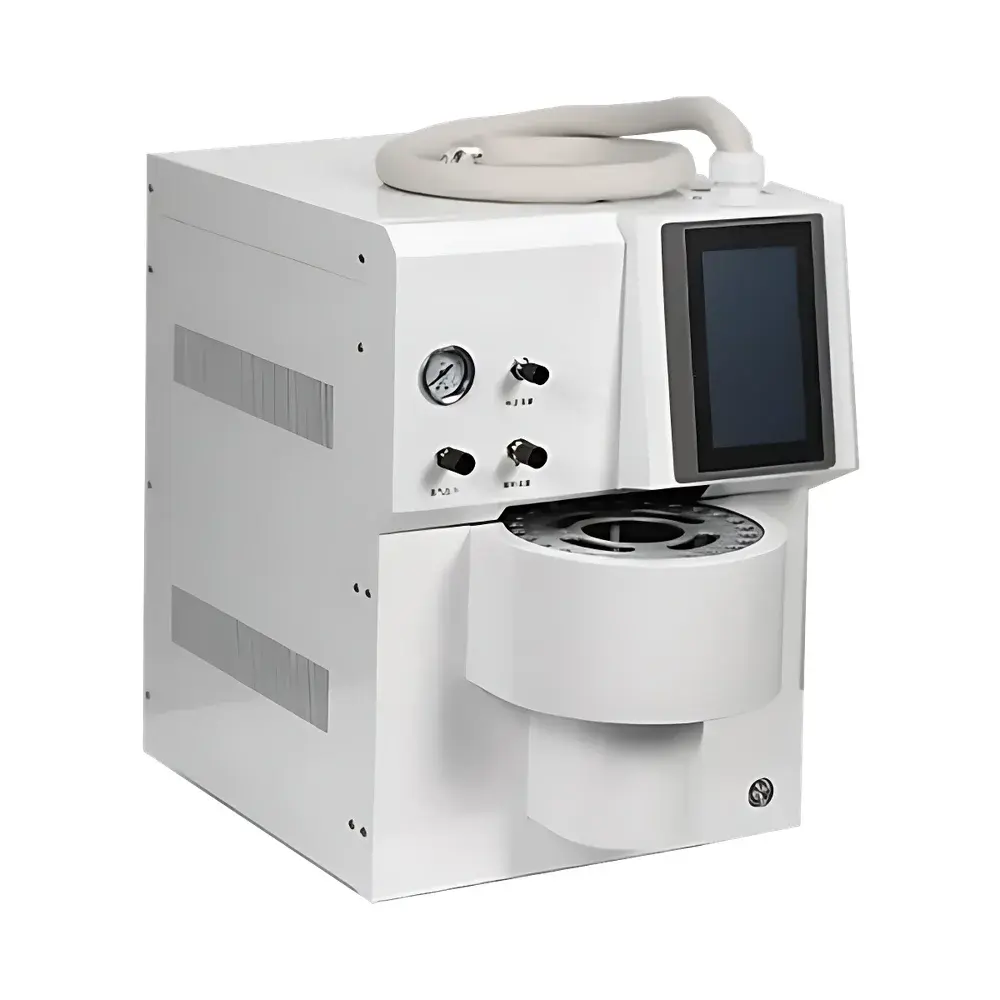
Acrichi ATD II-26 Fully Automated Two-Stage Thermal Desorber
| Brand | Acrichi |
|---|---|
| Origin | Beijing, China |
| Model | ATD II-26 |
| Instrument Type | Two-Stage Thermal Desorber |
| Automation Level | Fully Automated |
| Primary Desorption Temperature Range | Ambient to 400 °C, Control Accuracy: ±1 °C |
| Secondary Desorption Temperature Range | Ambient to 450 °C, Heating Rate: >4000 °C/min |
| Valve Temperature Range | Ambient to 220 °C |
| Transfer Line Temperature Range | Ambient to 300 °C |
| Cryo-Focusing Trap Temperature Range | −40 °C |
| Temperature Control Precision (Cryo Trap) | <±0.1 °C |
| Desorption Recovery Rate | >98% |
| Sample Capacity | 26 tubes |
Overview
The Acrichi ATD II-26 is a fully automated two-stage thermal desorber engineered for high-fidelity, quantitative analysis of volatile and semi-volatile organic compounds (VOCs and SVOCs) in environmental, occupational hygiene, and industrial air monitoring applications. It operates on the principle of sequential thermal desorption: first, analytes are thermally released from sorbent-packed tubes under controlled inert gas flow (primary desorption); second, the evolved vapors are cryogenically focused in a low-temperature trap (−40 °C), then rapidly heated (>4000 °C/min) to produce narrow, reproducible analyte bands prior to transfer into a gas chromatograph (GC) or GC–mass spectrometer (GC–MS). This dual-stage architecture eliminates matrix interference, minimizes breakthrough and carryover, and ensures optimal sensitivity—particularly critical for trace-level analysis per EPA Method TO-17, ISO 16017-1, and ASTM D6196.
Key Features
- Fully automated operation with one-touch start: executes complete sequence—including tube conditioning, leak check, primary desorption, cryo-focusing, secondary desorption, GC/GC–MS synchronization, and tube ejection—without manual intervention.
- Five independently temperature-controlled zones: sorbent tube oven, six-port high-temp valve (heated to 220 °C), transfer line (up to 300 °C), cryo-trap (−40 °C, stability <±0.1 °C), and secondary desorption chamber (up to 450 °C).
- High-speed secondary desorption (>4000 °C/min) combined with ultra-low cryo-trap temperature ensures sharp, symmetrical chromatographic peaks and improved resolution for co-eluting compounds.
- Integrated electronic mass flow control (EMFC) for carrier and purge gases—immune to ambient temperature and pressure fluctuations—enabling precise, repeatable flow programming across methods.
- Onboard leak detection prior to each run; real-time system diagnostics with audible/visual fault alerts; servo-motor-driven mechanical reliability for long-term unattended operation.
- Touchscreen HMI with intuitive workflow navigation, method editor, runtime status dashboard, and full audit trail logging compliant with GLP and 21 CFR Part 11 requirements (when configured with user access controls and electronic signatures).
Sample Compatibility & Compliance
The ATD II-26 accommodates standard 6 mm OD × 89 mm sorbent tubes (e.g., Tenax TA, Carbopack B/C, Carboxen series) and supports both single- and multi-bed configurations. Its 26-position autosampler enables batch processing aligned with ISO 16017-1 sampling protocols and EPA TO-17 validation criteria. All thermal zones meet ASTM E260 and ISO/IEC 17025 calibration traceability requirements when operated with NIST-traceable reference standards. The instrument’s gas-tight valve design, zero-dead-volume connections, and heated transfer path eliminate cold spots—ensuring quantitative recovery (>98%) and compliance with method-defined accuracy thresholds for regulated VOC analysis.
Software & Data Management
The embedded firmware supports up to 100 user-defined methods with parameter locking, versioning, and timestamped execution logs. Method synchronization with GC/GC–MS is achieved via TTL trigger signals or Ethernet-based event messaging (e.g., Agilent OpenLab, Thermo Chromeleon, Shimadzu GCsolution). Raw thermal desorption event data—including temperature ramps, flow profiles, valve actuation times, and leak test results—is stored in CSV-compatible format for LIMS integration. Optional software modules provide automated calibration curve generation using internal standard addition (gas-phase or liquid-phase), peak area normalization, and QC flagging based on recovery thresholds and retention time shifts.
Applications
- Ambient and indoor air quality monitoring (formaldehyde, benzene, toluene, xylenes, PAHs)
- Workplace exposure assessment per OSHA and NIOSH methodologies
- Soil headspace and landfill gas profiling
- Material emission testing (carpets, furniture, building materials) per ISO 16000 series
- Pharmaceutical residual solvent analysis (ICH Q3C-compliant workflows)
- Automotive cabin air and polymer off-gassing studies
FAQ
Does the ATD II-26 support unattended overnight operation?
Yes—its robust hardware architecture, integrated leak detection, and automatic tube handling enable continuous 24/7 batch runs across all 26 positions without operator presence.
Can I perform quantitative analysis with internal standard addition?
Yes—the system supports both gaseous and liquid-phase internal standard spiking, programmable per sample, with precise volumetric delivery and pre-desorption mixing.
Is the cryo-trap temperature uniform and stable during focusing?
Yes—temperature uniformity across the trap bed is maintained within ±0.1 °C via PID-controlled Peltier cooling and insulated chamber design, ensuring consistent analyte retention and minimal band broadening.
How does the system ensure compliance with regulatory data integrity requirements?
When deployed with optional audit trail and user role management features, the ATD II-26 meets ALCOA+ principles and supports 21 CFR Part 11 compliance through electronic signatures, immutable log files, and method change tracking.
What maintenance intervals are recommended for routine operation?
Valve seals and trap frits should be inspected every 500 runs; GC interface ferrules and sorbent tubes require replacement per manufacturer specifications—no scheduled downtime is needed for firmware updates or calibration verification.
Related Products




