
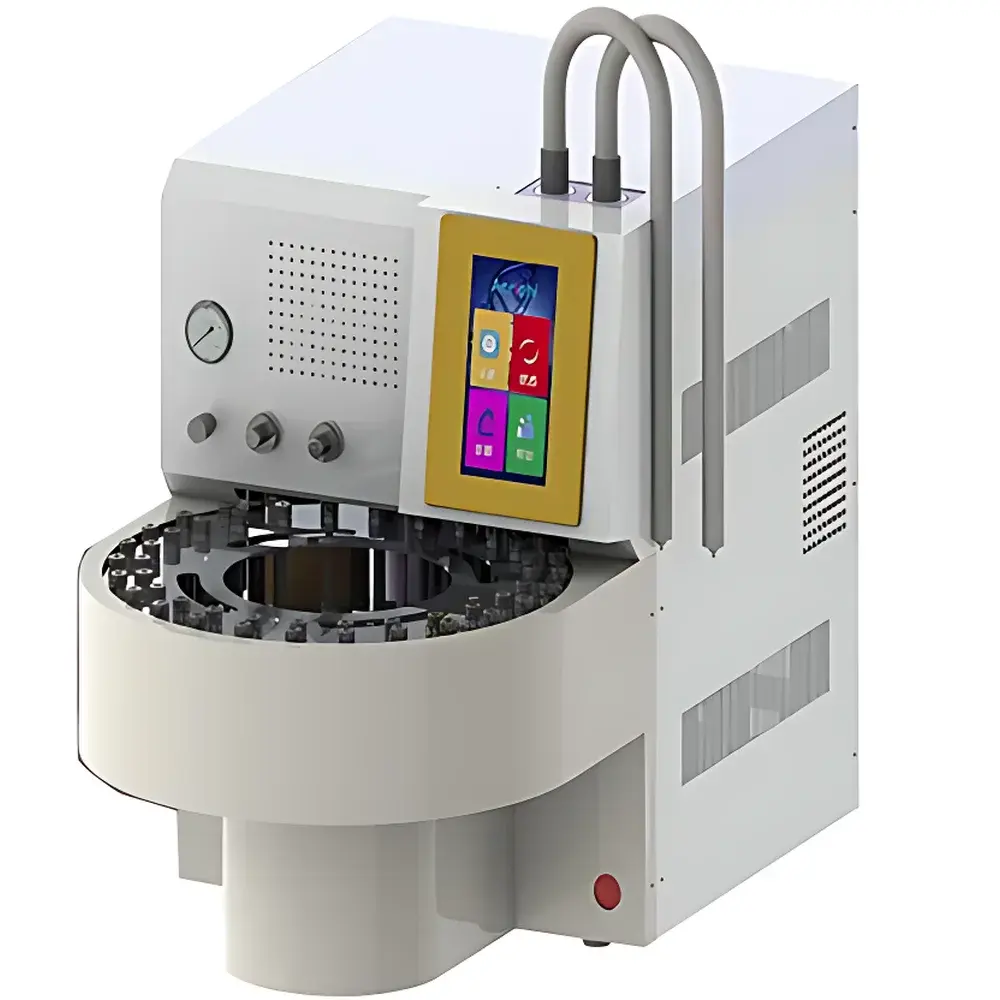
Acrichi ATD II-26D Automatic Dual-Channel Secondary Thermal Desorber
| Brand | Acrichi |
|---|---|
| Origin | Beijing, China |
| Model | ATD II-26D |
| Instrument Type | Secondary Thermal Desorber |
| Desorption Temperature Range | Ambient to 450 °C, Heating Rate >3600 °C/min |
| Cold Trap Temperature Range | −40 °C to Ambient (Electronic Cooling) |
| Desorption Recovery Rate | >98% |
| Sample Capacity | 52 Positions (26 × 2 Dual Channels) |
| Valve & Transfer Line Temp Control | Ambient to 220 °C (±1 °C) |
| Focusing Tube Temp Control | Ambient to 450 °C, Heating Rate >3000 °C/min |
| Carrier Gas Flow Control | 0–100 mL/min (Backflush), 100 mL/min (Sample Preparation) |
| Timing Resolution | 0.1 min (0.0–999.9 min) |
| Adsorbent Tube Dimensions | 6.35 mm OD × 88.9 mm L (¼″ × 3.5″) |
| Power | 900 W, 220 V, 50 Hz |
| Dimensions | 810 × 450 × 510 mm |
| Weight | ~40 kg |
Overview
The Acrichi ATD II-26D is an automated dual-channel secondary thermal desorber engineered for high-throughput, quantitative analysis of volatile and semi-volatile organic compounds (VOCs and SVOCs) in environmental, occupational health, and product safety laboratories. It operates on the principle of two-stage thermal desorption: first, analytes are thermally released from sorbent tubes under controlled inert gas flow; second, they are refocused onto a cryogenically cooled trap (cold trap) before rapid thermal desorption into a gas chromatograph (GC) or GC–MS system. This two-step process eliminates matrix interference, enhances sensitivity by up to two orders of magnitude, and delivers exceptional peak shape integrity—critical for trace-level quantification in compliance-driven applications such as EPA TO-17, ISO 16017-1, and ASTM D6196.
Key Features
- Dual independent channels with synchronized 26-position autosampler trays (52 total tubes), enabling parallel processing without cross-contamination or duty-cycle delay.
- High-fidelity temperature control across five independently regulated zones: adsorbent tube oven, six-port valve housing, transfer line, focusing tube, and cold trap—all maintained within ±1 °C accuracy.
- Ultra-rapid heating capability (>3600 °C/min for desorption; >3000 °C/min for focusing tube), ensuring narrow bandwidth injection and minimal thermal degradation of labile compounds.
- Electronic Peltier-based cold trap capable of sustained operation at −40 °C, eliminating reliance on liquid nitrogen or mechanical compressors while maintaining stable baseline performance.
- Integrated leak detection and real-time fault diagnostics with audible/visual alerts, supporting unattended overnight operation and GLP-compliant workflow integrity.
- Touchscreen HMI with intuitive method editor, live status dashboard, and 10 pre-configurable method templates—including automatic tube activation, calibration standard generation, and multi-segment time-programmed desorption.
Sample Compatibility & Compliance
The ATD II-26D accepts standard ¼″ OD × 3.5″ stainless steel or glass sorbent tubes packed with common media (e.g., Tenax TA, Carbopack B/C, Carboxen 1000). Its dual-path architecture supports simultaneous analysis of matched field samples and blanks—a requirement under ISO 16017-1 for indoor air quality assessment. The instrument meets essential regulatory design criteria for data integrity: hardware timestamps, audit-trail-enabled method storage, and event-logging compatible with 21 CFR Part 11–ready GC-MS data systems. All thermal zones are calibrated traceable to NIST standards, and temperature profiles comply with EPA Method TO-17 validation protocols for recovery, precision, and carryover (<0.1%).
Software & Data Management
Control firmware supports both standalone operation and external triggering via TTL or Ethernet-based event signals—enabling seamless synchronization with GC oven start, MS acquisition, or LIMS-initiated batch runs. Method parameters (desorption time, trap hold duration, backflush flow rate, etc.) are stored in non-volatile memory with user-accessible revision history. Exportable log files include per-tube thermal profiles, pressure transients, valve actuation timestamps, and recovery metrics—structured for direct ingestion into validated laboratory informatics platforms. Optional software modules support IQ/OQ documentation packages aligned with ISO/IEC 17025 and GMP Annex 11 requirements.
Applications
- Environmental monitoring: VOC profiling in ambient air, soil vapor, and stack emissions per EPA TO-11A, TO-15, and TO-17.
- Indoor air quality (IAQ): Formaldehyde, benzene, toluene, and aldehyde quantification in building materials per ISO 16000 series.
- Consumer product safety: Phthalates, flame retardants, and residual solvents in polymers, textiles, and electronics per EN 14382 and CPSC guidelines.
- Pharmaceutical packaging: Extractables and leachables screening from primary containers using USP and workflows.
- Forensic toxicology: Low-level volatile biomarker detection in breath or headspace samples requiring maximum sensitivity and reproducibility.
FAQ
Does the ATD II-26D support unattended overnight operation?
Yes—equipped with automatic tube detection, end-of-batch shutdown, and continuous self-diagnostic monitoring, it is validated for 24+ hour autonomous runs.
Can the cold trap be operated continuously at −40 °C during extended sequences?
Yes—the solid-state Peltier cooling system maintains stable sub-ambient temperatures without consumables or condensation-related downtime.
Is method transfer between different GC-MS platforms supported?
All thermal and timing parameters are platform-agnostic; only GC inlet and column conditions require re-optimization per instrument configuration.
How is adsorbent tube activation performed?
Built-in activation mode applies programmable heating (up to 350 °C), inert gas purge (100 mL/min), and timed conditioning—fully automated and logged.
What level of data traceability does the system provide for regulatory audits?
Full electronic record of every run—including operator ID, method version, thermal profiles, valve events, and recovery checks—is retained with immutable timestamps and exportable CSV/JSON reports.






