
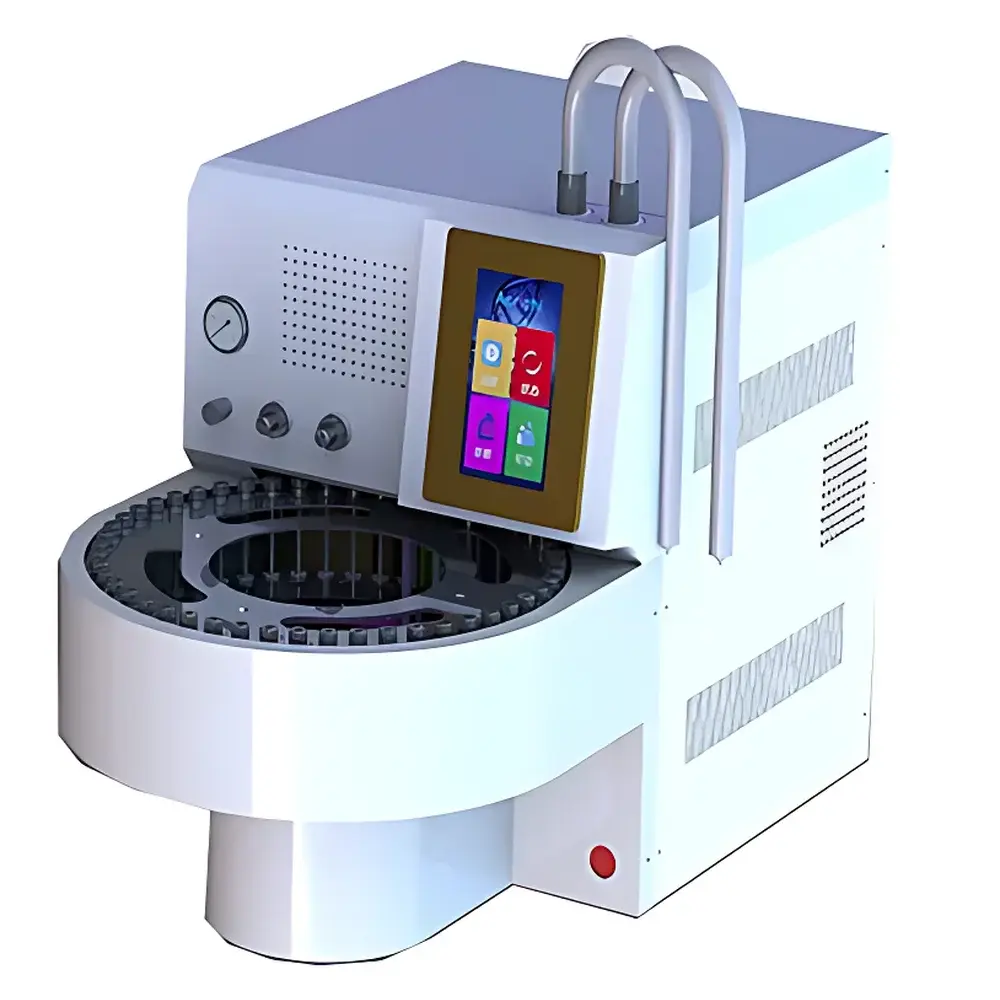
Acrichi ATD II-50 Fully Automated Two-Stage Thermal Desorber
| Brand | Acrichi |
|---|---|
| Origin | Beijing, China |
| Manufacturer Type | Authorized Distributor |
| Regional Classification | Domestic (China) |
| Model | Acrichi ATD II-50 |
| Instrument Type | Two-Stage Thermal Desorber |
| Automation Level | Fully Automated |
| Desorption Temperature Range | Ambient to 450 °C |
| Heating Rate | >6000 °C/min |
| Six-Port Valve Temperature Range | Ambient to 220 °C |
| Transfer Line Temperature Range | Ambient to 220 °C |
| Cold Trap Temperature Range | −40 °C to Ambient (Electronic Cooling) |
| Temperature Control Accuracy | ±1 °C |
| Desorption Recovery Rate | >98% |
| Sample Capacity | 50 positions |
Overview
The Acrichi ATD II-50 is a fully automated two-stage thermal desorption system engineered for high-throughput, trace-level volatile organic compound (VOC) and semi-volatile organic compound (SVOC) analysis in environmental, occupational health, food safety, and materials testing laboratories. It operates on the principle of sequential thermal desorption: first-stage desorption releases analytes from sorbent tubes under controlled inert gas flow; second-stage cryofocusing concentrates volatiles onto a cold trap (−40 °C), followed by rapid thermal desorption (>6000 °C/min) directly into a gas chromatograph (GC) or GC–MS inlet. This architecture eliminates solvent use, minimizes analyte degradation, and delivers exceptional sensitivity—typically sub-pg detection limits for target compounds such as BTEX, PAHs, aldehydes, and halogenated hydrocarbons. Designed for unattended operation over extended sequences, the ATD II-50 integrates seamlessly with major GC platforms via TTL or Ethernet triggering, supporting synchronized instrument startup and event-driven method execution.
Key Features
- Fully automated sample processing for up to 50 standard 1/4″ × 3.5″ sorbent tubes—no manual intervention required between runs.
- Independent five-zone temperature control: adsorbent tube furnace, six-port valve, transfer line, focusing trap, and cold trap—all with ±1 °C stability and real-time monitoring.
- High-efficiency electronic cooling system enables cold trap operation down to −40 °C, ensuring quantitative trapping of low-boiling compounds (e.g., C2–C6 hydrocarbons).
- Ultra-rapid heating capability (>6000 °C/min) during trap desorption yields narrow, symmetric chromatographic peaks and improved resolution in complex matrices.
- Heated valve-and-line architecture: the six-port valve and transfer line junction resides entirely within a thermally insulated oven—eliminating cold spots and minimizing carryover or condensation.
- Integrated leak-check routine with pressure decay diagnostics, automatic fault logging, and audible/visual alerts for system integrity verification prior to each sequence.
- 10 programmable methods stored onboard; dynamic queue editing allows real-time insertion, deletion, or reordering of samples during active runs.
- Onboard calibration functions include tube conditioning (in situ aging), dry-purge (moisture removal), and automated standard spiking for response factor generation.
Sample Compatibility & Compliance
The ATD II-50 accommodates industry-standard stainless steel or quartz sorbent tubes packed with single- or multi-bed media (e.g., Tenax TA, Carbopack B/C, Carboxen 1000). It supports EPA Methods TO-17 and ASTM D6196 for ambient and workplace air monitoring, and is compatible with ISO 16017-1 for indoor air VOC profiling. All temperature zones comply with IEC 61010-1 safety requirements. Data handling meets GLP/GMP expectations through audit-trail-enabled method storage, user-access logs, and timestamped run records. While not pre-certified for 21 CFR Part 11, the system’s deterministic control logic, non-modifiable raw data export (CSV, ASCII), and method versioning support validation protocols required in regulated environments.
Software & Data Management
Operation is managed via a 7-inch capacitive touchscreen interface running embedded Linux-based firmware. The GUI displays live temperature profiles, pressure/flow status (optional EPC/EFC integration), remaining runtime, and active method parameters. All methods—including desorption time, purge duration, trap hold time, and GC trigger delay—are configurable in 0.1-min increments. Raw event logs (start/stop times, temperature deviations, error codes) are saved automatically to internal storage and exportable via USB. No proprietary software license is required for basic operation; optional PC-based desktop software (sold separately) provides advanced scheduling, remote monitoring, and batch report generation aligned with LIMS interfaces.
Applications
- Ambient and indoor air quality monitoring per EPA TO-17 for regulatory compliance reporting.
- Occupational exposure assessment in manufacturing, petrochemical, and pharmaceutical facilities.
- VOC emissions profiling from building materials, adhesives, coatings, and consumer products (e.g., ISO 16000 series).
- Residual solvent analysis in polymer films, packaging, and medical devices.
- Odor source identification and forensic VOC fingerprinting in environmental forensics.
- Method development and reference material certification where reproducibility and traceability are critical.
FAQ
What sorbent tube formats does the ATD II-50 support?
Standard 1/4-inch OD × 3.5-inch length tubes—compatible with commercially available fused silica or stainless-steel variants packed with Tenax TA, Carbopack, or custom multi-bed sorbents.
Can the system perform tube aging and moisture removal automatically?
Yes—integrated dry-purge (up to 100 mL/min N₂) and programmable thermal conditioning (up to 450 °C) enable in-situ tube cleaning and stabilization without external ovens.
Is remote monitoring or network integration possible?
The unit includes Ethernet and RS-232 ports; optional desktop software enables TCP/IP communication for centralized lab management and alarm notification.
What maintenance intervals are recommended for long-term reliability?
Valve seals and O-rings should be inspected every 6 months; cold trap filters require replacement after ~2000 cycles; full system performance verification is advised annually per ISO/IEC 17025 guidelines.
Does the ATD II-50 support internal standard addition?
Yes—when equipped with the optional gas-phase internal standard module, precise spike introduction can be timed synchronously with desorption onset.





