
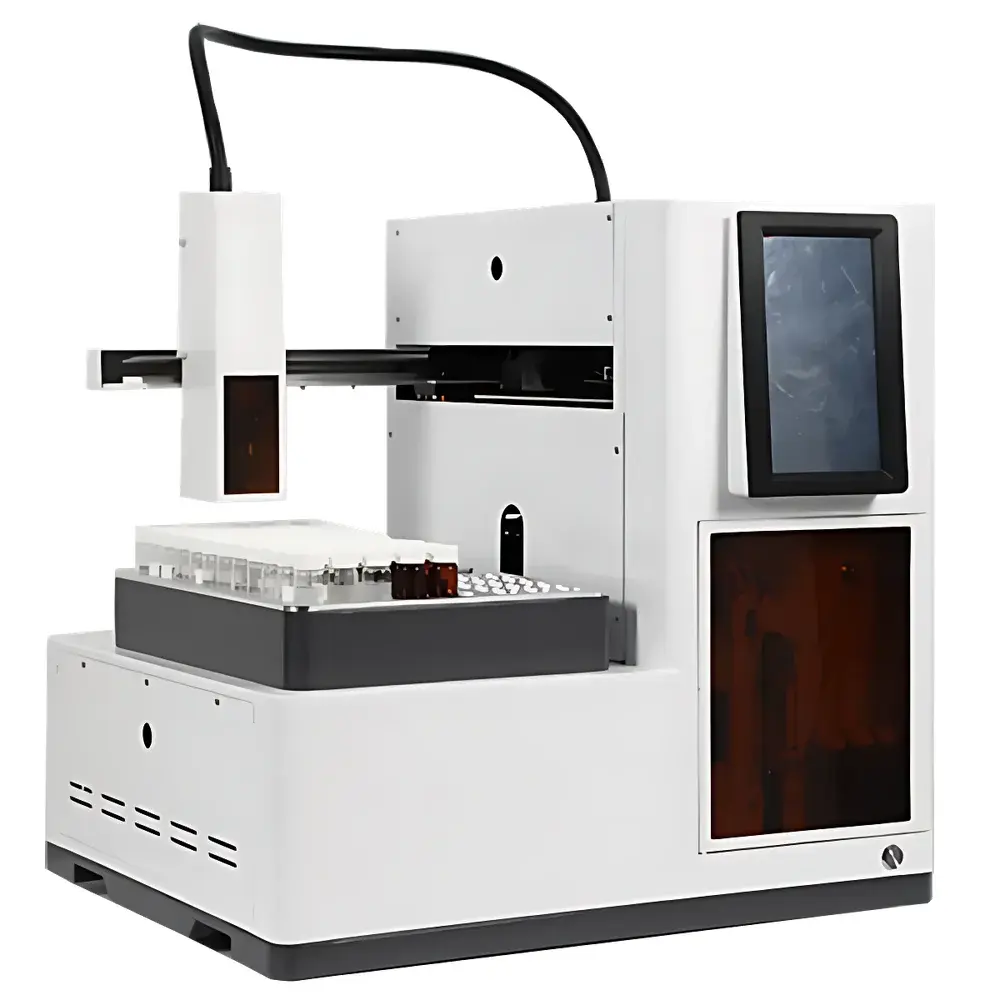
Acrichi PTC-106 Fully Automated Solid-Liquid Integrated Purge and Trap System
| Brand | Acrichi |
|---|---|
| Origin | Beijing, China |
| Model | PTC-106 |
| Sample Capacity | 106 positions |
| Injection Precision | RSD ≤ 10% |
| Trap Temperature Range | −40 °C to 450 °C |
| Purge Heater Temperature Range | Ambient to 100 °C |
| Vial Cooling Temperature Range | 4 °C to Ambient |
| Instrument Type | Water-and-Soil Dual-Mode Purge and Trap Device |
Overview
The Acrichi PTC-106 is a fully automated, dual-mode purge and trap (P&T) system engineered for high-throughput, regulatory-compliant volatile organic compound (VOC) analysis in environmental laboratories. It implements the standard EPA Method 502.2, 524.2, 524.4, 8260D, and ISO 15681-2 principles—relying on inert gas purging of aqueous or solid-phase samples, followed by cryogenic trapping of analytes on a sorbent-packed trap, thermal desorption, and transfer to a gas chromatograph–mass spectrometer (GC–MS) or GC–FID. Unlike single-mode systems, the PTC-106 integrates parallel liquid and solid sample handling within one platform, eliminating manual reconfiguration and minimizing analyst intervention. Its architecture supports unattended operation over extended batches, with real-time fault detection, leak monitoring, and closed-loop process validation—critical for GLP-compliant environmental testing labs performing drinking water, wastewater, soil, and sediment analyses.
Key Features
- Dual-sample-path design with independent water and soil probes—prevents cross-contamination between matrix types
- 106-position autosampler tray with bottom-heated vial positions and integrated 4 °C–ambient refrigeration for temperature-sensitive aqueous samples
- Cryogenic trap capable of operation from −40 °C to 450 °C, enabling efficient water vapor removal and high-fidelity recovery of polar and semi-volatile VOCs
- U-shaped purge tube with independent heating control, compliant with ASTM D3693 and EPA 524.4 requirements for heterogeneous liquid matrices
- Soil module featuring programmable magnetic stirring (0–300 rpm) and adjustable thermal ramping (up to 100 °C), supporting EPA Method 5035A extraction protocols
- Integrated methanol-assisted extraction mode: automated methanol addition, homogenization, supernatant aspiration, dilution, and subsequent P&T processing—fully traceable and repeatable
- Three standard internal standard ports (expandable to six), each with 15 mL vial capacity, nitrogen-pressure-driven delivery, and four selectable quantitative dispensing modes
- Foam detection and suppression algorithm, preventing carryover and column contamination during high-solids or surfactant-rich sample processing
- Heated valve manifold and transfer lines housed entirely within a thermally insulated oven—eliminating cold spots and ensuring quantitative analyte transfer
- Touchscreen HMI with method editor, real-time status dashboard, runtime logging, and audit-trail-ready event history
Sample Compatibility & Compliance
The PTC-106 accommodates a broad range of environmental matrices without hardware modification: liquid samples (groundwater, surface water, effluent), solid samples (soil, sediment, sludge, plant tissue), and semi-solid extracts. Its solid-phase handling meets EPA 5035A performance criteria—including moisture compensation, spiking reproducibility, and surrogate recovery monitoring. For aqueous applications, it satisfies EPA 524.4 sensitivity and blank requirements when paired with certified GC–MS systems. All fluidic pathways use Siltek®-treated stainless steel or fused silica-lined tubing; no PTFE or polymer seals contact the sample stream. The system supports 21 CFR Part 11–compliant data integrity features via optional software licensing, including electronic signatures, user role-based access control, and immutable audit trails. Routine operation aligns with ISO/IEC 17025:2017 clause 7.2.2 (method validation) and ASTM D8217 (standard guide for VOC analysis in soils).
Software & Data Management
The embedded firmware provides method creation, scheduling, and remote monitoring via Ethernet or USB. Each method stores full thermal profiles, valve timing sequences, pressure setpoints, and calibration parameters. Raw instrument logs—including leak test results, trap temperature ramps, and internal standard delivery volumes—are timestamped and exportable as CSV or XML. Optional PC-based software enables integration with LIMS platforms through ASTM E1394 or HL7 interfaces. Automatic calibration curve generation is supported using internal standard bracketing, with linear or quadratic regression options and forced-zero intercepts where appropriate. All data files include embedded metadata per MIAME/MIAPE conventions, facilitating long-term archival and regulatory review.
Applications
- Regulatory compliance testing for trihalomethanes (THMs), benzene, toluene, ethylbenzene, xylenes (BTEX), vinyl chloride, and chlorinated solvents in drinking water per US EPA Safe Drinking Water Act mandates
- Site characterization and RCRA corrective action studies requiring VOC screening in soil and groundwater
- Wastewater treatment plant influent/effluent monitoring under NPDES permit conditions
- Forensic environmental analysis involving petroleum hydrocarbon fingerprinting and degradation product profiling
- Research applications in biogeochemistry, including headspace analysis of microbial VOC emissions from anaerobic sediments
FAQ
Does the PTC-106 support unattended overnight operation?
Yes—the system includes automatic leak verification before each run, real-time pressure monitoring, and hardware-level fault interruption with audible/visual alerts. Completed runs are logged with timestamps and QC metrics.
Can the instrument be synchronized with third-party GC or GC–MS systems?
Yes—via TTL trigger input/output, RS-232 serial handshake, or Ethernet-based event messaging. GC start commands may be initiated either internally or externally.
Is the methanol-assisted extraction module included as standard equipment?
Yes—the methanol addition, mixing, phase separation, and dilution functions are fully integrated and factory-validated per EPA 5035A Annex B.
What maintenance intervals are recommended for routine operation?
Trap regeneration every 200 injections; O-ring replacement every 12 months; carrier gas filter change every 6 months; full system performance verification quarterly per laboratory SOP.
How is data integrity ensured during audit preparation?
All method edits, run executions, and calibration events generate immutable records with operator ID, timestamp, and hash-verified checksums—compatible with FDA 21 CFR Part 11 when configured with optional secure login and digital signature modules.




