
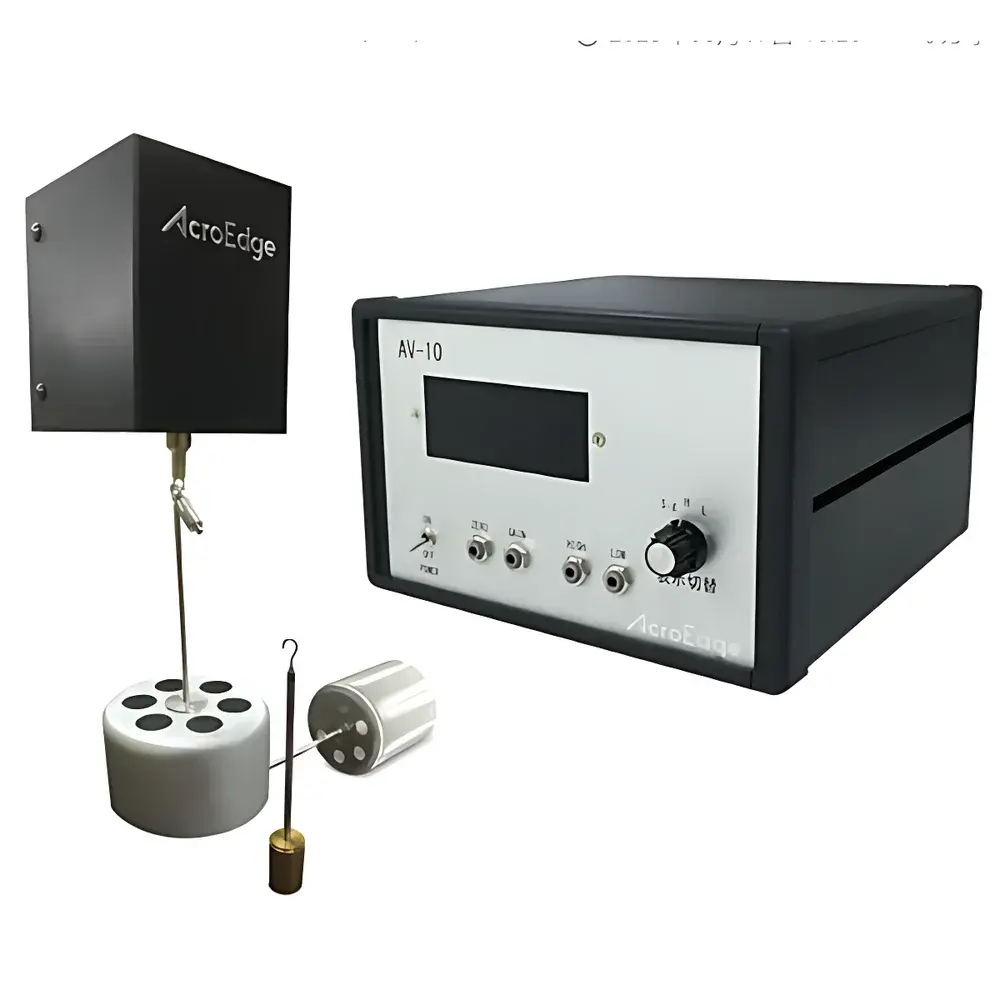
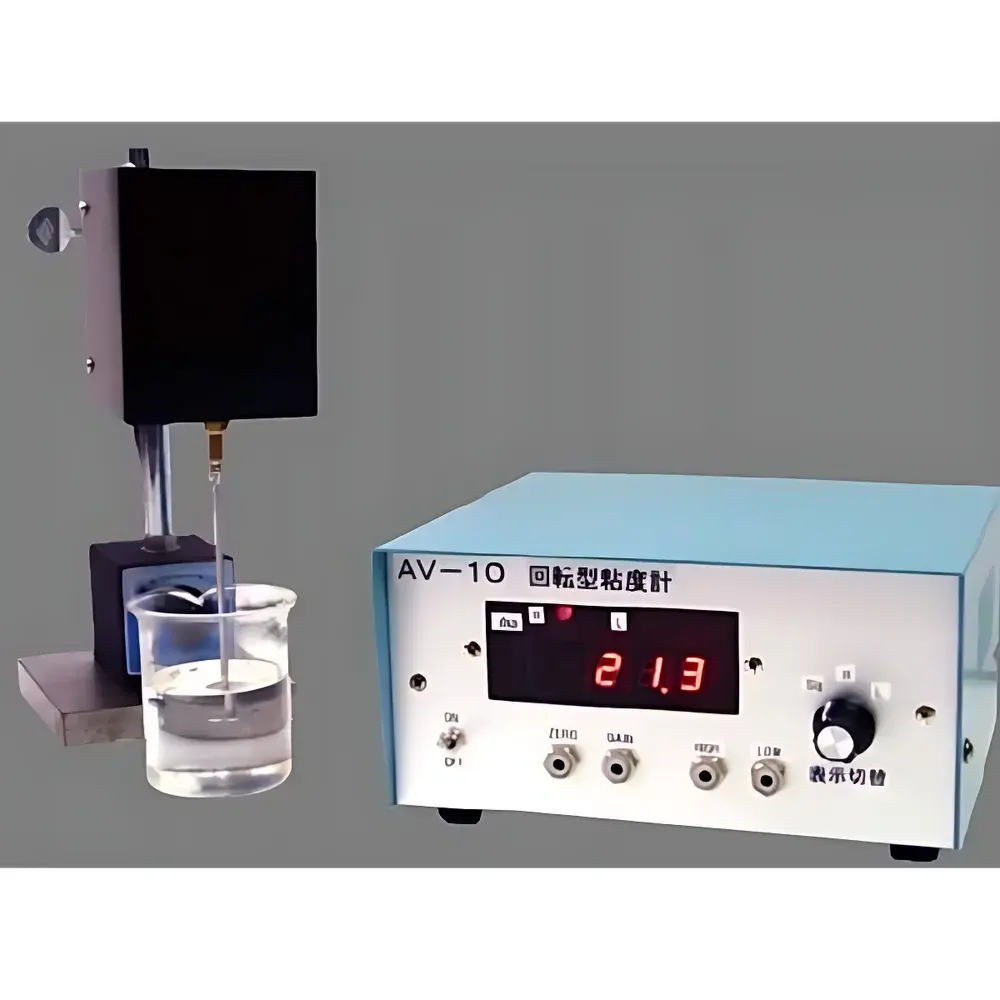
AcroEdge AV-10 Continuous In-Line Rotational Viscometer
| Brand | AcroEdge |
|---|---|
| Origin | Imported (Non-Chinese) |
| Model | AV-10 |
| Measurement Principle | Rotational (Couette flow geometry) |
| Torque Sensing | High-resolution electromagnetic torque transducer |
| Speed Control | Closed-loop DC motor with optical encoder feedback |
| Output Interfaces | RS-485, USB 2.0, Ethernet (TCP/IP), 4–20 mA analog output |
| Alarm Outputs | Dual programmable digital relay (Hi/Lo) |
| Temperature Compensation | Built-in RTD input (PT100 compatible) |
| Enclosure Rating | IP65 (sensor head), IP54 (controller unit) |
| Power Supply | 24 VDC ±10% |
| Operating Temperature | −10 to +60 °C (electronics), −20 to +150 °C (wetted sensor parts) |
| Wetted Materials | 316L stainless steel, Hastelloy C-276 optional |
| Air/N₂ Purge Port | Integrated on probe housing |
| Configuration | Modular — separate sensing probe and remote control unit |
Overview
The AcroEdge AV-10 is an industrial-grade, continuous in-line rotational viscometer engineered for real-time viscosity monitoring in dynamic production environments. It operates on the fundamental principle of Couette flow rheometry: a precisely machined cylindrical or disk-shaped rotor rotates at a controlled angular velocity within the process fluid, while a stationary stator (or fixed outer cylinder) defines the shear gap. The resulting viscous drag torque acting on the rotor is directly proportional to the fluid’s dynamic viscosity, as governed by Newton’s law of viscosity (τ = η·du/dy). Unlike batch-capable benchtop viscometers, the AV-10 is designed for permanent installation in pipelines, reactors, or mixing vessels—enabling uninterrupted, high-reproducibility measurement under actual process conditions. Its robust mechanical architecture supports long-term deployment in demanding chemical, pharmaceutical, food & beverage, and polymer manufacturing applications where viscosity serves as a critical quality attribute (CQA) linked to molecular weight, dispersion homogeneity, or reaction endpoint.
Key Features
- Modular design with physically separated sensing probe and control unit—facilitates installation in confined or hazardous areas while simplifying maintenance and calibration access.
- High-stability electromagnetic torque transduction system with sub-mN·m resolution ensures accurate detection of low-viscosity shifts (e.g., solvent dilution or polymer chain scission) and high-viscosity anomalies (e.g., gelation or particle agglomeration).
- Closed-loop speed regulation via optical encoder feedback maintains rotational accuracy across the full speed range (0.1–200 rpm), minimizing slip-induced measurement drift during transient flow conditions.
- Integrated air or nitrogen purge port on the probe body prevents fouling, condensation, or cross-contamination in vapor-sensitive or particulate-laden streams—critical for API crystallization or emulsion processing.
- Dual independent alarm relays configurable for upper/lower viscosity thresholds, supporting automated process interlocks or SCADA-level event triggering without external PLC intervention.
- Multi-protocol digital interfaces (RS-485 Modbus RTU, Ethernet TCP/IP, USB HID) enable seamless integration into DCS, MES, and historian platforms compliant with ISA-95 and OPC UA frameworks.
Sample Compatibility & Compliance
The AV-10 accommodates Newtonian and mildly non-Newtonian fluids typical of intermediate and final product streams—including aqueous solutions, organic solvents, suspensions, emulsions, and thermoplastic melts. Its 316L stainless steel wetted components meet FDA 21 CFR Part 11 requirements for material compatibility in pharmaceutical manufacturing, and optional Hastelloy C-276 construction extends chemical resistance to aggressive halogenated or acidic media. The instrument supports temperature-compensated viscosity reporting when paired with a calibrated PT100 RTD, aligning with ASTM D2196 and ISO 2555 standards for industrial viscosity measurement. Full traceability is maintained through time-stamped audit logs, user-access-controlled configuration changes, and electronic signature capability—satisfying GLP and GMP documentation expectations for regulated industries.
Software & Data Management
The embedded firmware provides real-time data acquisition at up to 10 Hz sampling rate, with onboard filtering (Butterworth IIR), linearization, and temperature compensation applied prior to value output. All raw and processed data—including torque, RPM, temperature, and calculated viscosity—are timestamped and stored in non-volatile memory (≥1 million records). The optional AcroEdge ViscoLink™ PC software enables remote configuration, trend visualization, statistical process control (SPC) charting (X̄–R, Cpk), and export to CSV, Excel, or SQL databases. Audit trail functionality records operator actions, parameter modifications, and calibration events—meeting FDA 21 CFR Part 11 electronic record requirements when deployed with user authentication and role-based permissions.
Applications
- Continuous monitoring of polymerization reactions (e.g., epoxy resin curing, acrylic monomer conversion) where viscosity rise correlates with molecular weight build-up.
- In-line quality verification of coatings, inks, and adhesives during filling or blending to ensure batch-to-batch consistency per ISO 2555 specifications.
- Real-time detection of phase separation or destabilization in pharmaceutical emulsions and nano-suspensions during sterile filtration or lyophilization support.
- Control of starch gelatinization or enzyme hydrolysis in food processing lines—linking viscosity trends to degree of modification or thermal history.
- Monitoring of catalyst slurry homogeneity in petrochemical hydroprocessing units to prevent reactor fouling or uneven feed distribution.
FAQ
Can the AV-10 be installed in pressurized pipelines?
Yes—the standard probe is rated for continuous operation up to 10 bar (145 psi) at 150 °C; custom pressure housings up to 40 bar are available upon request.
Is temperature measurement mandatory for accurate viscosity reporting?
While ambient temperature compensation improves accuracy, the AV-10 delivers valid relative viscosity trends even without RTD input; however, absolute viscosity values require temperature input per ASTM D1076 correlation models.
How often does the system require recalibration?
Factory calibration is traceable to NIST standards; field verification using certified silicone oil standards is recommended every 6–12 months depending on process severity and regulatory requirements.
Does the AV-10 support intrinsically safe (IS) certification for Zone 1 installations?
The probe-only configuration meets ATEX II 2G Ex db IIB T4 Gb and IECEx requirements when used with approved safety barriers; full IS-certified variants are available under model suffix “-IS”.
Can multiple AV-10 units be synchronized for multi-point viscosity profiling?
Yes—via Ethernet-based master-slave timing synchronization or Modbus polling with <100 ms latency across up to 32 nodes on a single network segment.
Related Products



