
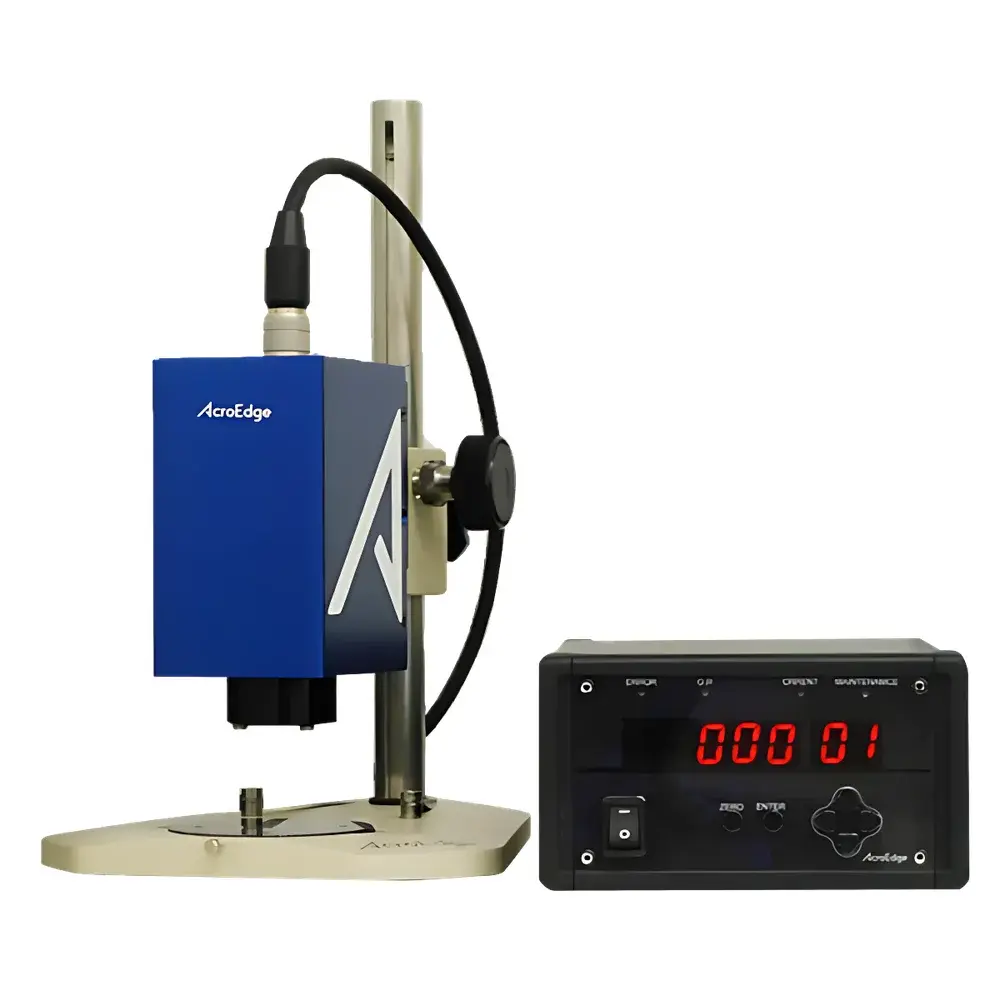
AcroEdge Curea UV Resin Cure Monitoring System
| Brand | AcroEdge |
|---|---|
| Origin | Japan |
| Model | Curea |
| Excitation Wavelength | 365 nm |
| Spot Diameter | 2 mm |
| Working Distance | 43 mm |
| Measurement Time | 0.1 s |
| Dimensions (W×D×H) | 50×75×125 mm |
| Weight | ~900 g |
| Application | Real-time non-contact UV-curable resin cure monitoring |
Overview
The AcroEdge Curea UV Resin Cure Monitoring System is a non-invasive, real-time fluorescence-based instrument engineered for quantitative assessment of photopolymerization kinetics in ultraviolet (UV)-curable resins. It operates on the principle of photoluminescence spectroscopy: when UV-curable monomers and oligomers absorb 365 nm excitation photons, electrons transition to excited singlet states; upon relaxation to the ground state, they emit characteristic fluorescence proportional to the concentration of unreacted photoreactive species. As polymerization progresses, the fluorophore environment changes—quenching or shifting emission intensity—enabling direct correlation between fluorescence signal decay and degree of cure (DOC). Unlike destructive or contact-dependent methods (e.g., DSC, FT-IR ATR), Curea requires no sample preparation, no physical contact, and imposes negligible photolytic load—making it uniquely suited for inline process validation in high-speed coating, laminating, and nanoimprint lithography lines.
Key Features
- Non-contact, non-destructive measurement: No surface contact or sample masking required—ideal for fragile, coated, or encapsulated substrates.
- Through-glass and through-film capability: Optical design enables reliable signal acquisition across transparent barriers including soda-lime glass, PET, PC, and silicone release liners.
- Sub-second temporal resolution: Fixed 0.1 s measurement cycle supports real-time tracking of rapid cure events (e.g., LED UV lamp exposure at >100 mW/cm²).
- Robust ambient operation: Engineered to maintain signal fidelity under typical factory lighting (including fluorescent and LED ambient sources) without optical shielding or dark-room requirements.
- Modular platform compatibility: Base unit (Curea) integrates with OEM motion stages, PLC-triggered acquisition, and industrial Ethernet protocols (Modbus TCP, EtherNet/IP) for automated line integration.
Sample Compatibility & Compliance
The Curea system is validated for use with acrylate-, epoxy-acrylate-, and vinyl ether–based UV formulations commonly employed in optical adhesives, conformal coatings, printed electronics encapsulants, and micro-optical bonding. It complies with IEC 61000-6-3 (EMC emissions) and IEC 61000-6-2 (immunity), and its Class 1 LED excitation source meets IEC 60825-1:2014 safety requirements for low-risk optical radiation. While not a regulatory testing device per se, Curea-generated cure profiles are compatible with GLP/GMP documentation workflows and support audit-ready data export for ISO 9001:2015 process control records and FDA 21 CFR Part 11–compliant electronic signatures when paired with validated third-party data acquisition software.
Software & Data Management
The system interfaces via USB 2.0 or optional RS-485 with AcroEdge’s CureView™ software (Windows 10/11, 64-bit), which provides real-time fluorescence intensity plotting, time-stamped DOC trend logging, and customizable alarm thresholds for process deviation detection. Raw spectral data (intensity vs. time) is stored in CSV and HDF5 formats for traceability; metadata includes timestamp, trigger source, ambient light compensation flag, and user-defined batch ID. Exported datasets integrate natively with JMP, MATLAB, and Python-based statistical process control (SPC) pipelines. Audit trails record all parameter changes, user logins, and data exports—meeting ALCOA+ (Attributable, Legible, Contemporaneous, Original, Accurate, Complete, Consistent, Enduring, Available) principles for regulated environments.
Applications
- Inline cure verification in roll-to-roll UV lamination of touch panel cover glasses.
- Real-time monitoring of adhesive bondline integrity during UV-cured optical film attachment in display module assembly.
- Quantitative validation of dose-response relationships in UV nanoimprint resist curing (e.g., OrmoStamp®, SU-8 derivatives).
- Correlation studies between fluorescence-derived DOC and mechanical properties (e.g., Shore D hardness, crosslink density via solvent swelling) for formulation development.
- Process window qualification for LED UV lamp aging—tracking gradual output drift via baseline fluorescence decay rate shifts over production shifts.
FAQ
Can Curea measure through thick or tinted glass substrates?
Yes—within optical transmission limits of the substrate at 365 nm. Standard 1.1 mm soda-lime glass transmits >85% at this wavelength; performance with colored or IR-absorbing glass must be verified empirically using reference cured samples.
Is calibration required before each measurement?
No routine recalibration is needed. The system employs factory-traceable LED intensity stabilization and built-in reference photodiode feedback to maintain signal stability over temperature (15–35 °C) and time (>12 months between verification checks).
How does fluorescence-based cure monitoring compare to FT-IR in terms of accuracy?
Peer-reviewed validation studies show R² > 0.98 between Curea fluorescence decay curves and FT-IR carbonyl peak area reduction (1720 cm⁻¹) across identical UV dose ramps—confirming equivalent kinetic resolution for acrylate systems, with superior temporal granularity and no ATR crystal contact artifacts.
Does ambient UV exposure (e.g., from nearby curing lamps) interfere with measurements?
Curea’s narrow-band 365 nm excitation and synchronous detection architecture reject broadband ambient UV noise; measurements remain stable even within 50 cm of operating 395 nm LED arrays when standard factory lighting protocols are followed.



