
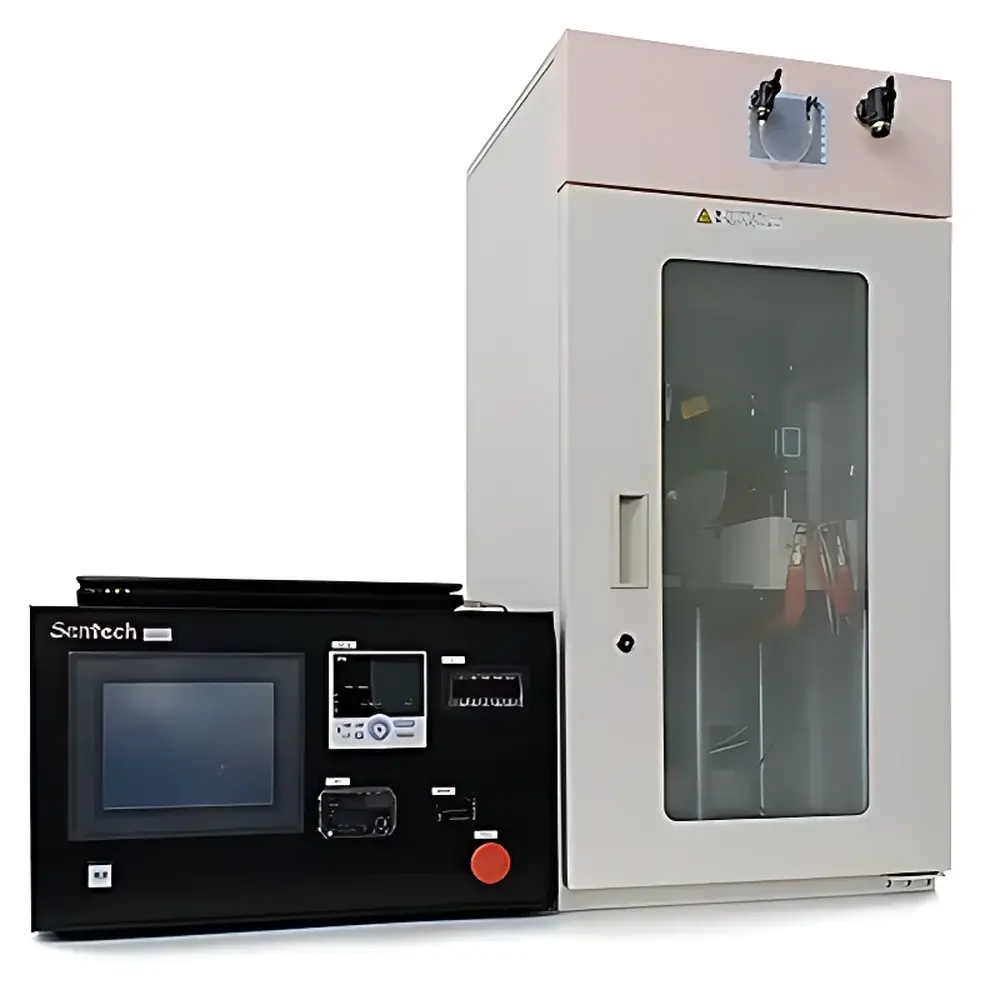
AcroEdge CUSTRON EU201 In-Situ Resin Cure Shrinkage and Stress Analyzer
| Brand | AcroEdge |
|---|---|
| Origin | Japan |
| Model | EU201 |
| Measurement Principle | Laser Displacement + Load Cell-Based Stress Monitoring |
| Temperature Control Range | –50 °C to 300 °C (programmable ramp/soak) |
| Laser Source | 655 nm Class 1 semiconductor diode (220 µW) |
| Displacement Resolution | 2 µm |
| Force Sensing Range | 5 N (standard), optional ranges: 500 mN, 1 N, 2 N, 10 N, 20 N |
| Force Nonlinearity | ±0.5 % RO |
| Force Repeatability | ±0.5 % RO |
| Heating Power | 450 W (3×50 W elements) |
| Cooling Unit Capacity | 450 W (10–25 °C adjustable) |
| Sample Volume | ~1 mL |
| Compliance | ISO 4216:2021, JIS K6941:2019 |
Overview
The AcroEdge CUSTRON EU201 is a high-precision, in-situ instrumentation platform engineered for the continuous, real-time quantification of volumetric shrinkage and development of internal stress during thermoset and UV-curable resin curing. It operates on a dual-sensor principle: non-contact laser displacement measurement (655 nm, Class 1, 2 µm resolution) tracks dimensional change of the sample surface with sub-micron stability, while a calibrated load cell (standard 5 N range, with selectable lower/higher capacities) measures axial force evolution—directly correlating to polymerization-induced stress buildup. The system integrates programmable thermal control (–50 °C to 300 °C), synchronized UV irradiation (optional add-on), and surface temperature monitoring via K-type thermocouple, enabling full replication of industrial cure profiles—including multi-stage heating, isothermal holds, UV exposure windows, and controlled cooling through the glass transition temperature (Tg). This architecture supports mechanistic interpretation of shrinkage partitioning: chemical shrinkage (B→C, reaction-driven), post-gel thermal contraction in the rubbery state (C→D, above Tg), and vitreous-state contraction (D→E, below Tg), yielding both total volumetric shrinkage (A→E) and maximum shrinkage (B→E) as defined in ISO 4216:2021.
Key Features
- Simultaneous, time-synchronized acquisition of shrinkage displacement (±2 µm resolution) and stress (±0.5 % RO repeatability) over full cure cycles
- Programmable thermal profile generator supporting up to 10 independent ramp/soak segments, with cooling capability down to 10 °C via integrated chiller
- Dual-mode temperature control: resistive heating (max 300 °C, 450 W total) + active liquid cooling (450 W capacity, 10–25 °C setpoint)
- Surface temperature monitoring via embedded K-type thermocouple, co-located with laser spot for thermal drift compensation
- Minimal sample requirement: <1 mL volume enables screening of high-value or limited-availability formulations
- Modular force sensor options (500 mN to 20 N) allow optimization for low-stress acrylics or high-modulus epoxies without hardware reconfiguration
- Compliant with ISO 4216:2021 and JIS K6941:2019 for standardized shrinkage reporting in R&D and QC environments
Sample Compatibility & Compliance
The EU201 accommodates a broad spectrum of reactive materials including cationic and free-radical UV-curable acrylates, epoxy resins (aliphatic, aromatic, cycloaliphatic), phenolic novolacs, polyurethanes, silicone-based systems, and thermoplastic-modified hybrids. Its open-sample chamber design permits direct placement of standard cuvettes, aluminum pans, or custom fixtures—enabling evaluation under nitrogen purge (optional gas inlet port) to suppress oxygen inhibition in surface-cure studies. All measurement protocols adhere to ISO 4216:2021 Annex A (continuous shrinkage determination) and JIS K6941:2019 Clause 5 (stress measurement methodology). Data traceability meets GLP/GMP documentation requirements: instrument calibration logs, sensor verification records, and thermal profile validation reports are retained per session. While not FDA 21 CFR Part 11-certified out-of-the-box, audit trails and electronic signature support can be implemented via optional software modules compliant with laboratory information management system (LIMS) integration standards.
Software & Data Management
Control and analysis are executed via AcroEdge’s proprietary EU201 Acquisition Suite (v3.x), a Windows-based application supporting real-time visualization of displacement, stress, temperature, and UV intensity (when equipped). Raw data streams are saved in HDF5 format—ensuring lossless storage of time-stamped, multi-channel datasets with metadata embedding (operator ID, sample ID, protocol name, calibration IDs). Batch processing tools enable automated calculation of key metrics: total shrinkage (%), maximum shrinkage (%), stress onset temperature, peak stress magnitude, and Tg-associated inflection points via first-derivative analysis. Export options include CSV, Excel, and MATLAB-compatible .mat files. For regulated environments, optional Audit Trail Module provides immutable timestamped logs of all user actions, parameter changes, and report generation events—fully aligned with ALCOA+ principles (Attributable, Legible, Contemporaneous, Original, Accurate, Complete, Consistent, Enduring, Available).
Applications
- Formulation development of low-shrinkage dental composites and orthodontic adhesives
- Process window optimization for LED-UV curing of printed electronics encapsulants
- Validation of Tg shift and residual stress in aerospace-grade carbon-fiber prepregs
- Comparative kinetics analysis of amine vs. anhydride-cured epoxy systems under thermal cycling
- Quantification of oxygen inhibition depth in thin-film UV coatings via nitrogen-purge-enabled surface stress profiling
- Correlation of in-situ shrinkage curves with exotherm profiles from DSC for kinetic modeling (e.g., Kamal model fitting)
FAQ
What is the minimum sample volume required for reliable measurement?
Approximately 1 mL is recommended to ensure stable optical reflection and mechanical contact with the load cell platen; smaller volumes (<0.5 mL) may be used with custom micro-fixtures but require empirical validation.
Can the system measure shrinkage during UV exposure without thermal input?
Yes—the UV irradiation module (optional accessory) operates independently of the thermal stage, allowing isothermal photopolymerization studies at ambient or sub-ambient temperatures.
Is nitrogen purging available as a factory-installed option?
Yes—gas inlet/outlet ports are standard; a dedicated N₂ purge kit (regulator, flowmeter, tubing) is available as a configurable option.
How is thermal drift compensated during long-duration measurements (>24 h)?
The system employs real-time K-type thermocouple feedback to the laser displacement algorithm, applying dynamic zero-offset correction based on measured surface temperature deviation from baseline.
Does the software support ASTM D2566 or ISO 3167 compliance for shrinkage reporting?
No—EU201 software implements only ISO 4216:2021 and JIS K6941:2019 methodologies; ASTM D2566 defines a different (non-continuous) test geometry and is not supported.



