
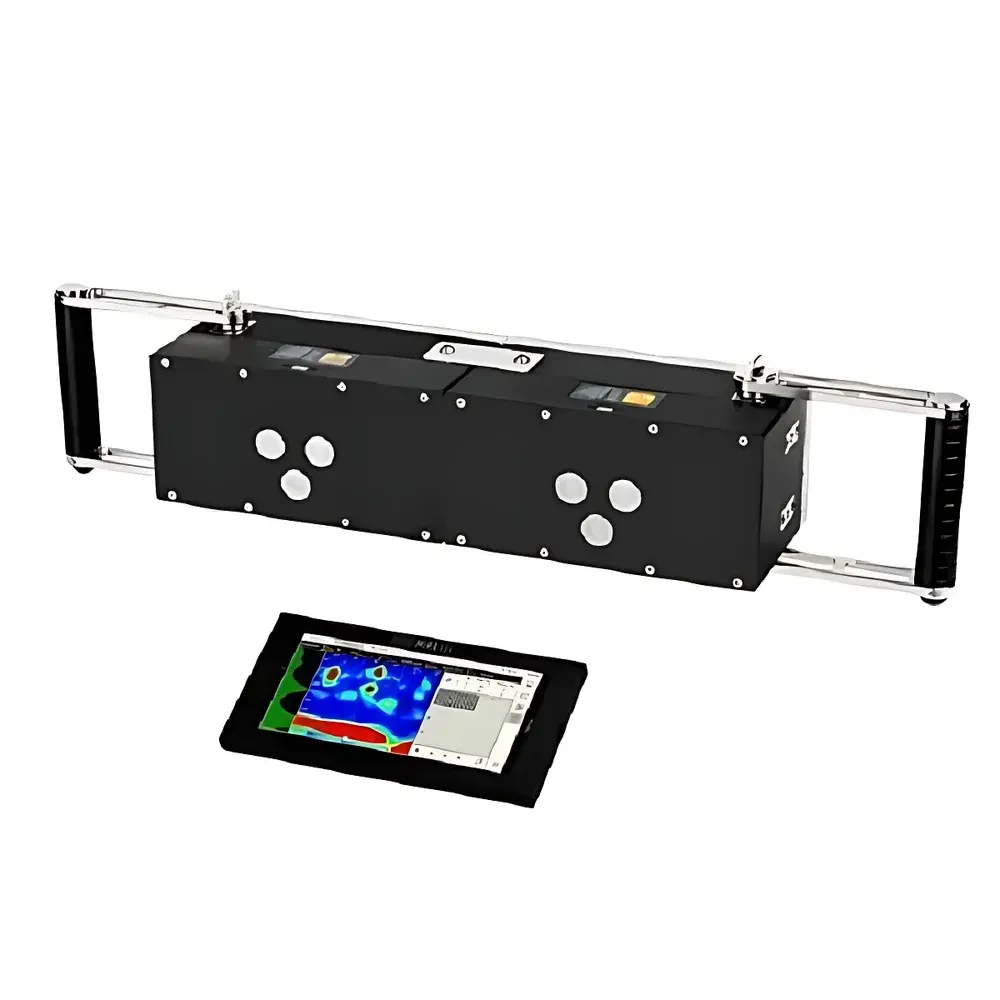
ACS A1040 MIRA 3D Pro Concrete 3D Ultrasonic Tomography System
| Brand | ACS |
|---|---|
| Origin | Italy |
| Manufacturer Type | Authorized Distributor |
| Origin Category | Imported |
| Model | A1040 MIRA 3D Pro |
| Frequency Bandwidth | 10–100 kHz |
| Parallel DAQ Channels | 64 |
| Maximum Penetration Depth | 4 m (concrete-dependent) |
| Maximum Scanning Area | 10 × 10 m |
| Frame Rate | 12 Hz (2D), 0.3 Hz (3D) |
| Battery Life | Up to 10 h per charge |
| Sensor Configuration | 4 × 16 or 8 × 8 A-DPC® array (expandable) |
| Compliance | T/CECS XXX-202X, JGJ/T 485–2019, DB32/T 3754–2020, DB34/T 5072–2017, DB37/T 5106–2018, DG/TJ 08–2252–2018, DB13(J)/T 8327–2019, DBJ/T–199–2020 |
Overview
The ACS A1040 MIRA 3D Pro is a high-resolution concrete ultrasonic tomography system engineered for non-destructive evaluation (NDE) of reinforced and precast concrete structures. It employs full-matrix capture (FMC) and total focusing method (TFM) reconstruction principles—rooted in pulse-echo ultrasonic wave propagation—to generate volumetric images of internal heterogeneities, including voids, delaminations, honeycombing, grout defects, and crack networks. Unlike conventional single-channel or phased-array systems, the MIRA 3D Pro implements true 3D tomographic acquisition at every transducer position, enabling depth-resolved, spatially registered visualization without mechanical scanning interpolation. Its core architecture supports real-time 3D imaging through GPU-accelerated TFM processing, delivering quantitative structural integrity assessment aligned with international NDT best practices for civil infrastructure inspection.
Key Features
- True3D® tomographic imaging: Full-matrix capture (FMC) with real-time TFM reconstruction at each probe location—no post-processing interpolation required.
- A-DPC® (Active Dry-Point Contact) sensor technology: Self-contained, low-noise piezoelectric transducers with integrated pulser-receiver circuits; eliminates coupling gel and enables rapid deployment on rough, dusty, or vertically oriented concrete surfaces.
- 64-channel parallel data acquisition: Enables simultaneous excitation and reception across configurable 4×16 or 8×8 sensor arrays, supporting scalable aperture expansion via modular array units.
- Depth-penetration enhancement mode: Optimized high-energy pulse generation for improved signal-to-noise ratio in low-frequency bands (10–100 kHz), critical for assessing thick sections up to 4 m in standard concrete (C20–C50).
- Multi-mode imaging suite: Includes area-scan (C-scan), panoramic B-scan, panoramic D-scan, and volumetric slice rendering—each calibrated to ASTM E1158 and ISO 12718 reference methodologies.
- Field-deployable control interface: Operates via ruggedized Windows tablet or laptop; Android-compatible remote viewer available for preliminary field triage.
Sample Compatibility & Compliance
The A1040 MIRA 3D Pro is validated for use on cast-in-place, precast, prestressed, and ultra-high-performance concrete (UHPC) substrates with compressive strengths ranging from 20 MPa to 150 MPa. Surface conditions—including formwork marks, laitance layers, and minor carbonation—do not impede A-DPC® coupling performance. The system conforms to multiple national technical standards governing prefabricated concrete inspection in China, including T/CECS XXX-202X, JGJ/T 485–2019, and regional codes such as DB32/T 3754–2020 and DG/TJ 08–2252–2018. While not certified to EN 13791 or ASTM C174/C1881 for direct strength correlation, its defect localization accuracy (< ±5 mm lateral, < ±10 mm depth) meets GLP-aligned QA/QC requirements for structural health monitoring programs.
Software & Data Management
INTROVIEW® Pro is a desktop-based software platform designed for acquisition control, 3D reconstruction, and metrological reporting. It supports audit-trail logging compliant with ISO/IEC 17025 documentation requirements and includes timestamped operator ID tagging, calibration history tracking, and version-controlled report export (PDF, DICOM, STL). Imaging workflows support both single-point inspection and grid-based area mapping, with automated stitching algorithms for large-area coverage (up to 10 × 10 m). Volume rendering options include isosurface extraction, maximum-intensity projection (MIP), orthogonal slicing, and partial-volume segmentation—enabling cross-sectional analysis along arbitrary planes. Raw FMC datasets are stored in HDF5 format for third-party algorithm integration and long-term archival per IEC 61508 functional safety guidelines.
Applications
- Quality assurance of tunnel lining grouting density and continuity.
- Pre- and post-tensioning duct integrity verification in bridge girders and segmental box culverts.
- Defect mapping in precast wall panels, floor slabs, and column connections prior to erection.
- In-service assessment of fire-damaged or chloride-affected concrete elements.
- Validation of repair interventions—including epoxy injection efficacy and patch bond-line integrity.
- Research-grade characterization of microcrack evolution under cyclic loading in laboratory specimens.
FAQ
Does the A1040 MIRA 3D Pro require ultrasonic coupling gel?
No. The A-DPC® sensors operate in dry-point contact mode and do not require liquid couplant, reducing setup time and eliminating surface preparation dependencies.
Can the system detect sub-millimeter cracks?
It quantifies open cracks ≥0.2 mm width with depth estimation accuracy dependent on orientation and signal attenuation; closed or hairline cracks below 0.1 mm remain outside detection threshold per ISO 12718 resolution limits.
Is raw FMC data export supported?
Yes—HDF5-formatted full-matrix datasets are fully accessible for external processing, academic research, or custom algorithm development.
What regulatory frameworks does INTROVIEW® Pro support for electronic records?
The software provides configurable user authentication, immutable audit logs, and electronic signature fields compatible with FDA 21 CFR Part 11 readiness when deployed in GxP-aligned environments.
How is calibration verified in the field?
A traceable reference block (included in standard configuration) with embedded artificial reflectors enables daily functional verification per ASTM E317 procedures, with deviation alerts triggered beyond ±5% amplitude drift.



