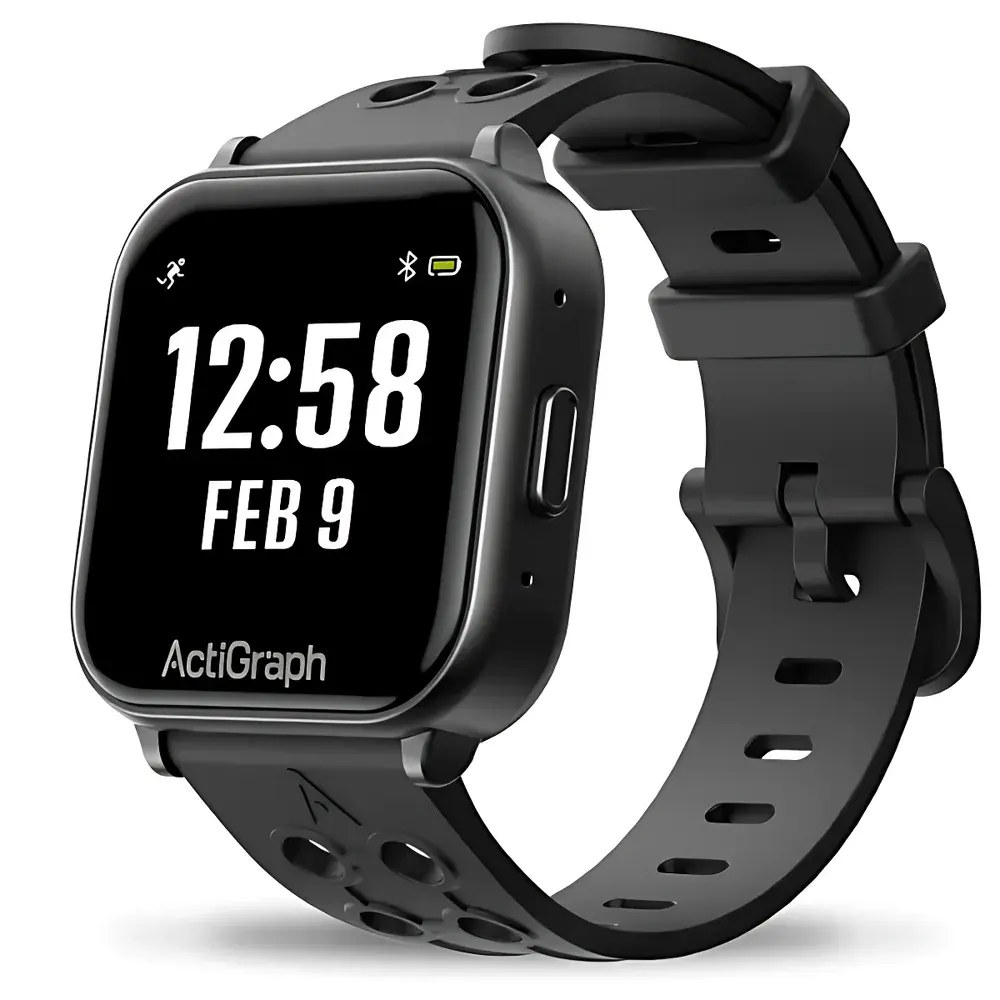
ActiGraph LEAP Wearable Multimodal Physiological & Motion Monitor
| Brand | ActiGraph |
|---|---|
| Origin | USA |
| Model | LEAP |
| Accelerometer Type | Triaxial MEMS |
| IMU | Integrated 6-DOF (3-axis accelerometer + 3-axis gyroscope) |
| Sampling Rate | 32–256 Hz |
| Primary Accelerometer Range | ±8 g |
| Secondary IMU Accelerometer Ranges | ±2 g / ±16 g |
| Gyroscope Range | ±2000 dps |
| PPG Wavelengths | 530 nm (green), 655 nm (red), 940 nm (IR) |
| Barometer Range | 300–1100 hPa |
| Skin Temperature Range | −20 °C to +50 °C |
| Microphone Bandwidth | 100 Hz–10 kHz |
| Battery Life | 32 days |
| Onboard Storage | 1 GB (79 days at default sampling) |
| Dimensions | 3.85 × 3.9 × 1.225 cm |
| Weight | 24 g |
| Water Resistance | IPX7 (1 m, 30 min) |
| Connectivity | USB-C, Bluetooth® Low Energy 5.0 |
| Wear Position | Wrist, waist, ankle, or chest |
Overview
The ActiGraph LEAP is a clinical-grade, multimodal wearable monitor engineered for longitudinal, ambulatory assessment of human physiology and movement dynamics in real-world settings. Unlike conventional accelerometers focused solely on activity quantification, the LEAP integrates a synchronized sensor suite—including a high-fidelity triaxial MEMS accelerometer, a 6-degree-of-freedom inertial measurement unit (IMU), photoplethysmography (PPG) array with three optical wavelengths, a calibrated barometer, a contact-based skin temperature sensor, and a broadband microphone—to enable concurrent, time-aligned acquisition of biomechanical, autonomic, respiratory, and environmental signals. Its architecture adheres to principles of motion artifact suppression, signal coherence preservation, and sensor fusion integrity—critical for deriving validated endpoints in regulatory-grade studies. Designed for continuous wear over extended periods, the LEAP supports objective measurement of physical behavior (e.g., posture transitions, gait cyclicity), autonomic regulation (HRV, SpO₂ trends), sleep architecture (via polysomnography-correlated algorithms), and contextual environmental exposure (e.g., altitude change, ambient acoustic events). It serves as a foundational platform for studies requiring compliance with ISO/IEC 17025 traceability frameworks and FDA-endorsed digital biomarker development pathways.
Key Features
- Multimodal physiological sensing: Simultaneous acquisition of heart rate (HR), heart rate variability (HRV), peripheral capillary oxygen saturation (SpO₂), respiration rate (RR), atrial fibrillation (AFib) detection, and skin temperature—all derived from synchronized PPG, IMU, and thermal data streams.
- Comprehensive activity profiling: Quantification of total movement volume, moderate-to-vigorous physical activity (MVPA), sedentary bout duration, step count, and metabolic equivalent of task (MET)-based energy expenditure using adaptive acceleration thresholding and machine learning–enhanced classification models.
- Clinically validated sleep staging: Automated estimation of total sleep time (TST), sleep efficiency (SE), wake after sleep onset (WASO), sleep latency (SOL), and REM/non-REM cycle distribution—validated against in-lab polysomnography (PSG) in peer-reviewed cohorts (e.g., Sleep, Journal of Clinical Sleep Medicine).
- Gait and postural stability analytics: Temporal-spatial gait parameter extraction—including stride velocity, step length, stance/swing phase ratios, and dynamic balance metrics—leveraging high-resolution IMU data and proprietary gait segmentation algorithms compliant with GAITRite and APDM Mobility Lab interoperability standards.
- Fall risk stratification: Real-time detection of pre-fall postural instability patterns (e.g., prolonged sway, trunk flexion angle deviation, loss of vertical alignment) via waist-worn configuration; outputs actionable alerts aligned with CDC STEADI fall risk assessment criteria.
- Robust field deployment: IPX7-rated enclosure ensures operational reliability during showering, light swimming, or high-humidity environments; 32-day battery life eliminates daily charging burden in community-based trials; 1 GB onboard memory supports >79 days of archival at 32 Hz sampling.
Sample Compatibility & Compliance
The LEAP is validated for use across diverse demographic cohorts—including older adults, pediatric populations (≥6 years), and individuals with chronic conditions such as COPD, heart failure, Parkinson’s disease, and obesity-related metabolic syndrome. Sensor calibration follows NIST-traceable protocols for acceleration sensitivity and PPG optical pathlength. Data output formats comply with HL7 FHIR R4 Observation and Device resources, enabling seamless ingestion into electronic health record (EHR) systems and clinical trial databases. The device meets IEC 62304 Class B software safety requirements and supports audit-ready data provenance under 21 CFR Part 11-compliant software environments (e.g., ActiLife 6.13+ with electronic signature and audit trail modules). It is CE-marked as a Class IIa medical device and listed with Health Canada as a Class II device for remote patient monitoring applications.
Software & Data Management
Data extraction and analysis are performed using ActiLife v6.13.5 or later—a validated desktop application supporting raw binary decoding, epoch-level aggregation (1-second to 60-minute windows), and algorithmic derivation of clinical endpoints. The software implements GLP/GMP-aligned processing pipelines, including automatic sensor orientation correction, motion-contaminated PPG segment rejection, and HRV spectral analysis per Task Force of the European Society of Cardiology guidelines. Export options include CSV, HDF5, and XPT (SAS transport) formats compatible with R (ggplot2, GGIR), Python (NumPy, MNE-Python), and MATLAB toolboxes. Cloud-based cohort management is supported via ActiCloud, which provides role-based access control, DICOM-SR–compatible annotation layers, and automated QC dashboards for missing data, battery depletion events, and wear-time validation per CHAMPS and NHANES protocols.
Applications
- Clinical research: Endpoint collection in interventional trials evaluating mobility interventions, cardiac rehabilitation efficacy, or digital therapeutics for insomnia and depression.
- Public health surveillance: Large-scale epidemiological assessment of physical activity patterns, sedentary behavior correlates, and sleep health disparities across socioeconomic strata.
- Neurodegenerative disease monitoring: Objective quantification of bradykinesia progression, gait freezing episodes, and circadian rhythm fragmentation in Parkinson’s and Alzheimer’s disease cohorts.
- Occupational health: Fatigue and workload assessment among shift workers, healthcare providers, and transportation personnel via combined actigraphy, HRV, and acoustic stress marker analysis.
- Sports science: Load monitoring in elite athletes through integrated mechanical power estimation, recovery-state indexing (via nocturnal HRV and skin temperature slope), and injury risk modeling based on gait asymmetry trends.
FAQ
Is the LEAP suitable for FDA-regulated clinical trials?
Yes—the LEAP’s hardware design, firmware validation, and ActiLife software implementation support use as a secondary endpoint device in FDA-submitted protocols. Full validation documentation, including analytical sensitivity reports and clinical correlation studies, is available under NDA/IDE sponsorship agreements.
What mounting configurations are supported beyond wrist placement?
The LEAP is validated for waist (anterior midline), ankle (lateral malleolus), and sternum placements using medically approved hypoallergenic straps. Each configuration triggers context-specific calibration and algorithm selection within ActiLife.
Does the device meet HIPAA or GDPR data security requirements?
Raw data remains stored locally until explicitly exported; all Bluetooth and USB transfers occur over encrypted channels. When used with ActiCloud, data residency, encryption-at-rest, and access logging conform to ISO 27001-certified infrastructure standards.
Can the microphone data be used for voice-based biomarker extraction?
Yes—recorded audio (100 Hz–10 kHz bandwidth) supports cough detection, vocal tremor analysis, and speech pause duration quantification; however, raw audio export requires IRB-approved consent and local ethics committee authorization.
How is skin temperature measured, and what is its clinical utility?
A thermistor embedded in the skin-contact surface provides continuous contact temperature readings (±0.2 °C accuracy). Diurnal skin temperature amplitude is a validated surrogate for circadian phase and autonomic tone—particularly useful in shift-work disorder and menopausal symptom tracking.