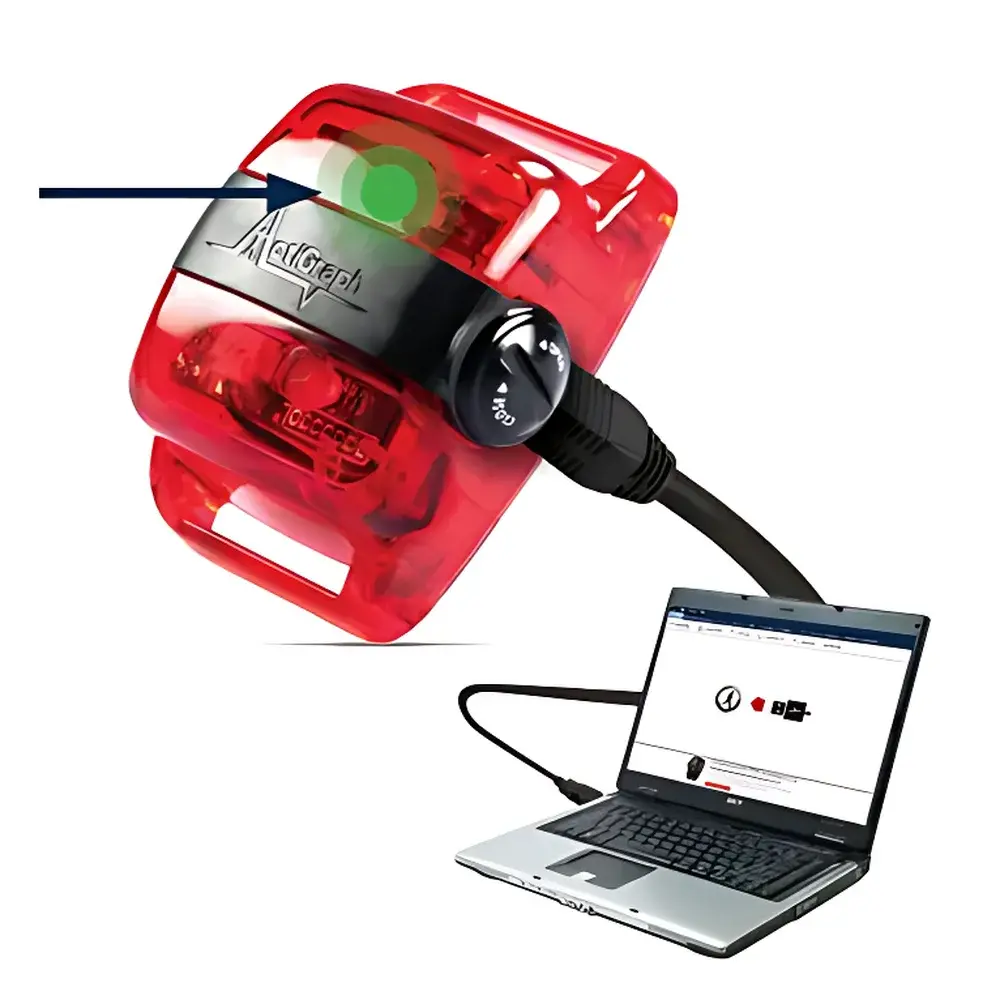
ActiGraph wGT3X-BT Wearable Triaxial Accelerometer for Objective Physical Activity and Energy Expenditure Monitoring
| Brand | ActiGraph |
|---|---|
| Origin | USA |
| Model | wGT3X-BT |
| Acceleration Range | ±8 g |
| Dimensions | 4.6 × 3.3 × 1.5 cm |
| Weight | 19 g |
| Memory Capacity | 2 GB (up to 120 days at 30 Hz) |
| Battery Life | Up to 25 days (fully charged) |
| Interface | USB 2.0 & Bluetooth® Smart |
| Sampling Rate | 30–100 Hz |
| Calibration | Factory-calibrated, no user calibration required |
| Water Resistance | IP27 (submersion up to 1 m for 30 min) |
| Measured Parameters | Raw triaxial acceleration (x/y/z), steps, activity intensity (METs), energy expenditure (kcal), heart rate (with compatible chest strap), ambient light level, total sleep time, sleep efficiency, sleep onset latency, wake after sleep onset (WASO), periodic limb movements (PLM) |
Overview
The ActiGraph wGT3X-BT is a CE- and FDA-listed Class II medical device-grade wearable triaxial accelerometer engineered for high-fidelity, long-term objective monitoring of human physical activity, sedentary behavior, and energy expenditure in free-living conditions. Operating on validated microelectromechanical systems (MEMS) sensor architecture, it captures raw acceleration signals at programmable sampling rates (30–100 Hz) across three orthogonal axes (x, y, z), enabling precise derivation of movement magnitude, frequency, and temporal patterning. Its embedded Bluetooth® Smart radio supports real-time data streaming and remote configuration—critical for longitudinal cohort studies, clinical trials, and ecological momentary assessment (EMA) protocols. Designed for 24/7 wearability over weeks or months, the wGT3X-BT delivers robust performance across diverse environmental settings—including home, school, workplace, outdoor terrain, and clinical environments—without constraining participant mobility or ecological validity.
Key Features
- Compact, wrist-worn form factor (4.6 × 3.3 × 1.5 cm; 19 g) optimized for minimal participant burden and high compliance in multi-day studies.
- Factory-calibrated ±8 g triaxial MEMS accelerometer with <0.5% nonlinearity and thermal drift compensation across –10°C to +50°C operational range.
- Onboard 2 GB flash memory supporting up to 120 days of continuous logging at 30 Hz (or 30 days at 100 Hz), eliminating dependency on external storage or frequent downloads.
- Dual-mode connectivity: USB 2.0 for high-speed bulk data transfer and Bluetooth® Smart (BLE 4.0) for wireless device pairing, firmware updates, and real-time signal verification during setup.
- IP27-rated enclosure: certified for immersion up to 1 meter for 30 minutes, ensuring reliability during showering, light rain exposure, or incidental submersion.
- Integrated ambient light sensor (0–65,535 lux resolution) and temperature sensor (±0.5°C accuracy) for contextual behavioral annotation and circadian rhythm analysis.
- Battery endurance of ≥25 days under typical usage (30 Hz sampling, 1-min epoch storage), with low-power sleep mode extending longevity during inactive periods.
Sample Compatibility & Compliance
The wGT3X-BT is validated for use across heterogeneous populations—including pediatric, adolescent, adult, geriatric, and clinical cohorts (e.g., type 2 diabetes, Parkinson’s disease, obesity, pregnancy). Its measurement algorithms comply with established consensus standards including the NIH-supported Compendium of Physical Activities, ISO 20442:2021 (wearable activity monitors), and ASTM F3070-22 (standard practice for validation of accelerometer-based activity monitors). Data output adheres to FAIR principles (Findable, Accessible, Interoperable, Reusable) and supports audit-ready workflows compliant with GLP and 21 CFR Part 11 requirements when used with ActiLife v6.13.4 or later (including electronic signatures, audit trails, and role-based access control).
Software & Data Management
ActiLife Desktop Software (v6.13.4+) serves as the validated analysis platform for wGT3X-BT data. It enables device configuration (epoch length, sampling rate, sensor sensitivity), encrypted data download, artifact detection (e.g., non-wear time via Choi algorithm), and standardized metric derivation—including vector magnitude (VM), Euclidean Norm Minus One (ENMO), MET-weighted activity counts, and sleep staging via Cole-Kripke and Sadeh algorithms. Export options include CSV, TXT, and HDF5 formats compatible with R (GGIR, GGIR), Python (PyActigraphy), SAS, SPSS, and MATLAB. All processing pipelines are version-locked and reproducible; software update logs and parameter change histories are automatically archived per regulatory traceability requirements.
Applications
- Epidemiological surveillance: Objective quantification of physical activity levels across national health surveys (e.g., NHANES, UK Biobank), stratified by age, sex, SES, and comorbidity status.
- Sleep architecture analysis: Derivation of clinically relevant metrics—including sleep onset latency, WASO, sleep efficiency, and PLM index—validated against polysomnography (PSG) in >47 peer-reviewed studies.
- Clinical trial endpoints: Primary or secondary outcome measurement in interventional studies assessing exercise prescription efficacy, rehabilitation progress, or metabolic response to lifestyle modification.
- Environmental epidemiology: Correlation of built environment features (e.g., park proximity, sidewalk density, schoolyard design) with objectively measured activity intensity and duration in children and adolescents.
- Occupational health: Assessment of sedentary time distribution and movement fragmentation among desk-based workers, healthcare providers, and military personnel.
FAQ
Is the wGT3X-BT suitable for pediatric populations?
Yes—its lightweight design and validated age-specific cut-points (Trost et al., 2011; Puyau et al., 2002) support reliable activity classification in children aged 3 years and older.
Does it require daily charging or frequent syncing?
No—25-day battery life eliminates daily recharging; Bluetooth Smart enables on-demand configuration without tethering, while USB ensures rapid batch data retrieval.
Can it measure heart rate natively?
No—HR requires pairing with a validated ANT+ or Bluetooth Smart chest strap (e.g., Polar H10); the wGT3X-BT synchronizes timestamps to enable integrated HR–activity analysis.
How is non-wear time identified in ActiLife?
Using the Choi algorithm (2012), which applies consecutive 60-minute windows with ≤50 activity counts per minute and standard deviation <13 counts/min across all axes.
Is raw acceleration data export supported for custom algorithm development?
Yes—full-resolution .gt3x binary files preserve unprocessed x/y/z signals at native sampling rate; ActiLife provides SDK documentation and MATLAB/Python reference parsers.