
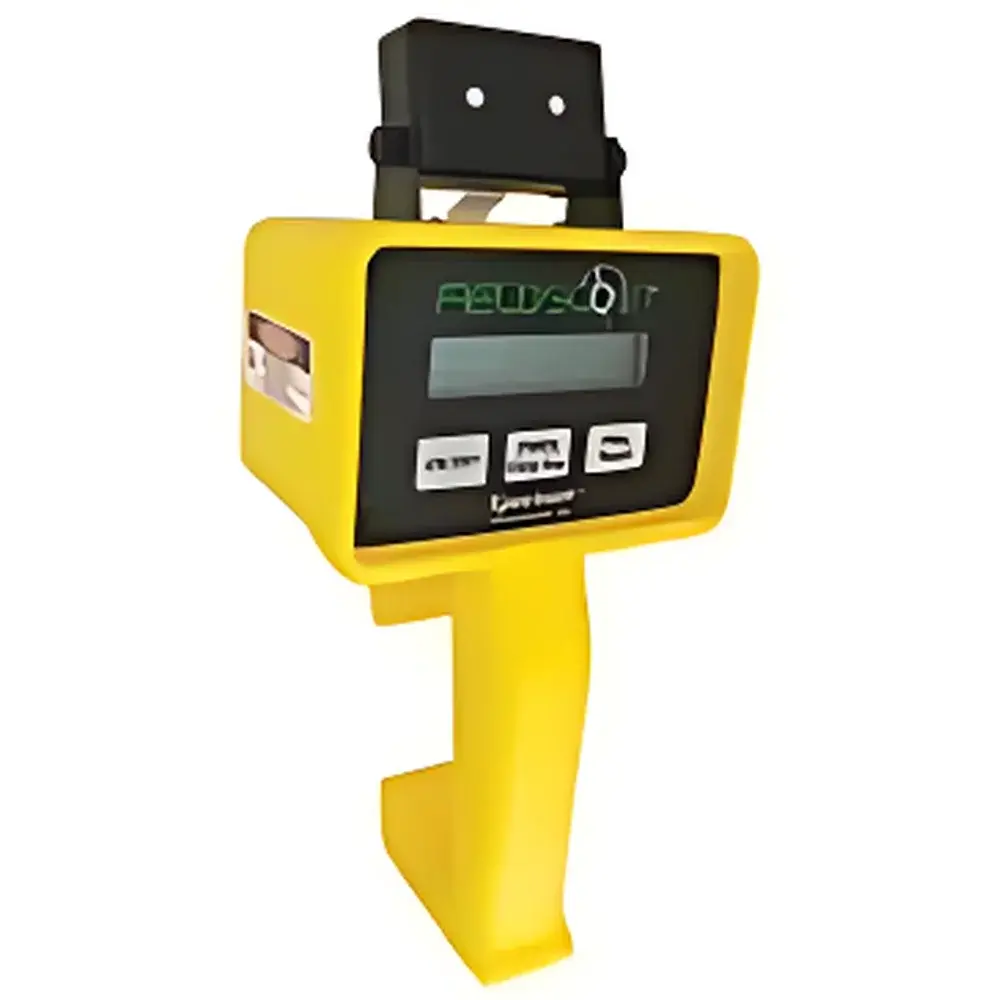
Active Spectrum CM-1000 Chlorophyll Meter
| Brand | Active Spectrum |
|---|---|
| Origin | USA |
| Model | CM-1000 |
| Measurement Principle | Dual-wavelength (700 nm & 840 nm) reflectance-based relative chlorophyll index |
| Measurement Area | 1.35 cm Ø at 30.5 cm distance |
| Effective Measurement Range | 0–999 (unitless relative chlorophyll index) |
| Repeatability | ±5% of reading |
| Measurement Interval | 2 seconds per reading |
| Detector | Four photodiodes (2 for sample reflectance, 2 for ambient light compensation) |
| Data Storage | 1,350 records with GPS metadata |
| Power | Two AAA alkaline batteries (~3,000 measurements per set) |
| Operating Distance Range | 30.5 cm to 183 cm |
| Weight | Handheld, lightweight ergonomic design |
| Environmental Compensation | Automatic ambient light correction |
| Connectivity | Optional GPS integration via serial interface |
| Compliance | Designed for field-deployable agronomic and ecological monitoring in accordance with ISO 11097 (optical plant sensors), ASTM E2912 (standard practice for spectral reflectance measurements of vegetation), and GLP-aligned data integrity workflows |
Overview
The Active Spectrum CM-1000 Chlorophyll Meter is a field-portable, non-destructive optical instrument engineered for rapid, repeatable estimation of relative chlorophyll content in intact plant tissues. It operates on the well-established principle of dual-wavelength reflectance spectroscopy—specifically measuring the differential absorption characteristics of chlorophyll-a at 700 nm (strongly absorbed) and near-infrared reflectance at 840 nm (minimally absorbed by photosynthetic pigments). The resulting ratio serves as a robust proxy for relative leaf chlorophyll concentration, strongly correlated with nitrogen status in C3 and C4 species. Unlike destructive lab assays (e.g., acetone extraction followed by spectrophotometry), the CM-1000 enables real-time, in situ assessment across heterogeneous canopies—including row crops, orchards, turfgrass, and natural vegetation—without tissue removal or chemical reagents. Its optical architecture is calibrated to minimize interference from leaf thickness, surface wax, and minor variations in incident illumination, supported by integrated ambient light compensation circuitry.
Key Features
- Non-invasive measurement: No leaf clipping, no solvent use, no tissue damage—preserves sample integrity for longitudinal monitoring.
- Automatic ambient light compensation: Dual photodiode array continuously monitors background irradiance, enabling stable readings under variable sky conditions (full sun, overcast, partial shade).
- Ergonomic handheld form factor: Lightweight (< 250 g), balanced weight distribution, and intuitive trigger operation optimized for extended field deployment.
- Configurable measurement geometry: Adjustable standoff distance (30.5–183 cm) supports both single-leaf spot assessment and small-canopy averaging (e.g., turf plots or young seedlings).
- On-device statistical processing: Calculates and displays real-time mean, standard deviation, and count of sequential measurements—reducing post-field data aggregation effort.
- Integrated non-volatile memory: Stores up to 3,250 index values locally; expands to 1,350 entries when paired with optional GPS module for georeferenced sampling grids.
- Battery efficiency: Two standard AAA alkaline cells support ~3,000 discrete measurements per set, with low-power sleep mode and auto-shutdown after 2 minutes of inactivity.
Sample Compatibility & Compliance
The CM-1000 is validated for use across broadleaf dicots (e.g., soybean, tomato, Arabidopsis), monocot grasses (maize, wheat, rice, bentgrass), and coniferous foliage. It accommodates leaf thicknesses from 0.1 mm (young seedlings) to 0.6 mm (mature oak), provided the measurement area remains fully covered within the optical cone. Surface pubescence or heavy cuticular wax does not significantly bias results due to the 840 nm reference channel’s insensitivity to structural scattering. The device complies with electromagnetic compatibility standards IEC 61326-1 (industrial environments) and meets IP54 ingress protection for dust and water splashes. Data output protocols align with FAO’s CropWatch framework and support traceability requirements under ISO 17025-accredited agronomy labs when used in conjunction with documented calibration verification procedures.
Software & Data Management
Raw index values and metadata (timestamp, battery voltage, ambient light intensity, GPS coordinates if enabled) are exported via RS-232 or USB-to-serial adapter using Active Spectrum’s proprietary PC software (Windows 10/11 compatible). The application supports batch export to CSV and Excel formats, generates spatial heatmaps when GPS-tagged, and allows user-defined thresholds for nitrogen sufficiency classification (e.g., “deficient”, “optimal”, “excessive”). Audit trails—including operator ID, firmware version, and last calibration date—are embedded in each data packet to satisfy GLP documentation requirements. Software updates preserve backward compatibility with legacy CM-1000 units and include configurable reporting templates aligned with USDA-NRCS soil health assessment protocols.
Applications
- Precision nitrogen management: Quantify spatial variability in crop N status to guide variable-rate fertilizer application, reducing input costs and nitrate leaching risk.
- Phenotyping trials: Screen large plant populations for chlorophyll stability under drought, heat, or pathogen stress—serving as a high-throughput proxy for photosynthetic capacity.
- Turfgrass quality assessment: Monitor seasonal chlorophyll dynamics in golf courses and sports fields to optimize mowing frequency and irrigation scheduling.
- Ecological field studies: Track chlorophyll decline during senescence or pollution-induced stress in native vegetation transects.
- Educational laboratories: Demonstrate structure-function relationships between leaf biochemistry and optical properties in undergraduate plant physiology courses.
FAQ
Does the CM-1000 provide absolute chlorophyll concentration (µg/cm²)?
No. It reports a unitless relative index calibrated against empirical chlorophyll extraction datasets. Conversion to absolute units requires species-specific regression equations derived from concurrent lab analysis.
Can it measure through plastic film or greenhouse glazing?
No. Direct line-of-sight to the leaf surface is required. Transparent barriers introduce uncorrected spectral attenuation and reflection artifacts.
Is factory recalibration required annually?
Not mandatory, but recommended every 12 months or after 10,000 measurements. Users may perform field verification using the included neutral-density reference tile.
How does it handle highly reflective or anthocyanin-rich leaves?
The 700/840 nm ratio inherently mitigates red-pigment interference, though extreme anthocyanin accumulation (>1.5 OD at 530 nm) may require empirical correction factors established per cultivar.
Is the device compatible with third-party GIS platforms?
Yes. Exported CSV files contain WGS84 latitude/longitude columns and can be directly imported into QGIS, ArcGIS Pro, or Farm Management Information Systems (FMIS) supporting ISO 11783-10 (ISOBUS) metadata schemas.
Related Products




