
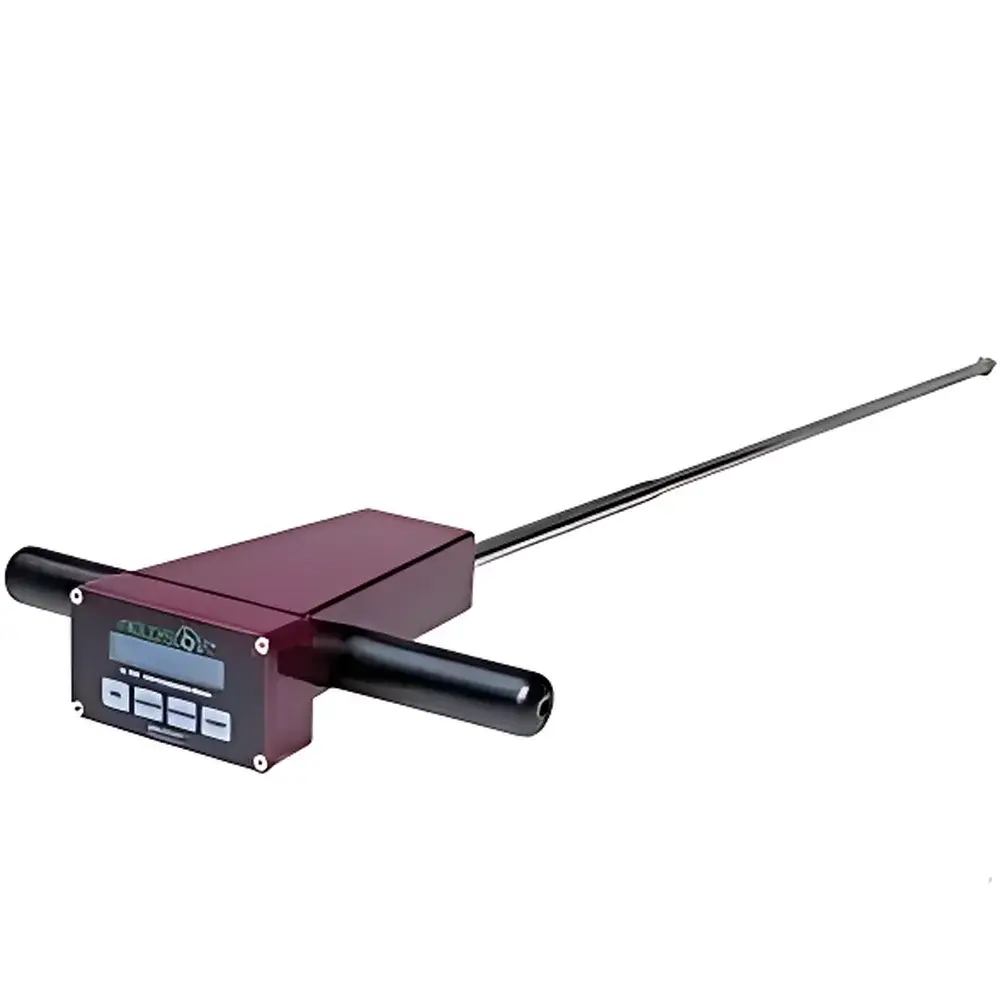
Active Spectrum SC900 Soil Compaction Tester
| Brand | Active Spectrum |
|---|---|
| Origin | USA |
| Model | SC900 |
| Measurement Units | PSI or kPa |
| Depth Resolution | 2.5 cm |
| Force Resolution | 5 PSI (35 kPa) |
| Depth Accuracy | ±1.25 cm |
| Force Accuracy | ±15 PSI (±103 kPa) |
| Penetration Range | 0–45 cm |
| Force Range | 0–1000 PSI (0–7000 kPa) |
| Max Insertion Speed | 182 cm/min |
| Max Load Capacity | 210 lb |
| Power | 4 × AAA alkaline batteries (≈12 months operation) |
| Data Storage | 772 soil profiles (GPS-off), 579 profiles (GPS/DGPS-enabled) |
| Display | 16-character × 2-line LCD |
| Weight | 1.25 kg |
| Cone Tip Diameter | 12.827 mm |
Overview
The Active Spectrum SC900 Soil Compaction Tester is a field-deployable, hand-held penetrometer engineered for quantitative assessment of soil mechanical resistance—commonly referred to as soil compaction. It operates on the standardized cone penetration principle defined in ASTM D6951 and ISO 23784, where a calibrated conical probe is driven vertically into undisturbed soil at a controlled rate, and the resistive force (in PSI or kPa) is recorded continuously as a function of depth (0–45 cm). This real-time profile provides critical insight into subsurface stratification, plow pan formation, root zone restriction, and moisture-dependent density variations—parameters directly linked to infiltration capacity, aeration, and crop root development. Unlike qualitative visual assessments or bulk density sampling, the SC900 delivers traceable, depth-resolved mechanical data essential for precision agronomy, land reclamation planning, and long-term soil health monitoring under evolving climate and tillage regimes.
Key Features
- Integrated high-fidelity analog-to-digital conversion with real-time force-depth synchronization, enabling millisecond-level timestamping of each measurement point
- Programmable dual-unit output (PSI/kPa) with automatic unit scaling during data export and on-device display
- Onboard data logger storing up to 772 full depth profiles (100-point resolution per profile); GPS/DGPS-compatible firmware supports georeferenced mapping via optional external receivers
- Ergonomic, single-hand operation design with low-inertia probe assembly optimized for consistent insertion speed (182 cm/min nominal), minimizing dynamic overshoot artifacts
- RS-232 serial interface compliant with standard PC COM port protocols; supports direct connection to field laptops or data acquisition hubs without proprietary drivers
- Robust aluminum-alloy housing rated IP54 for dust and splash resistance; cone tip manufactured from hardened stainless steel (Rockwell C58) to maintain dimensional integrity across >5,000 penetrations
Sample Compatibility & Compliance
The SC900 is validated for use in mineral soils ranging from sandy loam to heavy clay, including partially saturated and seasonally frozen conditions (down to −2°C surface temperature). It is not intended for use in gravel-rich substrates (>15% particles >2 mm), organic peat (>75% OM), or highly compacted urban fill containing rubble. The instrument conforms to ASTM D6951-22 “Standard Test Method for Use of the Dynamic Cone Penetrometer in Shallow Pavement Applications” for procedural alignment, and its calibration protocol follows NIST-traceable reference load cells certified annually per ISO/IEC 17025 requirements. All firmware and data handling routines support audit-ready metadata logging—including operator ID, date/time stamp, ambient temperature, and battery voltage—for GLP-compliant field reporting.
Software & Data Management
Data retrieval is supported via Active Spectrum’s cross-platform SC-Link utility (Windows/macOS/Linux), which imports raw .CSV files with embedded depth-force arrays, GPS coordinates (if enabled), and session metadata. The software enables depth-aligned profile overlay, statistical comparison across transects, and automated generation of contour maps using inverse distance weighting (IDW) interpolation. Export options include PDF summary reports compliant with USDA-NRCS technical note formatting, as well as structured JSON for integration into GIS platforms (ArcGIS Pro, QGIS) or enterprise LIMS systems. All data files include SHA-256 checksums and optional password-protected encryption to meet internal data governance policies aligned with FDA 21 CFR Part 11 principles for electronic records.
Applications
- Identification of restrictive layers affecting root elongation in corn, soybean, and wheat production systems
- Pre- and post-tillage evaluation to quantify mechanical impact of chisel plowing, subsoiling, or no-till adoption
- Validation of soil remediation efforts following construction site reclamation or mine spoil rehabilitation
- Calibration input for hydrological models (e.g., HYDRUS-1D) requiring spatially explicit soil mechanical parameterization
- Longitudinal monitoring of compaction trends in pastureland subjected to repeated livestock trafficking
- Research-grade data collection for peer-reviewed studies on soil physical quality indices (e.g., S-index, least limiting water range)
FAQ
What calibration standards are used for factory verification?
Each SC900 unit undergoes full-range static calibration using NIST-traceable dead-weight loading fixtures prior to shipment, with certificate of conformance included.
Can the device be used in wet or rainy field conditions?
Yes—the electronics enclosure meets IP54 ingress protection; however, prolonged submersion or operation in standing water is not recommended.
Is the cone tip replaceable, and what is its service life?
The 12.827-mm stainless steel cone is user-replaceable via hex-key tooling; typical service life exceeds 5,000 penetrations in medium-textured soils before recalibration is advised.
Does the SC900 support third-party GPS modules?
Yes—it accepts standard NMEA 0183 v3.01 serial GPS input (4800 baud), including common DGPS receivers such as Garmin GPSMAP 66i and Emlid Reach RS3.
How is data integrity ensured during extended field deployments?
Internal EEPROM retains all logged profiles even during battery replacement; power-loss recovery logic prevents partial-write corruption, and each profile includes cyclic redundancy check (CRC-16) validation.
Related Products







