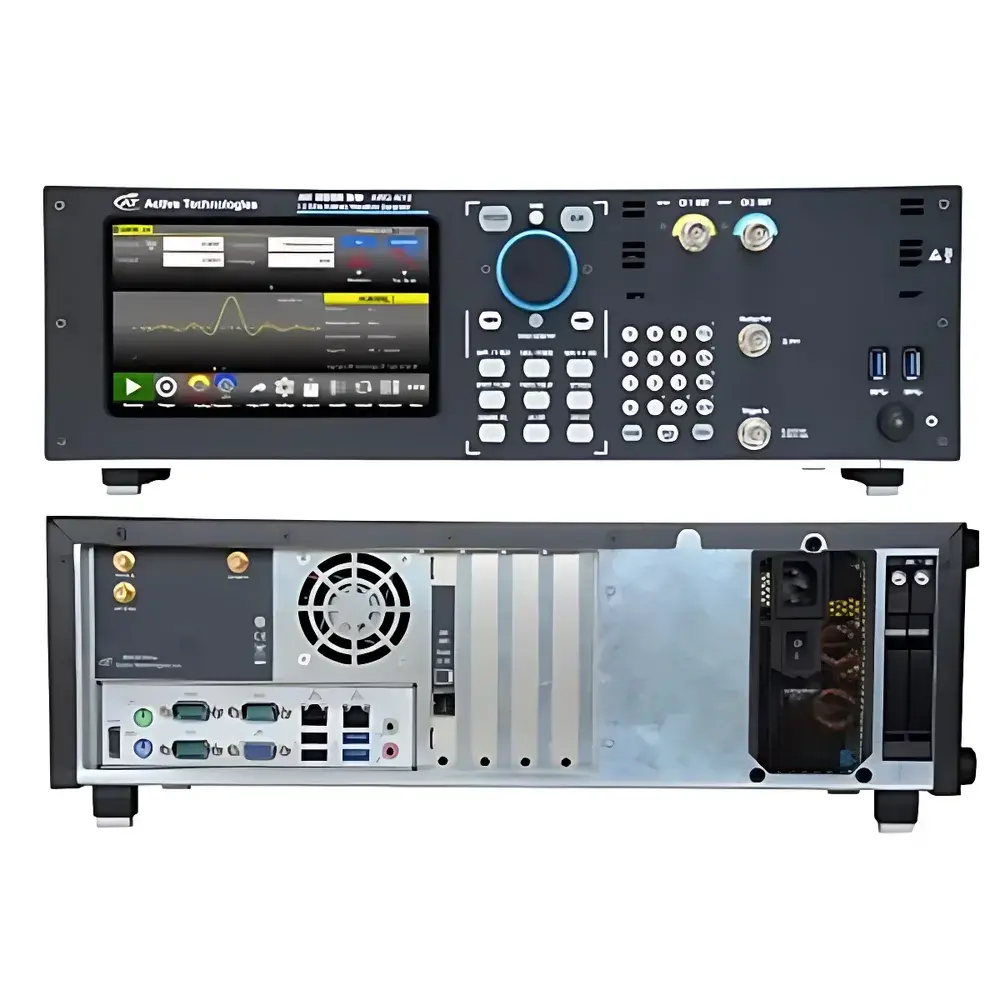
Active Technologies ARB Rider AWG-4000 Series Multi-Channel GHz-Sampling Arbitrary Waveform Generator
| Brand | Active Technologies |
|---|---|
| Model | AWG-4000 Series |
| Output Channels | 2 / 4 / 8 (analog) + up to 32 digital (TTL/LVDS) |
| Sampling Rate | 1.2 GS/s real-time |
| Bandwidth | 300 MHz |
| Vertical Resolution | 14-bit DAC |
| Memory Depth | 2 / 64 / 128 Mpts per channel (standard), up to 1 Gpts per channel (optional) |
| Sequencing Capacity | 16,384 entries |
| Max. Analog Output | 6 Vpp (standard), 12 Vpp (optional) |
| Digital I/O Standard | TTL or LVDS |
Overview
The Active Technologies ARB Rider AWG-4000 Series is a high-fidelity, multi-channel arbitrary waveform generator engineered for precision signal synthesis in advanced R&D and industrial test environments. Operating on true arbitrary waveform generation architecture with 1.2 GS/s real-time sampling and 14-bit vertical resolution, the AWG-4000 delivers sub-nanosecond timing fidelity and exceptional spectral purity across its 300 MHz analog bandwidth. Unlike conventional DDS-based function generators, this platform integrates four distinct operational modes—Arbitrary Waveform Generation (AWG), Advanced Function Generation (AFG), Digital Pattern Generation (DPG), and Serial Pattern Generation (SPG)—within a single hardware architecture. Each mode leverages dedicated signal path optimization: AFG employs variable-clock DDS for glitch-free parameter modulation (e.g., frequency, amplitude, offset), while AWG mode supports full memory-mapped waveform playback with conditional branching, looping, and inter-channel synchronization. The instrument’s core design targets applications demanding deterministic timing, phase coherence across multiple channels, and hybrid analog-digital stimulus generation—particularly in semiconductor characterization, RF front-end validation, LiDAR system prototyping, and quantum control experiments.
Key Features
- Multi-mode signal synthesis: Seamless switching between AWG, AFG, DPG, and SPG modes without hardware reconfiguration
- Scalable channel architecture: Configurable 2-, 4-, or 8-channel analog outputs with optional 8–32 synchronized digital lines (TTL/LVDS compliant)
- High-resolution waveform storage: Up to 1 Gpts per analog channel (optional), enabling ultra-long transient capture and replay
- Deterministic sequencing engine: 16,384 programmable sequence entries supporting nested loops, conditional jumps, and real-time event triggering
- Sub-picosecond inter-channel skew control: Hardware-level synchronization ensures <5 ps channel-to-channel timing jitter under full load
- Integrated serial data generation: PRBS patterns (up to 231−1), transition shaping (rise/fall time control), pre-emphasis, and embedded clock recovery support
Sample Compatibility & Compliance
The AWG-4000 Series is designed for laboratory and production test environments requiring traceable, repeatable signal stimulus. Its analog output stages comply with IEC 61000-4-3 (radiated immunity) and IEC 61326-1 (EMC for measurement equipment). All firmware and configuration data are stored in non-volatile memory with checksum verification to ensure integrity across power cycles. The instrument supports audit-ready operation under GLP and GMP frameworks via optional timestamped logging and user-access-level permissions. While not FDA 21 CFR Part 11 certified out-of-the-box, its deterministic waveform replay, immutable sequence definitions, and hardware-enforced channel synchronization make it suitable for use in validated test systems where electronic records are governed by ISO/IEC 17025 or ASTM E2500-18 guidelines.
Software & Data Management
The AWG-4000 is controlled via Active Technologies’ proprietary WaveStudio software—a cross-platform application (Windows/Linux/macOS) supporting Python, MATLAB, and LabVIEW APIs. WaveStudio provides hierarchical waveform construction tools, including FFT-based spectral preview, eye diagram overlay for serial data, and real-time parameter sweeping with CSV export. All waveform files adhere to IEEE 1596.1-compliant binary format (.awg), ensuring interoperability with third-party simulation tools (e.g., Keysight PathWave, Cadence Virtuoso). Internal memory management includes wear-leveling algorithms for flash-based waveform storage and automatic fragmentation handling during long-duration sequencing. Optional remote access enables secure HTTPS-based web interface control, supporting role-based authentication and TLS 1.2 encryption for network-deployed test benches.
Applications
- Semiconductor device testing: Stimulus generation for high-speed ADC/DAC characterization, SERDES compliance testing, and jitter tolerance analysis
- Automotive electronics: Emulation of CAN FD, FlexRay, and automotive Ethernet signals with precise timing margins and voltage-level accuracy
- LiDAR and optical sensing: Generation of nanosecond-scale laser pulse trains with programmable burst repetition, pulse width modulation, and thermal drift compensation waveforms
- Quantum computing control: Coherent multi-tone RF/microwave drive signals for superconducting qubit manipulation, with sub-100 ps edge placement accuracy
- Industrial IoT sensor validation: Mixed-signal stimulus for MEMS accelerometer/gyroscope calibration, including correlated analog excitation and digital handshake protocols
FAQ
What is the maximum sustained sampling rate across all analog channels?
The AWG-4000 maintains 1.2 GS/s real-time sampling on each analog channel simultaneously, with no interleaving or decimation applied in multi-channel mode.
Can digital and analog outputs be triggered from an external source with deterministic latency?
Yes—the instrument features a low-jitter (<1 ns RMS) external trigger input with configurable delay registers (0–100 ns, 10 ps resolution) and hardware-triggered start/stop for both analog and digital output banks.
Is waveform memory shared between channels or allocated per channel?
Memory is allocated per channel by default; however, optional memory mirroring allows identical waveforms to be loaded across multiple channels without duplication overhead.
Does the AWG-4000 support direct connection to differential probe inputs?
All analog outputs are fully floating and DC-coupled, supporting direct connection to 50 Ω or high-impedance loads; optional differential output modules (AWG-DIFF-KIT) provide balanced ±6 Vpp capability with common-mode rejection >60 dB up to 200 MHz.
How is firmware updated, and is rollback supported?
Firmware updates are performed via signed .bin files through USB or Ethernet; the bootloader retains the previous version and allows verified rollback within 30 seconds of installation failure.