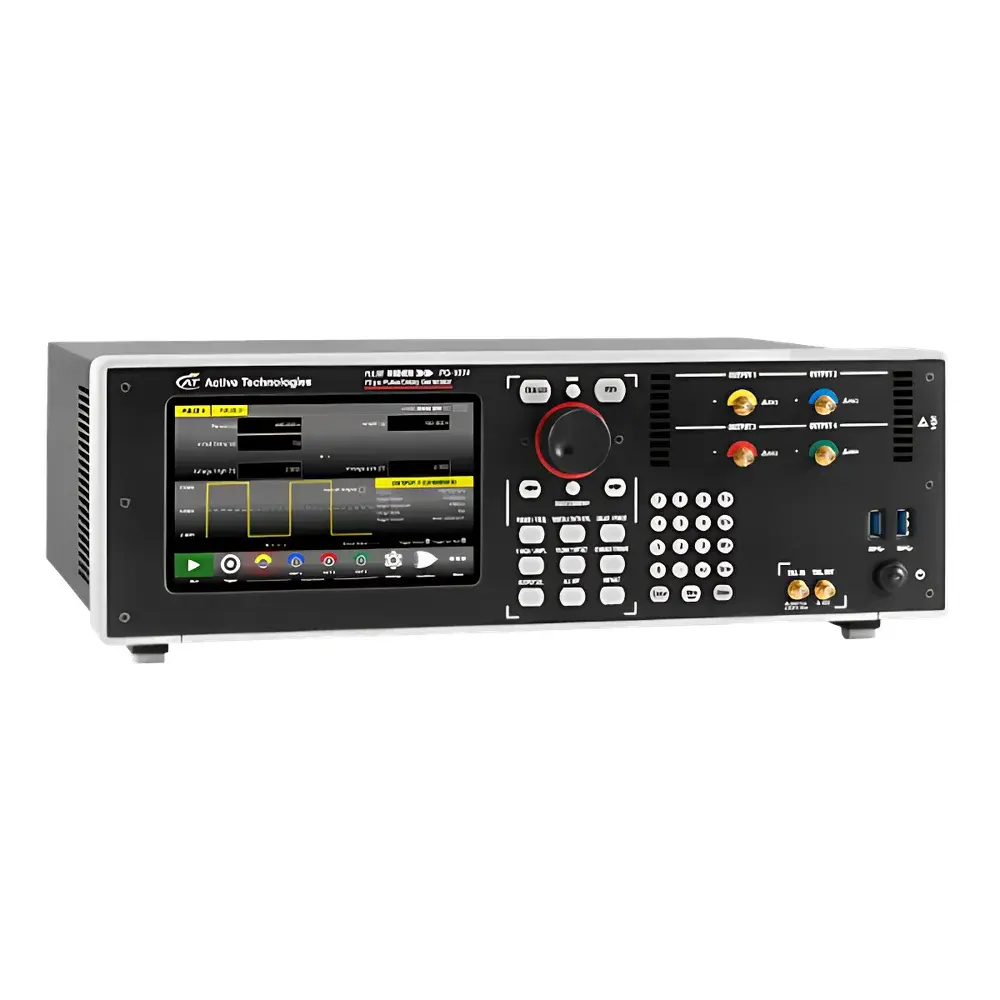
Active Technologies PG-1500 High-Amplitude Pulse Generator
| Brand | Active Technologies |
|---|---|
| Origin | Italy |
| Model | PG-1500 |
| Output Channels | 2 |
| Rise/Fall Time (20%–80%) | <400 ps |
| Adjustable Output Amplitude | 100 mVpp to 50 Vpp |
| Baseline Offset | ±25 V per channel |
| Max Repetition Rate | 400 MHz |
| Pulse Width Range | 1 ns to >1 s |
| Width Resolution | 10 ps |
| Trigger Jitter (Input to Output) | <30 ps RMS |
| Trigger Modes | Continuous, Single-Shot, Burst, Gated, External Trigger |
| External Clock Input/Output | Yes |
| Compliance | CE, RoHS |
Overview
The Active Technologies PG-1500 High-Amplitude Pulse Generator is a precision-engineered, dual-channel electronic instrument designed for demanding applications requiring ultrafast edge transitions, high-voltage pulse fidelity, and sub-nanosecond timing resolution. Based on a proprietary hardware architecture optimized for signal integrity, the PG-1500 generates clean, low-jitter pulses with rise/fall times under 400 ps (20%–80%), enabling accurate stimulation of wideband devices such as ultrafast photodetectors, electro-optic modulators, avalanche photodiodes, and high-speed semiconductor switches. Its core functionality centers on deterministic pulse synthesis—supporting arbitrary multi-pulse sequences (dual-, triple-, and quad-pulse) with fully independent timing control per pulse—making it particularly suitable for time-domain reflectometry, transient characterization, and pulsed laser driver applications where temporal accuracy and voltage stability are critical.
Key Features
- Dual independent output channels, each supporting amplitude (100 mVpp–50 Vpp), baseline offset (±25 V), and pulse width (1 ns–>1 s) adjustment
- Sub-400 ps rise/fall time with <30 ps RMS trigger jitter ensures minimal timing uncertainty in synchronized systems
- 10 ps pulse width resolution and 10 mV vertical amplitude resolution enable fine-grained parametric sweeps
- Flexible triggering: internal clock, external TTL/LVDS input, gated operation, and single-shot mode with programmable delay
- Integrated SimpleRider™ touchscreen interface for intuitive waveform configuration—no PC or scripting required for basic operation
- External clock I/O (SMA) supports system-level synchronization across multiple instruments in radar, LIDAR, or particle physics test benches
- Backward compatibility with legacy HP/Agilent pulse generators (e.g., 2214A, 214B, 8114A) via standard BNC outputs and compatible command syntax
Sample Compatibility & Compliance
The PG-1500 is engineered for direct interfacing with 50 Ω impedance environments typical in RF, microwave, and ultrafast optoelectronics laboratories. It delivers stable, non-loaded output into matched loads and includes built-in protection against reverse voltage and overcurrent conditions. The instrument complies with EU Directive 2014/30/EU (EMC Directive) and 2011/65/EU (RoHS), bearing the CE marking. While not certified for medical or aerospace-specific standards (e.g., DO-160, MIL-STD-461), its low phase noise floor, repeatable edge placement, and traceable calibration path make it suitable for R&D environments operating under GLP-aligned quality frameworks. For regulated testing workflows (e.g., semiconductor qualification per JEDEC JESD22-A118), users may implement external audit trails via optional SCPI-over-LAN logging and timestamped waveform export.
Software & Data Management
The PG-1500 supports full remote control via SCPI commands over USB, LAN (TCP/IP), and optional GPIB interfaces. A vendor-provided Windows/Linux-compatible software suite enables script-based sequence generation, real-time parameter sweeping, and batch export of pulse configurations in CSV and JSON formats. All internal settings—including channel-specific delay offsets, burst counts, and gate enable logic—are stored in non-volatile memory and survive power cycles. Firmware updates preserve user-defined presets and maintain backward compatibility with prior configuration files. For integration into automated test systems (ATE), the instrument supports IEEE 488.2-compliant error reporting and status byte polling, facilitating seamless interoperability with National Instruments TestStand and Keysight PathWave platforms.
Applications
- Ground-Penetrating Radar (GPR) Development: Generates high-amplitude, narrow-width pulses (1 ns @ 50 Vpp) essential for maximizing depth resolution and signal-to-clutter ratio in subsurface imaging systems used in civil engineering, archaeology, and defense applications.
- Semiconductor Device Characterization: Supports short-pulse (<10 ns) and slow-pulse (>100 µs) testing of MOSFETs, memristors, and NV-RAM cells—particularly for charge trapping analysis in high-k dielectrics under controlled bias conditions.
- LIDAR & Optical Systems: Serves as a flexible laser diode driver or electro-optic modulator trigger source, capable of producing precisely timed pulse trains up to 400 MHz for time-of-flight calibration and beam steering validation.
- Ultrafast Physics Experiments: Used to stimulate and gate photomultiplier tubes (PMTs), streak cameras, and superconducting nanowire single-photon detectors (SNSPDs) in nuclear, astrophysical, and quantum optics research facilities.
- Radar & EW System Validation: Emulates complex RF pulse signatures—including PRI-modulated bursts and staggered pulse trains—for receiver sensitivity testing and jammer effect evaluation in C4ISR labs.
FAQ
What is the maximum output voltage swing into a 50 Ω load?
The PG-1500 delivers up to 50 Vpp into a 50 Ω termination, with DC-coupled output and adjustable baseline offset from –25 V to +25 V.
Can the PG-1500 generate asynchronous pulses on both channels?
Yes—each channel operates independently with separate delay, width, amplitude, and trigger assignment, enabling true asynchronous multi-pulse synthesis.
Is the 10 ps width resolution achievable across the full 1 ns–1 s range?
The 10 ps resolution applies to pulse width, delay, and period settings within the instrument’s internal timing engine; actual output fidelity remains constrained by analog bandwidth and edge rate limitations at extreme duty cycles.
Does the PG-1500 support user-defined arbitrary waveforms?
No—it is a dedicated pulse generator optimized for rectangular, delayed, and multi-pulse sequences—not an arbitrary waveform generator (AWG). For arbitrary shapes, consider pairing with an external DAC-based system.
How is calibration maintained over time and temperature?
The PG-1500 incorporates temperature-compensated delay lines and auto-calibrating DAC references. Annual recalibration is recommended; traceable NIST-matched certificates are available upon request.