
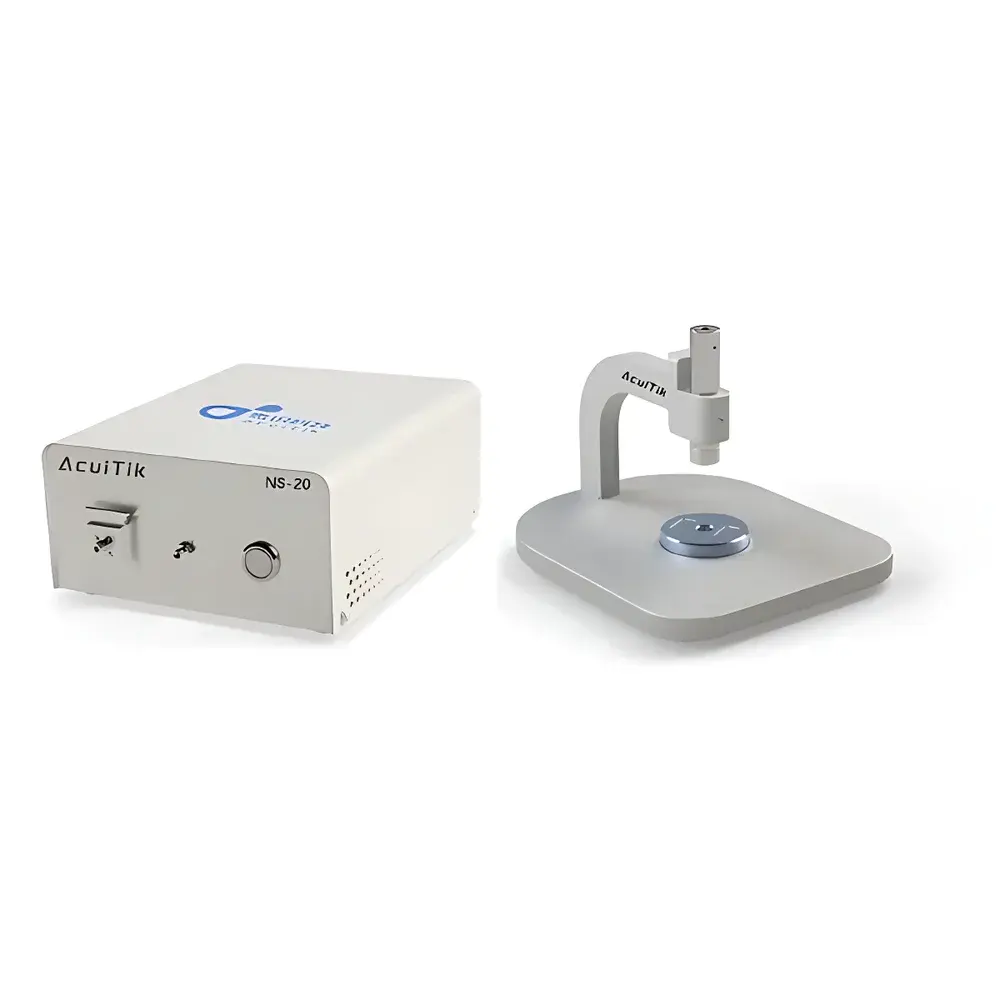
AcuiTik NS-20 Pro White Light Interferometric Photoresist Thickness Metrology System
| Brand | AcuiTik |
|---|---|
| Origin | Jiangsu, China |
| Manufacturer Type | Original Equipment Manufacturer (OEM) |
| Product Category | Domestic |
| Model | NS-20 Pro |
| Price | Upon Request |
| Wavelength Range | 400–700 nm (non-UV, non-actinic) |
| Measurement Range | 15 nm – 1.5 mm |
| Measurement Precision | < 0.02 nm (static repeatability) |
| Spot Size | Standard 0.2 mm (optional micro-spot configuration available) |
| Configuration Options | Benchtop, Portable, and In-Line Integration Capable |
Overview
The AcuiTik NS-20 Pro is a white light interferometric (WLI) thickness metrology system engineered specifically for non-destructive, in-situ measurement of photoresist films across semiconductor fabrication, MEMS development, and advanced packaging processes. Unlike conventional ellipsometers or contact profilometers, the NS-20 Pro operates within the visible spectrum (400–700 nm), deliberately excluding actinic UV wavelengths that induce unintended polymerization, crosslinking, or solvent evaporation in photosensitive resists. Its core principle relies on spectral-domain white light interferometry: broadband interference fringes generated at film–substrate and air–film interfaces are captured by a high-resolution spectrometer and decoded via Fourier-transform analysis to extract absolute optical thickness with sub-angstrom resolution. This enables quantitative, calibration-free determination of physical thickness (d), refractive index (n), and extinction coefficient (k) — critical parameters for process control in lithography stack design and post-apply bake (PAB) verification.
Key Features
- Non-actinic illumination: Full-spectrum visible-light source eliminates resist exposure risk—no latent image formation, no post-measurement development bias.
- Nanometer-scale precision: < 0.02 nm static repeatability verified under ISO 5725-2 conditions; traceable to NIST-traceable step-height standards.
- Broad dynamic range: Simultaneous capability for ultra-thin ( 100 µm) deep-UV or e-beam resists without hardware reconfiguration.
- Multi-layer optical modeling: Built-in thin-film solver supports up to 5-layer stacks with independent n(k, λ) dispersion models per layer (Cauchy, Sellmeier, or user-defined).
- Auto-focus & auto-alignment: Motorized Z-stage and centroid-based beam positioning ensure consistent probe placement—even on warped wafers or patterned substrates.
- Fully integrated hardware architecture: All-optical path components (interferometer head, spectrometer, LED source) are co-designed and factory-aligned to minimize thermal drift and vibration sensitivity.
Sample Compatibility & Compliance
The NS-20 Pro accommodates standard 100–300 mm silicon, glass, quartz, and compound semiconductor wafers—including those with reflective, transparent, or semi-transparent substrates (e.g., SiO₂/Si, ITO/glass, GaN/sapphire). It supports both bare and patterned surfaces, with robust signal recovery even on low-contrast structures (e.g., DUV resists on ARC layers). The system complies with ISO 9001:2015 manufacturing protocols and meets electromagnetic compatibility (EMC) requirements per IEC 61326-1. Data integrity conforms to FDA 21 CFR Part 11 guidelines through audit-trail-enabled software, electronic signatures, and role-based access control. Calibration certificates include uncertainty budgets aligned with GUM (JCGM 100:2008) methodology.
Software & Data Management
Controlled by AcuiTik’s PolarX™ metrology platform, the NS-20 Pro features a deterministic, scriptable workflow engine optimized for high-mix, low-volume R&D labs and high-throughput pilot lines. PolarX implements real-time fringe envelope detection, automatic peak identification, and physics-constrained nonlinear least-squares fitting—eliminating manual parameter initialization. Measurement reports export in CSV, XML, and PDF formats with embedded metadata (timestamp, operator ID, instrument serial number, environmental logs). Batch processing supports wafer maps with spatial trend analysis (e.g., edge exclusion, radial uniformity, within-wafer thickness variation). API integration (RESTful + Python SDK) enables direct linkage to MES, SPC systems, or custom AI-driven process monitoring dashboards.
Applications
- Pre- and post-exposure thickness verification in 193i, EUV, and nanoimprint lithography processes.
- Real-time monitoring of spin-coating uniformity and solvent evaporation kinetics during soft-bake.
- Quantitative evaluation of resist swelling behavior in developer solutions (in-situ immersion mode).
- Characterization of bilayer resist systems (e.g., PMMA/HSQ) where interfacial roughness and gradient n(k) profiles affect etch selectivity.
- Qualification of anti-reflective coatings (BARC, TARC) and hard masks (SiON, SiOC) in gate-last and CFET integration schemes.
- Support for DOE-driven process window studies requiring ≤ 0.1% thickness CV across > 500 measurement points per wafer.
FAQ
Does the NS-20 Pro require reference standards for daily calibration?
No—its self-referencing interferometric architecture eliminates the need for physical step standards. Daily verification uses internal wavelength-stabilized LED and built-in cavity-length references; full calibration is recommended annually or after major maintenance.
Can it measure on patterned wafers with dense topography?
Yes—the 0.2 mm spot size resolves features down to ~1.5× diffraction limit; optional micro-spot configurations (down to 50 µm) improve lateral resolution while maintaining SNR on structured surfaces.
Is the system compatible with cleanroom Class 100 environments?
All enclosure materials meet SEMI F27-0204 outgassing specifications; optional HEPA-filtered purge ports support ISO Class 5 integration.
How is data security enforced during remote operation?
PolarX employs TLS 1.3 encryption for all network communications; local database storage uses AES-256 encryption with FIPS 140-2 validated modules.
What level of technical support is provided for algorithm customization?
AcuiTik offers tiered engineering support packages, including access to PolarX source code modules (under NDA) for customers developing proprietary optical models or integrating third-party dispersion databases.



