
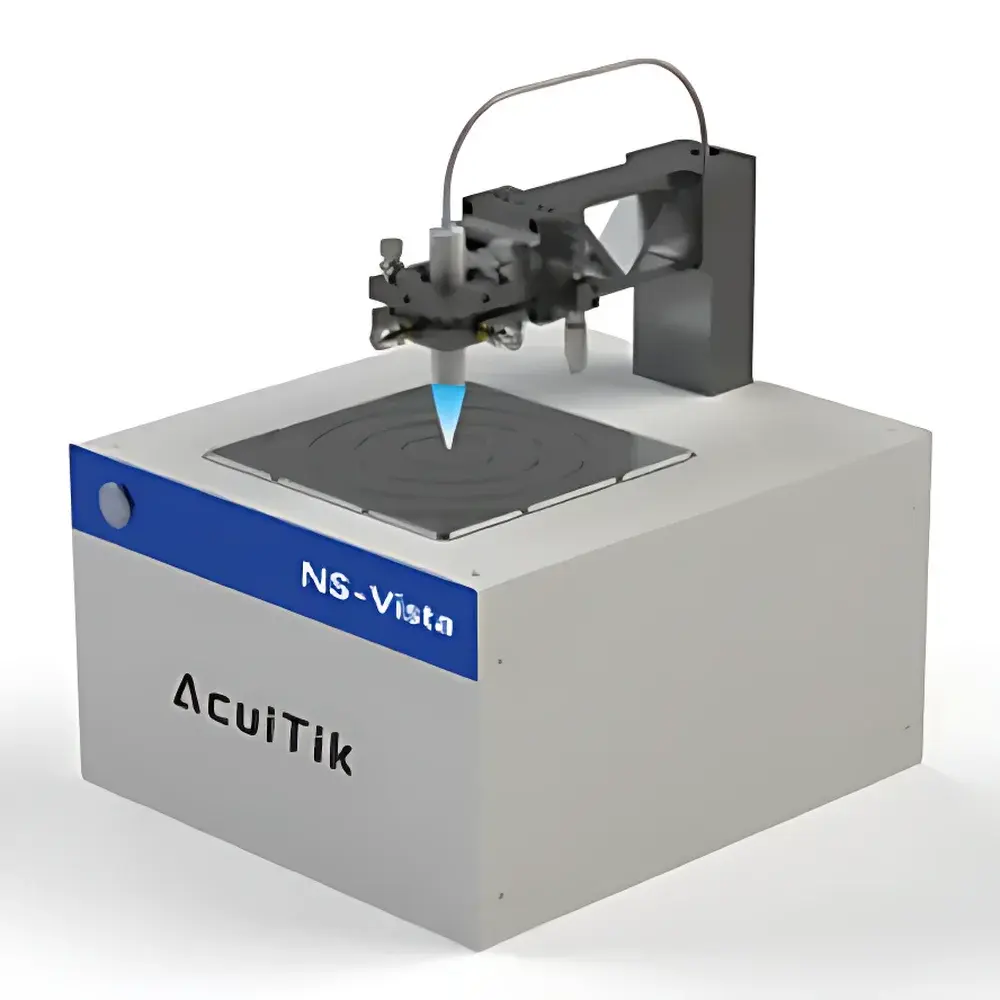
AcuiTik NS-Vista White Light Interferometric Thin-Film Thickness Measurement System
| Brand | AcuiTik |
|---|---|
| Origin | Shanghai, China |
| Manufacturer Type | Original Equipment Manufacturer (OEM) |
| Product Origin | Domestic (China) |
| Model | NS-Vista |
| Wavelength Range | 190–1700 nm |
| Thickness Measurement Range | 1 nm – 250 µm |
| Accuracy | ±1 nm or ±0.2% (UV configuration) |
| Precision | 0.02 nm (UV/Vis), 0.1 nm (NIR) |
| Stability | 0.05 nm (UV/Vis), 0.12 nm (NIR) |
| Spot Size | Adjustable from 0.2 mm to 1.5 mm |
| Measurement Speed | <1 s per acquisition |
| Light Source | Tungsten-halogen + Deuterium lamp (UV), Tungsten-halogen (Vis/NIR) |
| Sample Diameter Compatibility | 1 mm – 300 mm (or larger) |
Overview
The AcuiTik NS-Vista is a fully domestically developed, benchtop white light interferometric (WLI) thin-film thickness measurement system engineered for high-precision, non-contact optical characterization of transparent and semi-transparent multilayer coatings. It operates on the principle of spectral-domain white light interferometry: a broadband collimated beam (190–1700 nm) is vertically incident onto the sample surface, generating interference fringes from reflections at each dielectric interface. These spectral interferograms are captured by a high-resolution spectrometer and processed using physically constrained regression algorithms to extract layer thicknesses, refractive indices, and extinction coefficients—without requiring prior knowledge of material dispersion models. Unlike ellipsometry or stylus profilometry, the NS-Vista delivers absolute thickness values traceable to optical path difference (OPD) calibration, making it suitable for R&D validation, process monitoring, and quality control in photovoltaics, semiconductor packaging, optical filter manufacturing, and advanced display coating lines.
Key Features
- Fully indigenous hardware and software architecture—100% domestically designed and manufactured in Shanghai, ensuring full supply chain transparency and long-term technology sovereignty.
- Dual-channel simultaneous acquisition of reflectance and transmittance spectra, enabling robust thickness determination for both high-reflectivity (e.g., metal-dielectric stacks) and low-reflectivity (e.g., anti-reflective coatings on glass) samples.
- Three configurable optical modules (NS-Vista UV, NS-Vista, NS-Vista NIR) covering complementary spectral bands—190–1100 nm, 380–1050 nm, and 950–1700 nm—each optimized for specific material absorption and dispersion profiles.
- Vista Learning™ adaptive algorithm suite, trained on physically simulated and empirically validated multilayer interference datasets, enabling reliable convergence even on highly scattering, rough-surface (>100 nm Ra), or ultra-thick (>100 µm) films where conventional fitting fails.
- Motorized spot-size adjustment (0.2–1.5 mm diameter) with diffraction-limited focusing optics, supporting micro-area analysis on patterned wafers and macro-scale uniformity mapping across 300 mm substrates.
- Sub-angstrom static stability (0.02 nm RMS over 1 hour) achieved via passive thermal isolation, vibration-damped optical bench, and real-time reference channel normalization.
Sample Compatibility & Compliance
The NS-Vista accommodates rigid and flexible substrates—including silicon wafers, fused silica, sapphire, polymer films (PET, PI), ITO-coated glass, and OLED encapsulation layers—without mechanical contact or vacuum requirements. Its non-destructive nature preserves sample integrity for post-measurement electrical or reliability testing. The system complies with ISO 9001:2015 design control requirements and supports GLP/GMP documentation workflows through audit-trail-enabled software logging. All optical calibration artifacts are NIST-traceable, and spectral responsivity is verified per ASTM E275 and ISO 13697. For regulated environments, PolarX software includes 21 CFR Part 11-compliant electronic signatures, role-based access control, and immutable measurement history archiving.
Software & Data Management
PolarX—a proprietary cross-platform analysis suite—integrates spectral acquisition, multi-layer optical modeling (based on the transfer matrix method), and metrology reporting in a unified GUI. Key capabilities include: recipe-driven batch measurement with auto-alignment; “Formula Prediction & Validation” mode for rapid screening of unknown stack compositions; “Material Blending” module for constructing custom dispersion models from ellipsometric or literature data; and export of thickness maps (CSV, HDF5) compatible with JMP, Python (NumPy/Pandas), and MES systems. Raw interferograms and fitted residuals are stored with full metadata (timestamp, environmental conditions, instrument configuration), enabling retrospective root-cause analysis and inter-laboratory correlation studies.
Applications
- Photovoltaic R&D: Thickness and n/k mapping of SiNx, AlOx, and perovskite charge-transport layers on textured silicon.
- Semiconductor packaging: Cu diffusion barrier (Ta/TaN) and low-k dielectric film uniformity on fan-out wafer-level packages.
- Optical coating QC: Real-time verification of quarter-wave stacks in AR/HR filters, including stress-induced thickness drift during curing.
- Flexible electronics: In-line thickness monitoring of PEDOT:PSS and Ag nanowire electrodes on roll-to-roll coated PET.
- Biomedical device manufacturing: Quantification of hydrophilic PEG-based anti-fouling layers on microfluidic chips.
FAQ
Does the NS-Vista require vacuum or nitrogen purging for UV measurements?
No—its UV-optimized optical path uses fused silica transmission components and sealed spectrometer housing, enabling stable operation under ambient laboratory conditions down to 190 nm.
Can it measure absorbing or opaque films like metals or carbon-based layers?
Yes—by combining reflectance and transmittance data, the system constrains optical constants using Kramers-Kronig consistency, allowing thickness estimation of sub-10-nm metallic films on transparent substrates.
Is PolarX compatible with third-party LIMS or MES platforms?
Yes—PolarX provides RESTful API endpoints and OPC UA server support for bidirectional integration with enterprise manufacturing execution systems.
What calibration standards are supplied with the system?
Each NS-Vista ships with a certified SiO₂-on-Si reference wafer (NIST-traceable thickness), a fused silica transmission standard, and a set of calibrated neutral density filters for spectral responsivity verification.
How is measurement repeatability verified across different operators?
PolarX enforces standardized SOPs via locked measurement templates, operator ID logging, and automated pass/fail criteria based on residual error thresholds and confidence intervals derived from Cramér-Rao bounds.



