
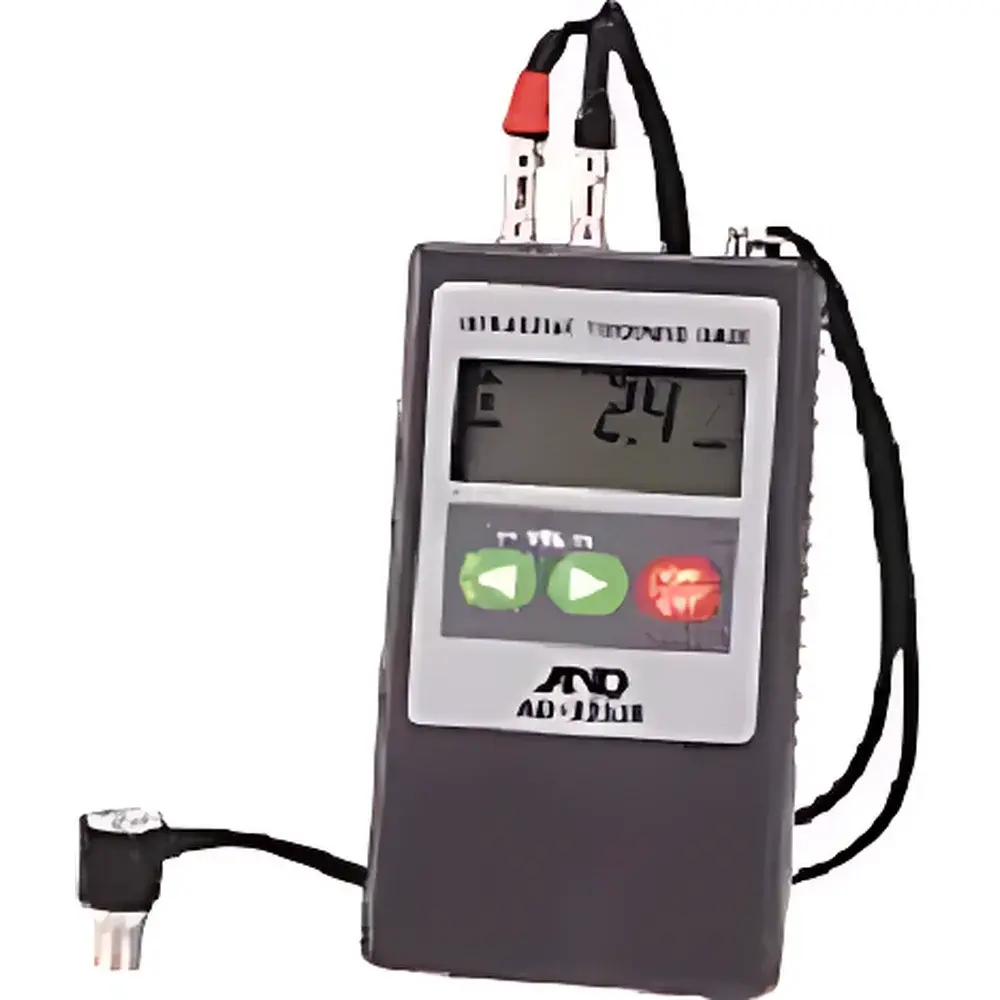
A&D AD-3253 / AD-3253B Ultrasonic Thickness Gauge
| Brand | A&D |
|---|---|
| Origin | Japan |
| Manufacturer | A&D Co., Ltd. |
| Type | Imported Instrument |
| Model | AD-3253 / AD-3253B |
| Thickness Range | 0.8–100 mm (AD-3253: 2–200 mm) |
| Accuracy | ±0.1 mm |
| Weight | 180 g |
| Power | Single AA alkaline battery |
| Battery Life | >30 h continuous operation (at 25°C, 5 mm steel sample) |
| Auto Power-Off | After 5 min idle |
| Display | Backlit LCD |
| Units | mm / inch selectable |
| Sound Velocity Input | Adjustable via keypad, stored non-volatile memory |
| Calibration | Single-point material calibration for velocity determination |
| Standard Accessories | Protective leather case, 5 mm calibration block, instruction manual, probe holder (AD-3252 only), dual probe (optional) |
Overview
The A&D AD-3253 and AD-3253B are precision ultrasonic thickness gauges engineered for non-destructive evaluation (NDE) of solid materials in industrial quality control, maintenance inspection, and laboratory settings. Based on the pulse-echo principle, these instruments transmit a high-frequency ultrasonic pulse (typically 5 MHz) into the test material via a piezoelectric transducer; the time-of-flight between the initial pulse and the echo reflected from the back surface is measured and converted to thickness using the known acoustic velocity of the material. Designed specifically for lightweight portability and operational simplicity, the AD-3253/3253B delivers reliable, repeatable measurements across a broad range of engineering materials—including carbon steel, stainless steel, cast iron, aluminum, copper, ceramics, glass, and rigid plastics—without requiring surface preparation beyond basic coupling.
Key Features
- High-resolution measurement capability with ±0.1 mm accuracy across the specified thickness range (0.8–100 mm for AD-3253B; 2–200 mm for AD-3253), suitable for thin-wall tubing, sheet metal, and coated substrates.
- Compact, ergonomic design weighing only 180 g—optimized for extended handheld use during field inspections or production line audits.
- Non-volatile sound velocity memory: Acoustic velocity values (m/s) can be entered and retained indefinitely—even after battery replacement—enabling rapid reconfiguration for multi-material workflows.
- Intuitive single-point calibration: Users determine unknown material velocity by measuring a reference sample of known thickness, allowing automatic velocity calculation and subsequent thickness reporting without external instrumentation.
- Backlit LCD display with dual-unit support (mm/inch), clearly presenting real-time thickness readings and current velocity setting.
- Intelligent power management: Automatic shutdown after 5 minutes of inactivity extends battery life; low-battery indicator provides ≥60 minutes of residual operation post-alert.
Sample Compatibility & Compliance
The AD-3253/3253B is validated for use on homogeneous, isotropic solids with parallel front and back surfaces. It supports common industrial materials per ASTM E797-22 (Standard Practice for Measuring Thickness by Manual Ultrasonic Pulse-Echo Contact Method) and complies with general requirements for portable NDT equipment under ISO 2400:2018 (Ultrasonics — Vocabulary). While not certified for intrinsically safe environments or explosive atmospheres, its robust housing meets IP54-rated ingress protection against dust and water splashes. The device does not require regulatory registration under FDA 21 CFR Part 820 or EU MDR for thickness verification applications, though it may serve as a supporting tool in GLP/GMP-compliant corrosion monitoring programs when used with documented calibration procedures and traceable reference standards.
Software & Data Management
The AD-3253/3253B operates as a standalone instrument with no embedded data logging or PC connectivity. All measurements are displayed in real time and must be manually recorded. However, its deterministic measurement algorithm ensures high inter-operator reproducibility—critical for audit-ready documentation in QA/QC processes. For integration into digital inspection workflows, users may pair the gauge with external barcode scanners or mobile data capture systems using standardized visual readouts. Velocity parameters and unit preferences are retained in non-volatile memory, eliminating recalibration drift between sessions and supporting consistent adherence to internal SOPs.
Applications
- Corrosion mapping of pipelines, pressure vessels, and storage tanks in oil & gas, chemical processing, and power generation facilities.
- In-process thickness verification of rolled sheet metal, extruded profiles, and injection-molded plastic components.
- Quality assurance testing of anodized aluminum, ceramic coatings, and laminated composites where substrate integrity must be confirmed without sectioning.
- Educational demonstration of ultrasonic wave propagation principles in materials science and NDT training curricula.
- Maintenance inspection of marine hulls, aircraft skins, and rail infrastructure where weight and portability are operational constraints.
FAQ
What materials can the AD-3253/3253B measure?
It measures thickness in metals (e.g., steel, aluminum), plastics, ceramics, glass, and other solid, non-porous materials with smooth, parallel surfaces.
Does it require couplant?
Yes—a water-based or glycerin couplant is required to ensure efficient ultrasonic energy transfer between the transducer and test surface.
How is acoustic velocity calibrated for unknown materials?
Using a single reference sample of known thickness and identical composition, the instrument calculates and stores the appropriate velocity value automatically.
Is the device compatible with ASTM or ISO thickness measurement standards?
Yes—it conforms to the fundamental methodology outlined in ASTM E797-22 and ISO 2400:2018 for manual contact ultrasonic thickness gauging.
Can measurement data be exported or stored internally?
No—the device lacks internal memory or digital output ports; all results must be recorded externally.





