
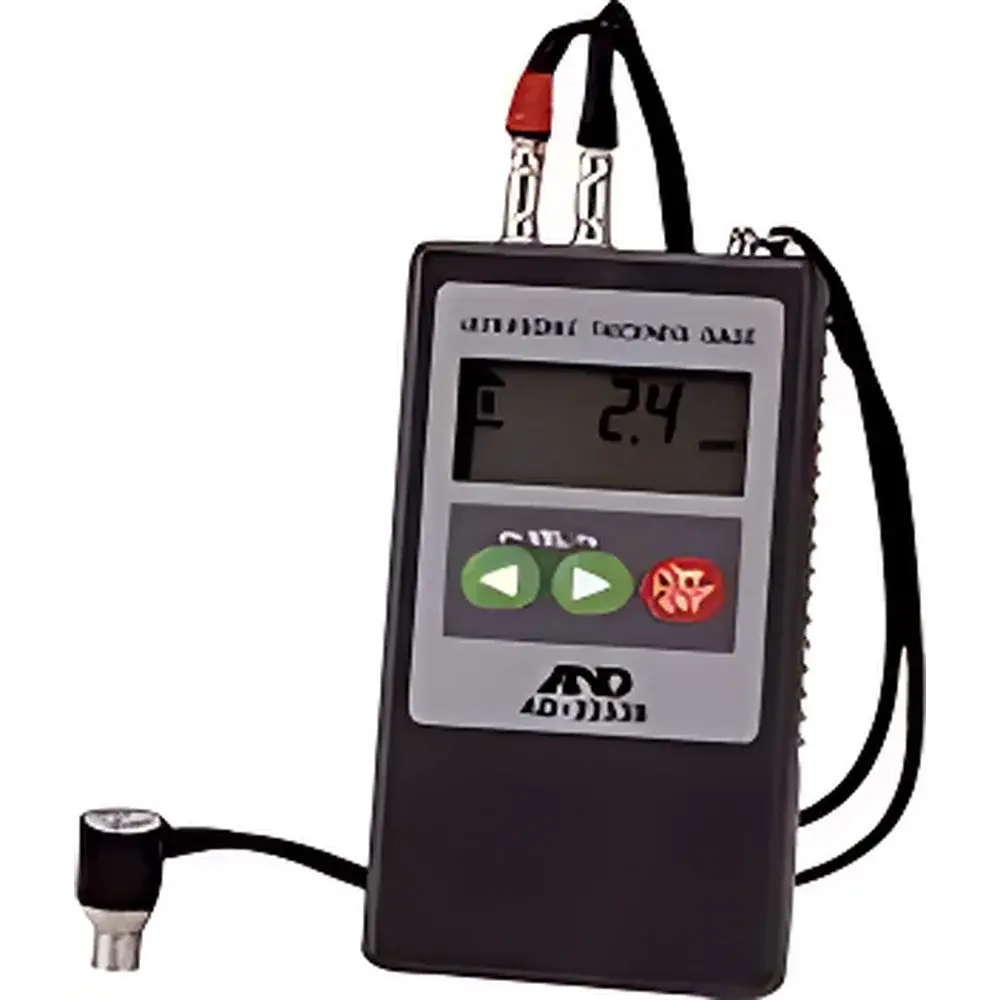
A&D AD-3253 / AD-3253B Ultrasonic Thickness Gauge
| Brand | A&D |
|---|---|
| Origin | Japan |
| Model | AD-3253 / AD-3253B |
| Measurement Principle | Ultrasonic Pulse-Echo |
| Thickness Range (AD-3253) | 2.0–200.0 mm |
| Thickness Range (AD-3253B) | 0.8–100.0 mm |
| Accuracy | ±0.1 mm ±1.0% (AD-3253, 2–100 mm) / ±0.1 mm ±0.5% (AD-3253B, 0.8–40 mm) |
| Resolution | 0.1 mm |
| Display | LCD |
| Units | mm / inch |
| Sound Velocity Adjustment | Yes |
| Sampling Rate | 4 Hz |
| Operating Temperature | 0°C to 50°C |
| Power | 2 × AA alkaline batteries |
| Battery Life | ~30 hours |
| Weight | 180 g |
| Dimensions | 68 × 120 × 27 mm |
Overview
The A&D AD-3253 and AD-3253B are precision handheld ultrasonic thickness gauges engineered for non-destructive evaluation (NDE) of solid materials using the pulse-echo measurement principle. These instruments transmit high-frequency ultrasonic pulses (5 MHz nominal frequency) into a test specimen and precisely time the interval between the initial pulse and its reflection from the back surface. By applying the known or calibrated sound velocity in the material, the device calculates and displays thickness with traceable accuracy—enabling reliable wall thickness assessment, corrosion monitoring, and quality assurance across industrial, maintenance, and laboratory environments.
Key Features
- Compact ergonomic design weighing only 180 g—optimized for extended field use without operator fatigue
- Intuitive one-button operation: automatic zero calibration on known reference surfaces followed by immediate thickness readout upon probe contact
- High-contrast LCD display showing real-time thickness value and current sound velocity setting simultaneously
- User-adjustable sound velocity (range: 1000–9999 m/s) via up/down keys; settings retained through power cycles and battery replacement
- Two selectable measurement units (mm or inch) with seamless toggle functionality
- Low-battery warning indicator provides ≥60 minutes of remaining operational time after activation
- Auto-power-off after 5 minutes of inactivity—extends battery life to approximately 30 hours per set of two AA alkaline cells
- Dual-model configuration: AD-3253 optimized for thicker sections (2.0–200.0 mm), AD-3253B for high-resolution thin-wall applications (0.8–100.0 mm)
Sample Compatibility & Compliance
The AD-3253/3253B is validated for consistent performance on homogeneous, isotropic solids with parallel front and back surfaces. Compatible materials include carbon steel, stainless steel, cast iron, aluminum, titanium, copper, brass, glass, ceramics, and engineering plastics—including polyethylene, PVC, and ABS. Surface roughness, curvature, and acoustic coupling significantly influence measurement repeatability; therefore, proper couplant application and transducer alignment are essential per ASTM E797 and ISO 2400 standards for ultrasonic thickness testing. While not certified for intrinsically safe environments, the gauge meets IEC 61010-1 safety requirements for portable electrical measuring equipment. Its firmware architecture supports manual documentation workflows aligned with GLP and basic GMP traceability protocols—though it does not include FDA 21 CFR Part 11-compliant electronic signature or audit trail features.
Software & Data Management
These models operate as standalone, embedded-system instruments with no onboard data logging or PC connectivity. All measurements are displayed in real time but are not stored internally. For traceable recordkeeping, users must manually transcribe readings or integrate optional accessories such as the A&D color thermal printer (model CP-100) or analog chart recorder interfaces. Sound velocity calibration can be performed using a reference sample of known thickness—enabling rapid adaptation to unknown materials without external software. This architecture prioritizes robustness, simplicity, and regulatory transparency over digital feature bloat—making it suitable for auditable QA/QC processes where minimal validation overhead is required.
Applications
- Corrosion mapping and remaining wall thickness assessment in pipelines, pressure vessels, and storage tanks
- In-service inspection of aircraft skins, engine components, and structural welds
- Manufacturing process control for extruded tubing, rolled plate, and molded plastic housings
- Quality verification of coated substrates (e.g., paint + metal) when combined with dual-element transducers (optional)
- Field verification of anodized layer thickness on aluminum alloys (with appropriate velocity calibration)
- Academic and vocational training in NDT fundamentals and material property relationships
FAQ
What is the difference between the AD-3253 and AD-3253B models?
The AD-3253B has enhanced sensitivity for thinner materials, with a lower measurement limit of 0.8 mm and improved accuracy (±0.5%) in the 0.8–40 mm range. The AD-3253 starts at 2.0 mm and offers broader upper-range capability up to 200.0 mm.
Can this gauge measure through coatings or paint layers?
No—it measures total thickness from front surface to back surface. Paint or coating layers will be included in the reading unless a dual-element transducer (sold separately) and appropriate setup are used to isolate substrate thickness.
Is sound velocity calibration required for every new material?
Yes. Accurate thickness calculation depends on correct sound velocity input. A single-point calibration using a reference sample of known thickness is sufficient for homogeneous materials.
Does the instrument support temperature compensation?
No. It does not incorporate real-time temperature sensing or automatic velocity correction. Users must apply empirical corrections if operating outside 20°C ±5°C ambient conditions.
Are calibration certificates available?
A&D provides factory calibration documentation upon request. Field recalibration requires traceable reference blocks and adherence to ISO 16949 or ASTM E797 procedures—typically performed by accredited metrology service providers.



