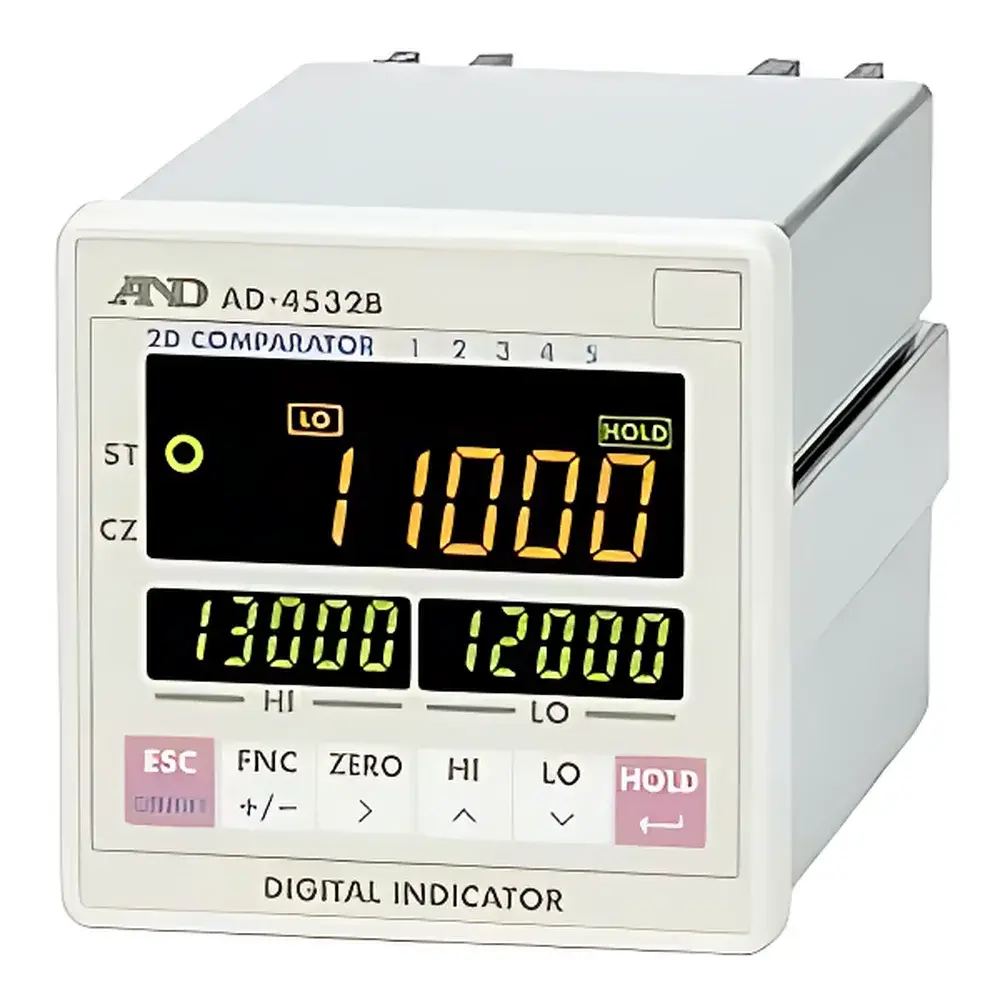
A&D AD-4532B Strain Gauge Digital Indicator
| Brand | A&D |
|---|---|
| Origin | Japan |
| Model | AD-4532B |
| Input Impedance Compatibility | <10 kΩ |
| Excitation Voltage Options | 5 V (up to four 350 Ω sensors) or 2.5 V (up to four 120 Ω or eight 350 Ω sensors) |
| Calibration | Digital calibration (sensor sensitivity input) or physical load calibration |
| Zero Adjustment Range | ±50% of full-scale output voltage |
| Span Adjustment Range | ±0.25 mV/V to ±3 mV/V |
| Minimum Input Sensitivity | 0.6 µV/d |
| Minimum Display Resolution | 0.12 µV/d |
| Maximum Display | ±999999 |
| Linearity | 0.02% F.S. (within ±1 digit) |
| A/D Conversion Rate | 2000 samples/sec |
| Zero Temperature Coefficient | ±0.5 µV/°C (typ.) |
| Span Temperature Coefficient | ±30 ppm/°C (typ.) |
| Display | 6-digit, 7-segment LED (14 mm height) |
| Keypad | 6 keys |
| Comparison Output | HI/OK/LO relay contacts (0.1 A, 250 V AC) or MOSFET outputs (0.5 A, 30 V DC) |
| Hold Modes | Sample hold, peak hold, valley hold, bipolar hold |
| Analog Amplified Output | ±10 V (fixed at 3.2 mV/V sensitivity), linearity 0.05% F.S., tempco 100 ppm/°C |
| D/A Output | ±10 V, resolution 1/10000, tempco 100 ppm/°C |
| Communication | Modbus-RTU (RS-485) |
| Power Supply | 85–250 V AC, 50/60 Hz, ~20 W |
| Operating Environment | –5 to +40 °C, ≤85% RH (non-condensing) |
| Dimensions (W×H×D) | 96 × 96 × 155 mm |
| Panel Cutout | 92 × 92 mm |
| Optional Interfaces | BCD (AD-4532B-01), RS-232C (AD-4532B-04), ±10 V / 4–20 mA D/A (AD-4532B-07), Ethernet (AD-4532B-08) |
Overview
The A&D AD-4532B Strain Gauge Digital Indicator is a high-speed, precision measurement interface engineered for industrial and laboratory environments requiring real-time, high-fidelity acquisition from analog strain gauge transducers. Designed around a robust 24-bit sigma-delta A/D architecture, the AD-4532B delivers up to 2000 stable measurements per second—enabling accurate dynamic monitoring of transient mechanical phenomena including load, pressure, torque, tension, and vibration-induced strain responses. Its core functionality centers on converting low-level mV/V signals (ranging from ±0.25 to ±3 mV/V) into calibrated, high-resolution digital values with a display range of ±999999 and an inherent linearity of 0.02% full scale. The unit supports both 5 V and 2.5 V excitation modes, allowing flexible configuration for mixed-sensor arrays—up to four 350 Ω sensors at 5 V, or eight 350 Ω (or four 120 Ω) sensors at 2.5 V—while maintaining signal integrity under varying load-cell impedances (<10 kΩ). As a dedicated signal conditioner and display terminal—not a standalone weighing controller—the AD-4532B serves as a critical node in closed-loop test benches, fatigue testing rigs, and automated QC stations where traceable, deterministic analog-to-digital conversion is required.
Key Features
- Ultra-high-speed sampling: 2000 A/D conversions per second with synchronous D/A output capability for real-time feedback control loops.
- Dual-mode excitation selection: Software-switchable 5 V or 2.5 V excitation, optimized for sensor count and bridge impedance matching.
- Advanced 2D five-segment comparator: Enables time- or event-triggered sequential thresholding across five independent zones—ideal for ramped load profiles, creep tests, or pass/fail verification against evolving specification limits.
- Multi-mode hold functions: Front-panel, external TTL trigger, or Modbus-RTU command activation for sample, peak, valley, and bipolar hold—ensuring capture of extremal values without software dependency.
- Hysteresis and debounce configuration: Programmable deadband width and delay time to suppress relay chatter or false triggering near limit boundaries—a necessity in noisy industrial electrical environments.
- Digital calibration workflow: Eliminates reliance on physical test weights; users input nominal sensor sensitivity (e.g., 2.0 mV/V) directly via keypad for rapid span setup and zero offset compensation.
- Redundant output interfaces: Standard ±10 V amplified analog output and isolated ±10 V D/A channel, plus configurable HI/LO/OK discrete outputs using either electromechanical relays or solid-state MOSFETs (0.5 A, 30 V DC).
Sample Compatibility & Compliance
The AD-4532B interfaces exclusively with passive, full-bridge strain gauge sensors meeting standard Wheatstone bridge specifications: nominal output sensitivity between 0.25 and 3 mV/V, bridge resistance of 120 Ω or 350 Ω, and output impedance below 10 kΩ. It does not support active sensors (e.g., 4–20 mA transmitters) or digital-output load cells (e.g., TEDS-enabled devices). While the unit itself carries no formal certification for hazardous locations or medical use, its design adheres to IEC 61000-4 immunity standards for electrostatic discharge (ESD), fast transients (EFT), and conducted RF disturbances—verified during A&D’s internal EMC validation. For regulated industries, the Modbus-RTU interface supports audit-ready parameter logging (zero, span, limits, hysteresis) when integrated with SCADA systems compliant with FDA 21 CFR Part 11 requirements for electronic records and signatures—provided the host system implements appropriate user authentication, change tracking, and data integrity safeguards.
Software & Data Management
The AD-4532B operates as a Modbus-RTU slave device (RS-485, default address 1, 9600 bps, 8N1), exposing over 60 register-mapped parameters—including real-time measurement value, status flags, comparator thresholds, hold mode state, and calibration coefficients. All front-panel operations (zero set, span adjust, limit entry, hysteresis configuration) are fully replicable via Modbus function codes 03 (read holding registers) and 06/16 (write single/multiple registers), enabling centralized configuration and remote diagnostics in PLC- or PC-based control architectures. No proprietary software is required; standard Modbus utilities (e.g., QModMaster, Simply Modbus) suffice for commissioning and troubleshooting. The unit maintains no internal non-volatile storage for historical data—it functions strictly as a real-time interface. Persistent data logging must be handled externally by the master controller or SCADA historian. Optional Ethernet (AD-4532B-08) and RS-232C (AD-4532B-04) modules extend connectivity but do not alter the core register map or introduce additional protocols.
Applications
- Dynamic tensile and compression testing: Captures rapid load transitions in materials testing machines where conventional indicators undersample critical inflection points.
- Production-line force verification: Integrates with pneumatic/hydraulic actuators to validate assembly torque, crimp force, or spring compression within tight statistical process control (SPC) bands.
- Vibration-sensitive weighing: Used in conveyor belt scales or hopper load cells where mechanical resonance demands >1 kHz sampling to resolve true static load amid oscillatory noise.
- Calibration lab reference interface: Serves as a traceable readout for verifying sensor linearity and repeatability per ISO 376 or ASTM E4 procedures—leveraging its 0.02% F.S. linearity and temperature-stable analog outputs.
- Research-grade instrumentation: Paired with custom-built transducers (e.g., micro-strain gauges on MEMS structures), the AD-4532B provides deterministic timing and sub-microvolt resolution for academic mechanical characterization studies.
FAQ
Can the AD-4532B be used with load cells rated for 1 mV/V sensitivity?
Yes. The unit accepts any strain gauge sensor with output sensitivity between ±0.25 mV/V and ±3 mV/V—covering the full range of standard industrial and laboratory load cells.
Is it possible to disable the front-panel keypad during automated operation?
Yes. The key lock function prevents accidental parameter changes while preserving all Modbus-RTU and external trigger capabilities.
Does the 2000 Hz sampling rate apply to all output channels simultaneously?
The A/D converter samples the analog input at 2000 Hz; derived outputs (display, analog voltage, Modbus register updates) operate at the same effective rate, though minor latency may occur in serial communication due to protocol overhead.
Can multiple optional interface modules be installed at once?
No. Only one optional module (AD-4532B-01, -04, -07, or -08) may be installed concurrently due to shared bus resource constraints on the rear expansion connector.
What is the accuracy impact of operating at 40 °C ambient temperature?
At maximum rated temperature (40 °C), zero drift contributes up to ±2 µV total (±0.5 µV/°C × 40 °C), and span drift adds approximately ±120 ppm (±30 ppm/°C × 40 °C)—well within the specified 0.02% F.S. linearity envelope for most applications.