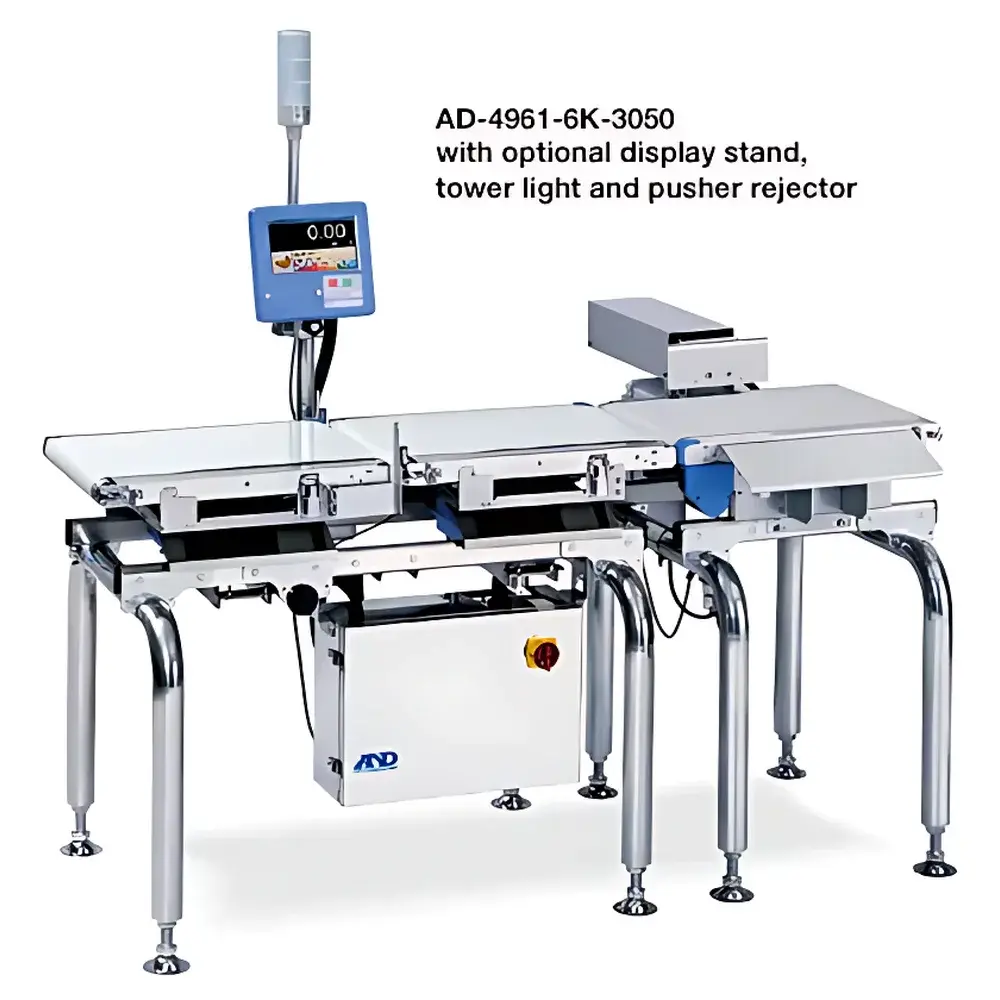
A&D AD-4961-6K-3035 High-Speed Checkweigher System
| Brand | A&D |
|---|---|
| Origin | Japan |
| Model | AD-4961-6K-3035 |
| Construction | Stainless Steel Frame |
| Drive Mechanism | Direct Gear Motor Transmission |
| Communication Interface | Standard Modbus RTU/TCP |
| Modular Architecture | Feed Conveyor Unit, Weighing Conveyor Unit, Control Unit, Frame Assembly |
| Maintenance Design | Hot-Swappable Functional Modules |
| Compliance | Designed for ISO 22000, HACCP, and GMP-aligned food/pharma production environments |
Overview
The A&D AD-4961-6K-3035 is a modular, high-speed checkweigher system engineered for precision weight verification and dynamic product sorting in regulated manufacturing environments. Based on load cell–based dynamic weighing principles, the system operates under continuous motion—measuring individual items as they traverse the dedicated weighing conveyor at line speed—without requiring mechanical stoppage or dwell time. Its architecture adheres to industrial metrology standards for dynamic mass measurement (aligned with OIML R51 and ASTM E178 for repeatability assessment), delivering consistent accuracy across variable throughput conditions. Designed specifically for food, pharmaceutical, nutraceutical, and consumer packaged goods (CPG) lines, the AD-4961-6K-3035 integrates seamlessly into end-of-line packaging workflows where compliance with weight labeling regulations (e.g., EU Directive 2009/22/EC, U.S. NIST Handbook 133) is mandatory.
Key Features
- Modular four-unit configuration: independently serviceable feed conveyor, high-stability weighing conveyor, embedded control unit, and rigid stainless-steel frame—enabling rapid field-level diagnostics and replacement without system-wide shutdown.
- Direct gear motor drive system: eliminates belt slippage and tension variability, ensuring stable conveyor velocity and repeatable dwell time over the load cell zone—critical for minimizing dynamic weighing error.
- IP65-rated stainless-steel construction (AISI 304): fully washdown-compatible; smooth, crevice-free surfaces meet EHEDG and FDA 21 CFR Part 110 hygienic design requirements for wet-process environments.
- Factory-installed Modbus RTU/TCP interface: enables bidirectional communication with PLCs, SCADA systems, or MES platforms for real-time command execution (e.g., start/stop weighing, change setpoints, trigger reject logic) and automated data logging.
- Tool-free conveyor maintenance: quick-release mechanisms allow full disassembly of the weighing belt assembly in under 90 seconds—reducing mean time to repair (MTTR) by >70% compared to fixed-frame alternatives.
Sample Compatibility & Compliance
The AD-4961-6K-3035 accommodates rigid and semi-rigid packaged products ranging from 30 g to 6 kg, with dimensions up to 303 mm × 350 mm (L × W). It supports standard cartons, trays, pouches, bottles, blister packs, and metalized or foil-wrapped units—provided surface stability permits uninterrupted conveyance. The system complies with electromagnetic compatibility (EMC) per IEC 61326-1, safety certification per IEC 61000-6-2/6-4, and carries CE marking for machinery directive 2006/42/EC. For regulated industries, its deterministic communication protocol and non-volatile event logging support audit readiness under FDA 21 CFR Part 11 (electronic records/signatures) and EU Annex 11 (computerized systems validation).
Software & Data Management
While the AD-4961-6K-3035 operates autonomously via its embedded controller, its Modbus interface allows integration with third-party supervisory software (e.g., Ignition, Siemens WinCC, or custom Python-based dashboards) for centralized data aggregation. Weight histograms, pass/fail statistics, trend analysis, and batch-level summary reports can be exported in CSV or XML format. All weigh events—including timestamps, raw ADC values, temperature-compensated results, and reject triggers—are timestamped and stored locally for ≥30 days, satisfying GLP/GMP data retention expectations. No proprietary software license or cloud dependency is required for basic operation or data retrieval.
Applications
- Food processing: verification of filled pouches, canned goods, frozen entrées, and bakery trays prior to case packing.
- Pharmaceutical secondary packaging: weight-based integrity checks for blister cards, vial trays, and serialized cartons under ALCOA+ data integrity principles.
- Consumer electronics: detection of missing components (e.g., cables, manuals, adapters) in retail-ready kits.
- Chemical and agrochemicals: confirmation of net content in HDPE pails, jerry cans, and laminated sachets subject to national metrological oversight.
- Contract manufacturing: deployment in shared facilities where rapid reconfiguration between SKUs—enabled by modular hardware and programmable setpoints—is essential.
FAQ
What is the maximum allowable product width for stable weighing on the AD-4961-6K-3035?
The weighing conveyor supports products up to 350 mm wide; exceeding this dimension may compromise lateral stability and load cell signal fidelity.
Does the system include built-in statistical process control (SPC) functionality?
No—SPC calculations are performed externally via connected HMIs or MES platforms leveraging the Modbus-exported weight stream; the onboard controller provides only pass/fail output and raw weight data.
Can the weighing conveyor operate at variable speeds synchronized with upstream equipment?
Yes—the Modbus interface accepts external speed commands (0–10 V or 4–20 mA analog input optional via add-on module), enabling closed-loop synchronization with fillers or cappers.
Is calibration traceable to national standards?
Field calibration uses certified test weights traceable to JCSS (Japan Calibration Service System); factory calibration certificates include uncertainty budgets compliant with ISO/IEC 17025.
How is firmware updated in validated environments?
Firmware updates require offline loading via USB; version history, checksums, and change logs are provided in advance to support change control documentation per GAMP 5 guidelines.