
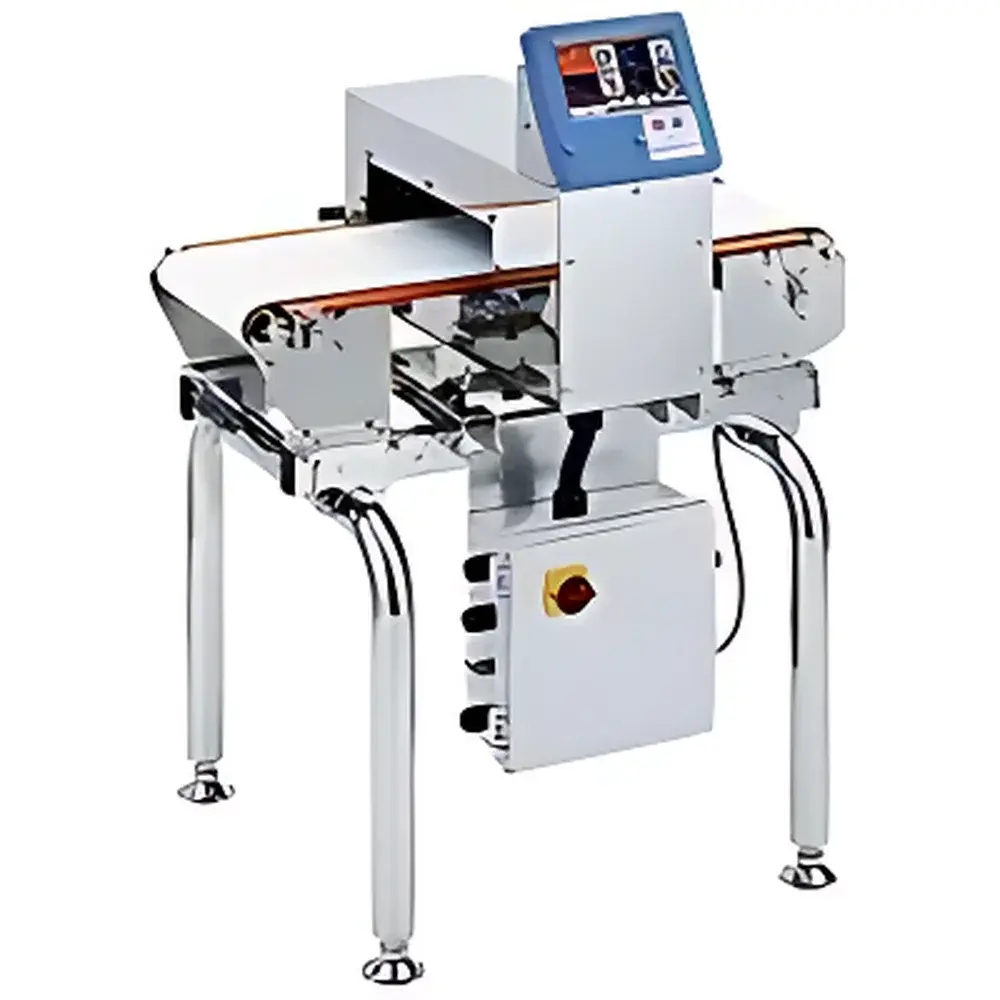
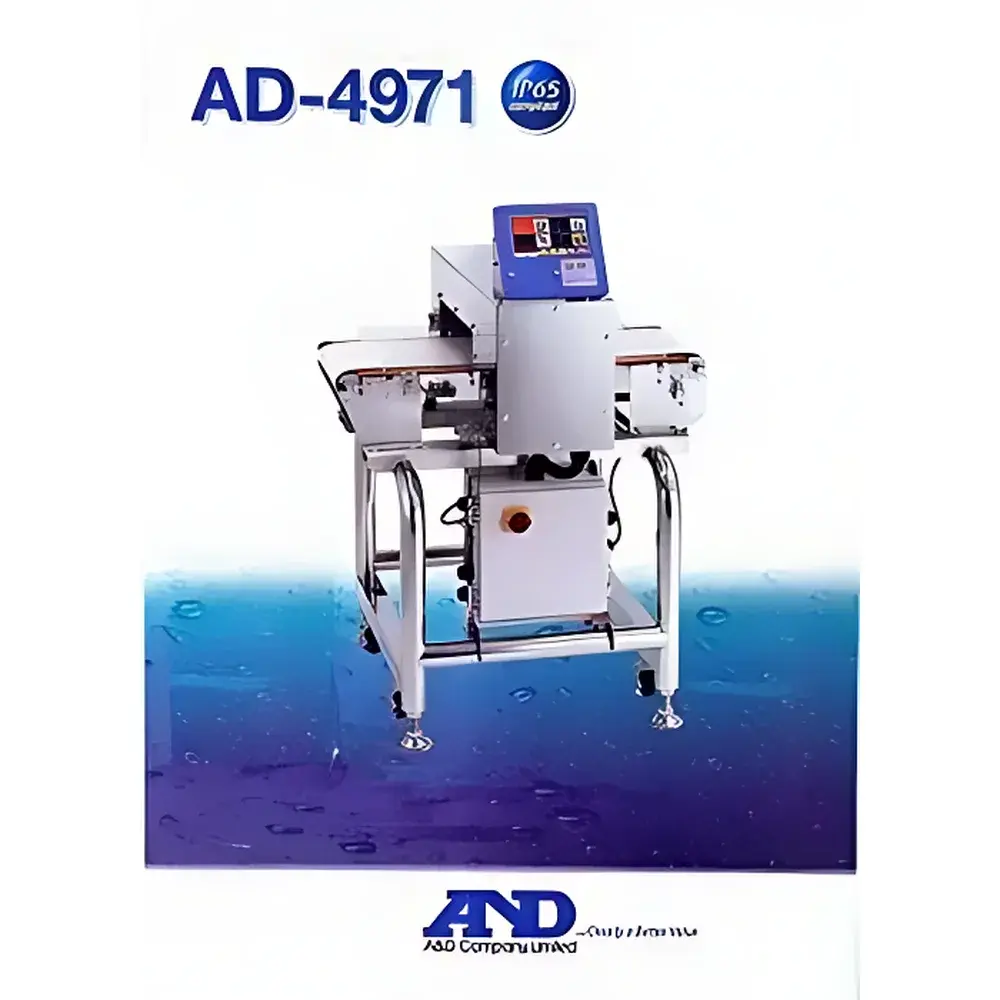
A&D AD-4971-E Metal Detection and Rejection System
| Brand | A&D |
|---|---|
| Origin | Japan |
| Model | AD-4971-E |
| Detection Sensitivity | Fe Ø0.3 mm / SUS Ø0.8 mm |
| Aperture Width | 350 mm |
| Aperture Height Options | 100 mm / 170 mm / 250 mm |
| Through-Height Options | 80 mm / 150 mm / 230 mm |
| Conveyor Belt Width | 250 mm |
| Conveyor Length | 800 mm |
| Display | 7-inch WVGA Color Touchscreen |
| IP Rating | IP65 |
| Communication | Standard Modbus RTU/TCP |
| Data Export | Ethernet + USB (PDF/Chart) |
| Product Memory | 1,000 Recipes |
| Construction | Stainless Steel Frame |
| Drive Mechanism | Direct Gear Drive |
Overview
The A&D AD-4971-E Metal Detection and Rejection System is an industrial-grade, high-sensitivity electromagnetic induction-based metal detection platform engineered for continuous in-line inspection of bulk and packaged products across food, pharmaceutical, chemical, and light industrial manufacturing environments. Operating on the principle of balanced coil eddy current disruption, the system detects ferrous (Fe), non-ferrous (e.g., Cu, Al), and stainless steel (SUS) contaminants by measuring minute perturbations in a high-frequency magnetic field generated within the aperture. Its design conforms to the fundamental physics of electromagnetic metal detection as defined in IEC 62366-1 (usability engineering) and supports compliance with HACCP, BRCGS Food Safety Issue 9, and FDA’s Current Good Manufacturing Practice (cGMP) requirements for foreign material control. The AD-4971-E integrates real-time rejection actuation—via pneumatic or servo-driven diverters—ensuring automatic removal of contaminated units without process interruption.
Key Features
- High-sensitivity detection capability: minimum detectable ferrous sphere diameter of Ø0.3 mm under optimal conditions; stainless steel (AISI 304) sensitivity down to Ø0.8 mm at standard conveyor speed and product effect compensation.
- Modular aperture configuration: three standard height options (100 mm, 170 mm, 250 mm) paired with fixed 350 mm width, enabling flexible integration into existing production lines handling diverse product profiles—from flat biscuits to tall beverage bottles.
- IP65-rated stainless steel enclosure: fully washdown-compatible housing with sealed electronics and corrosion-resistant fasteners, validated for daily CIP/SIP protocols in wet processing zones.
- Direct gear-driven conveyor: tool-free belt installation/removal, eliminating timing belts or chain tensioning; reduces mechanical drift and maintenance intervals while ensuring consistent belt tracking and speed stability.
- 7-inch WVGA color touchscreen interface: intuitive icon-driven navigation with multilingual OS support (English, Spanish, Chinese, Japanese), real-time alarm visualization, and contextual help overlays for operator guidance during setup or troubleshooting.
- Embedded Modbus RTU/TCP protocol stack: enables bidirectional communication with PLCs, MES, or SCADA systems for remote start/stop, recipe selection, fault logging, and dynamic threshold adjustment without local HMI interaction.
Sample Compatibility & Compliance
The AD-4971-E accommodates dry, frozen, chilled, and ambient-temperature products—including high-salt, high-moisture, and conductive matrices—through adaptive signal filtering and product-phase compensation algorithms. It is routinely deployed in facilities producing frozen meats, confectionery, dairy powders, herbal extracts, pharmaceutical tablets/capsules, and plastic granules. The system meets ISO 22000:2018 clause 8.5.3 (control of foreign bodies), complies with EU Machinery Directive 2006/42/EC for safety integration, and supports audit readiness for FDA 21 CFR Part 11 when paired with A&D’s optional secure data logging module (AD-LOG-SV). All electrical components carry CE, UL/cULus, and RoHS certifications.
Software & Data Management
Firmware v3.2+ delivers comprehensive statistical process monitoring via embedded SPC tools: real-time X̄–R charts, histogram-based reject frequency analysis, and cumulative trend reporting. Measurement data—including timestamped pass/fail status, detected metal type (inferred), signal amplitude, and environmental temperature/humidity—is stored locally on internal flash memory (16 GB) and exportable via Ethernet to networked printers (PDF reports) or USB mass storage devices. Audit trails record all parameter changes, user logins, and calibration events with ISO/IEC 17025-aligned metadata (operator ID, timestamp, action type). Optional cloud synchronization (via MQTT) enables centralized fleet monitoring across multi-site operations.
Applications
This system serves as a critical control point (CCP) in HACCP plans for processors of ready-to-eat meals, snack foods, infant formula, dietary supplements, and sterile medical device packaging components. In pharmaceutical manufacturing, it verifies absence of metallic wear particles from tablet presses or capsule fillers prior to blister packaging. For nutraceutical and spice producers, it mitigates risk from grinding media fragmentation or screen mesh failure. Its low false-reject rate (<0.001% under validated conditions) and rapid changeover capability (≤90 seconds between product recipes) make it suitable for high-mix, low-volume production environments subject to frequent SKU transitions.
FAQ
What regulatory standards does the AD-4971-E support for food safety audits?
It provides documented traceability for BRCGS Clause 4.9.5.2 (metal detection validation), SQF Code Edition 9 Section 2.6.4.2, and IFS Food v7.1 Requirement 4.12.2. Calibration certificates and validation protocols are available upon request.
Can the system detect metallized film or aluminum foil packaging?
No—it is not designed for metallized packaging inspection. Detection is optimized for free metallic contaminants within non-conductive or low-conductivity product matrices. Metallized films require dedicated X-ray or specialized RF-based systems.
Is third-party validation assistance available for installation qualification (IQ) and operational qualification (OQ)?
Yes. A&D partners with accredited validation service providers in North America, EMEA, and APAC to deliver IQ/OQ documentation packages compliant with ISO/IEC 17025 and Annex 11.
What is the recommended verification frequency for sensitivity testing?
Per FDA Guidance for Industry: Metal Contamination Prevention (2022), test spheres must be passed at least once per shift using documented SOPs; full system validation required annually or after major hardware/software changes.
Does the AD-4971-E support integration with ERP systems such as SAP or Oracle?
Via Modbus TCP and optional OPC UA gateway modules, yes—enabling direct feed of reject counts, uptime metrics, and calibration logs into MES/ERP analytics dashboards.



