
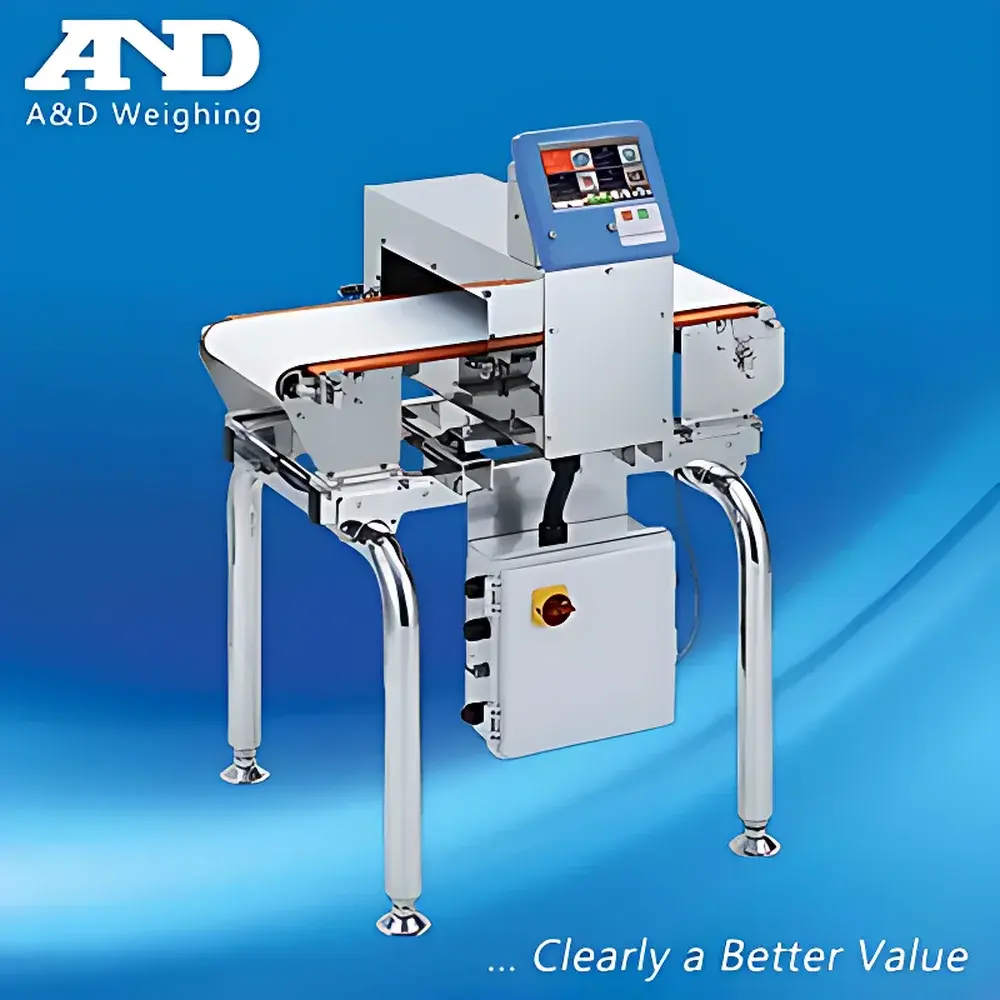
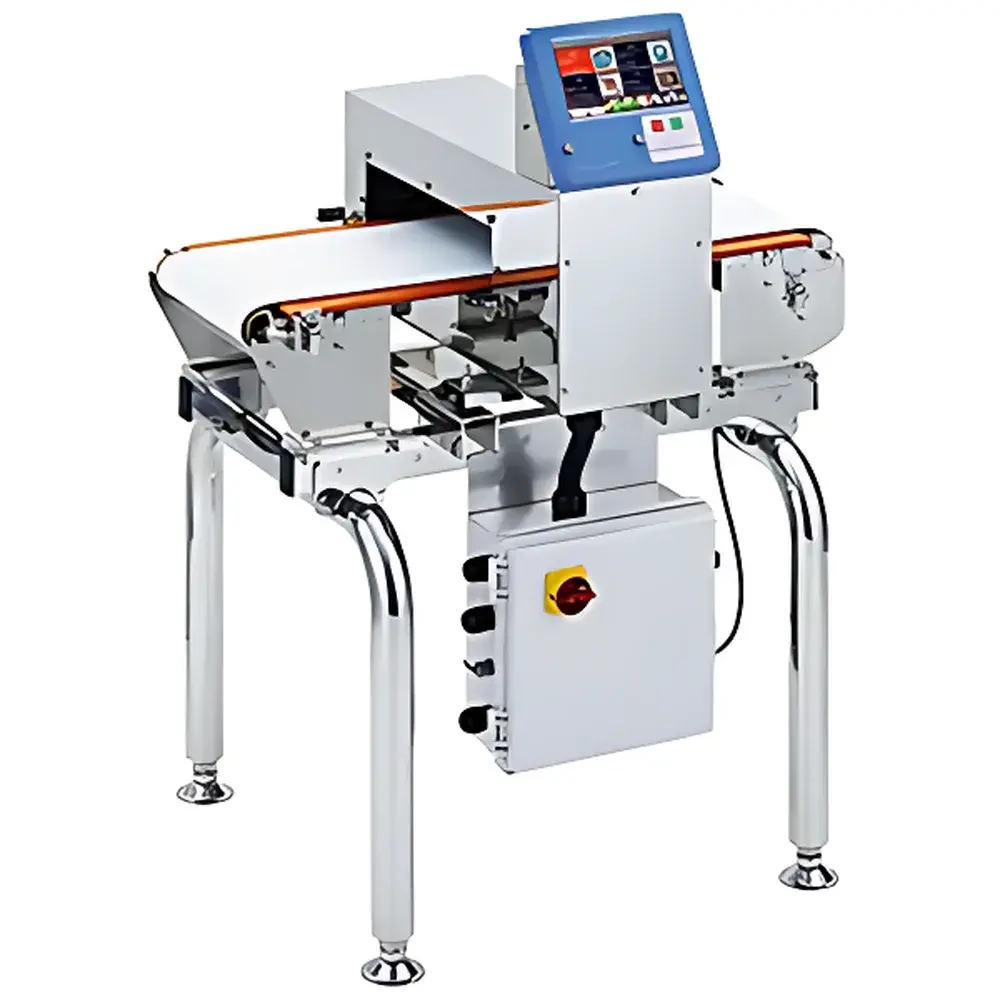
A&D AD-4971 Industrial Metal Detector
| Brand | A&D |
|---|---|
| Origin | Japan |
| Model | AD-4971 |
| Detection Aperture | 350 mm (W) × 80 / 150 / 230 mm (H) |
| Detection Sensitivity | Fe Ø0.3–0.7 mm |
| Conveyor Belt Width | 250 mm |
| Belt Length | 800 mm |
| Belt Speed | 10–60 m/min |
| Display | 7-inch color TFT LCD touchscreen |
| IP Rating | IP65 |
| Communication | Modbus RTU/TCP standard |
| Data Output | Ethernet + USB storage (PDF reports, histograms, X̄-R charts, trend plots) |
Overview
The A&D AD-4971 Industrial Metal Detector is a high-reliability, food-grade inline metal detection system engineered for continuous production environments requiring strict contamination control. Operating on dual-frequency electromagnetic field technology, the AD-4971 dynamically suppresses product effect interference—particularly from conductive or mineral-rich materials such as wet meats, cheese, or salty snacks—by simultaneously analyzing two independent frequency bands and applying proprietary signal processing algorithms. This architecture delivers enhanced signal-to-noise (S/N) ratio stability across variable operating conditions, enabling consistent detection performance without frequent recalibration. Designed for integration into automated packaging lines, the unit meets fundamental requirements of HACCP, ISO 22000, and BRCGS Food Safety Standard Issue 9 (Section 4.10.2), where validated foreign material detection is a critical control point (CCP). Its stainless-steel frame and IP65-rated enclosure support full-washdown protocols compliant with USDA and EHEDG hygiene guidelines.
Key Features
- Dual-frequency excitation and real-time adaptive filtering to minimize false rejects caused by product effect, temperature drift, or ambient electromagnetic noise.
- 7-inch capacitive touchscreen interface with icon-driven navigation, multilingual OS support (English, Spanish, Chinese, Japanese), and context-sensitive help—reducing operator training time and minimizing misoperation risk.
- Tool-free conveyor belt assembly/disassembly via precision-machined spur gear drive system; belt tensioning and alignment adjustments require no specialized tools.
- Full-stainless-steel construction (304 grade), including detector head, frame, and support structure—certified to meet FDA 21 CFR Part 117 sanitary design principles.
- Built-in Modbus RTU/TCP communication as standard—enabling bidirectional data exchange with PLCs, SCADA systems, or MES platforms for automated reject actuation, batch traceability, and centralized alarm management.
Sample Compatibility & Compliance
The AD-4971 accommodates products conveyed on flat, non-metallic belts up to 250 mm wide and 800 mm long, with nominal throughput speeds ranging from 10 to 60 meters per minute. Its three selectable aperture heights (80 mm, 150 mm, 230 mm) allow optimization for low-profile confectionery bars, medium-height frozen entrées, or tall beverage containers. Detection sensitivity is verified per ASTM F2151-22 Annex A1 using standardized test spheres under controlled environmental conditions (23 ± 2°C, 50 ± 5% RH). The system complies with IEC 60601-1 (electrical safety), EN 62061 (functional safety for machinery), and CE marking requirements under the EU Machinery Directive 2006/42/EC. Optional validation kits—including certified Fe/SUS/Non-Ferrous test pieces and logbook templates—are available to support GLP/GMP audit readiness.
Software & Data Management
Embedded firmware supports comprehensive data logging with timestamped event records (pass/fail decisions, sensitivity changes, calibration events, door open/close status). Statistical process monitoring includes real-time X̄-R chart generation, histogram-based rejection frequency analysis, and moving average trend visualization—all exportable in PDF format via integrated Ethernet port or USB 2.0 host interface. Audit trail functionality logs all user-initiated configuration modifications with operator ID and timestamp, satisfying FDA 21 CFR Part 11 electronic record/electronic signature (ERES) requirements when deployed with appropriate access controls and password policies. Historical datasets are retained for ≥30 days onboard; longer-term archiving is supported via external SFTP or OPC UA server integration.
Applications
- Food manufacturing: detection of ferrous, non-ferrous, and stainless-steel contaminants in baked goods, dairy products, ready meals, and pet food.
- Pharmaceutical solid-dose production: verification of metallic particulate absence in blister-packed tablets and capsules prior to secondary packaging.
- Consumer electronics assembly: screening of plastic housings and rubber gaskets for machining swarf or tool fragments pre-shipment.
- Plastics extrusion: inline inspection of granulated polymer feedstock for tramp metal before melt processing.
FAQ
What standards does the AD-4971 comply with for food safety applications?
It meets ISO 22000:2018 clause 8.5.2 (control of potential hazards), BRCGS Issue 9 Section 4.10.2 (metal detection), and is designed to support validation per Codex Alimentarius CAC/RCP 1-1969 Annex.
Can the AD-4971 be integrated into an existing factory MES?
Yes—via native Modbus TCP, it communicates with most industrial IT infrastructure without protocol gateways; OPC UA bridge modules are available upon request.
Is routine sensitivity verification required between shifts?
Per GMP best practice, a documented sensitivity check using certified test pieces must be performed at startup, after maintenance, and at least once per shift—with results logged in the built-in audit trail.
Does the system support remote diagnostics?
Remote firmware updates and diagnostic data retrieval are supported over Ethernet when configured with enterprise-grade network security policies (e.g., VLAN segmentation, TLS 1.2 encryption).



