
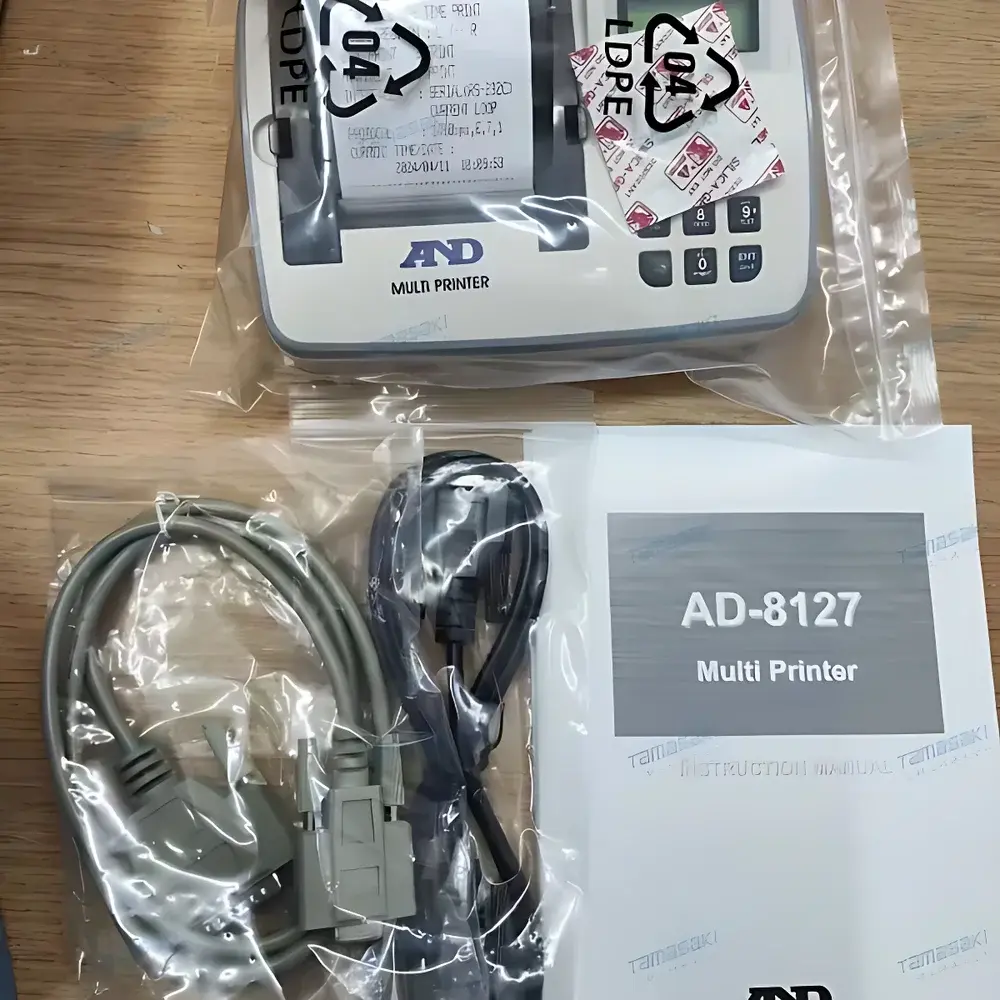
A&D AD-8127 Multi-Function Log Printer for Precision Balances and Scales
| Brand | A&D |
|---|---|
| Model | AD-8127 |
| Printing Method | Impact Dot-Matrix |
| Character Format | 7×9 dots |
| Character Size | 1.6 mm (W) × 3.2 mm (H) |
| Print Speed | ~1.6 lines/sec |
| Paper Feed Speed | ~4 lines/sec |
| Characters per Line | 24 |
| Operating Temp. | 0–40 °C, 35–85% RH (non-condensing) |
| Storage Temp. | −20–60 °C, 10–90% RH (non-condensing) |
| Interface | RS-232C / Current Loop |
| Power Supply | AC Adapter AX-TB135 or AX-TB285 (Input: AC 100 V ±10% / −15%, 50/60 Hz) |
| Power Consumption | ~36 VA (incl. adapter) |
| Dimensions (W×D×H) | 174 × 141 × 87 mm |
| Weight | ~500 g |
| Standard Accessories | Ribbon cartridge, plain paper roll, AC adapter, identification label, user manual, RS-232C cable (D-Sub9P/D-Sub25P configurable) |
Overview
The A&D AD-8127 is a dedicated impact dot-matrix log printer engineered for seamless integration with analytical balances, precision scales, and industrial weighing systems—particularly in regulated environments where traceable, permanent hard-copy records are required. Unlike generic thermal or inkjet printers, the AD-8127 employs robust mechanical impact printing technology, ensuring legible, smudge-resistant output on standard plain paper or low-static dust-free paper—critical for cleanroom applications in semiconductor component manufacturing and printed electronics fabrication. Its design prioritizes deterministic behavior: every print command, including weight data, timestamps, operator IDs, and zeroing events, is executed with fixed latency and no buffer-dependent delays. The built-in real-time clock (RTC) enables automatic date/time stamping of each line, satisfying documentation requirements under ISO/IEC 17025, ASTM E1169, and internal GLP/GMP audit protocols. As an OEM-compatible peripheral, it supports both RS-232C serial and current loop interfaces—ensuring backward compatibility with legacy A&D, Mettler Toledo, Sartorius, and Shimadzu weighing instruments without protocol translation layers.
Key Features
- Impact dot-matrix printing mechanism delivering high-contrast, archival-quality output on plain or dust-free paper—no consumables beyond ribbon cartridges
- Integrated LCD display and numeric keypad enabling local configuration: real-time weight monitoring, printer status verification, manual date/time entry, user ID assignment, and immediate tare/zero commands
- Dedicated RTC module with battery-backed memory ensures accurate timestamping across power cycles—essential for batch traceability in semiconductor wafer handling and PCB assembly workflows
- Configurable D-Sub interface (9-pin or 25-pin) with factory-set pinout mapping; RS-232C parameters (baud rate, parity, stop bits) programmable via front-panel keys or host command
- Low-power architecture: consumes only ~36 VA including integrated AC adapter (AX-TB135 or AX-TB285), rated for continuous operation within Class 1000 cleanroom temperature/humidity envelopes (0–40 °C, 35–85% RH, non-condensing)
- Compact footprint (174 × 141 × 87 mm) and lightweight chassis (~500 g) facilitate benchtop mounting adjacent to balance enclosures or integration into automated metrology workstations
Sample Compatibility & Compliance
The AD-8127 is not a sample-processing instrument but a certified data logging peripheral validated for use with Class I and II precision weighing devices compliant with OIML R76 and NIST Handbook 44. It accepts ASCII-formatted weight strings from balances operating in standard “print-on-stable” or “print-on-command” modes. Its mechanical print head tolerates static-dissipative paper substrates used in printed electronics cleanrooms (e.g., polyester-coated rolls meeting JIS P8111 surface resistivity standards). Regulatory alignment includes support for FDA 21 CFR Part 11-compliant workflows when paired with balance firmware that logs operator authentication and electronic signatures prior to transmission. Device-level compliance covers CE marking (EMC Directive 2014/30/EU, LVD Directive 2014/35/EU), PSE certification for Japanese market deployment, and RoHS 3 material declarations.
Software & Data Management
No proprietary software installation is required—the AD-8127 operates as a transparent serial endpoint. Host systems send printable ASCII sequences using industry-standard ESC/P-like control codes (e.g., ESC t for time stamp, ESC i for ID prefix). All configuration—including baud rate (1200–19200 bps), character set (ASCII-7 or JIS X 0201), and line feed behavior—is performed locally via the numeric keypad, eliminating dependency on PC-based utilities. Audit trails are inherently generated: each printed line contains verifiable metadata (timestamp, weight value, unit symbol, optional ID tag), enabling direct correlation with LIMS or MES database entries. For validation purposes, the device supports self-test mode (initiated by holding ‘0’ + ‘#’) that prints diagnostic patterns and firmware revision (v1.2x), facilitating IQ/OQ documentation.
Applications
- Semiconductor component manufacturing: logging weight measurements of die carriers, lead frames, and solder paste dispensers under ISO 14644-1 Class 5 conditions
- Printed electronics R&D: documenting mass changes during conductive ink deposition, flexible substrate lamination, and thin-film gravimetric calibration
- Pharmaceutical QC labs: generating tamper-evident balance printouts for reference standard reconciliation per USP General Chapter 1058
- Automotive sensor calibration: pairing with microgram-resolution balances for MEMS accelerometer proof-mass verification
- Educational metrology training: teaching fundamental concepts of measurement traceability, uncertainty propagation, and ALARP (As Low As Reasonably Practicable) recordkeeping
FAQ
Does the AD-8127 support USB or Ethernet connectivity?
No. It provides RS-232C and current loop interfaces only. USB or Ethernet functionality requires an external protocol converter certified for electromagnetic compatibility in laboratory environments.
Can the printer operate without the AC adapter?
No. It lacks internal battery or DC input capability. Operation requires the supplied AX-TB135 or AX-TB285 AC adapter.
Is the ribbon cartridge reusable or refillable?
The ribbon is a disposable OEM cartridge (part number RB-AD8127); refilling is not supported due to precise tension calibration requirements.
What paper widths are compatible?
Standard width is 57 mm (2.24 in), accommodating both standard plain paper and static-dissipative rolls with core diameters of 25 mm.
How is firmware updated?
Firmware is factory-programmed and not field-upgradable. Version verification is available via self-test mode.






