
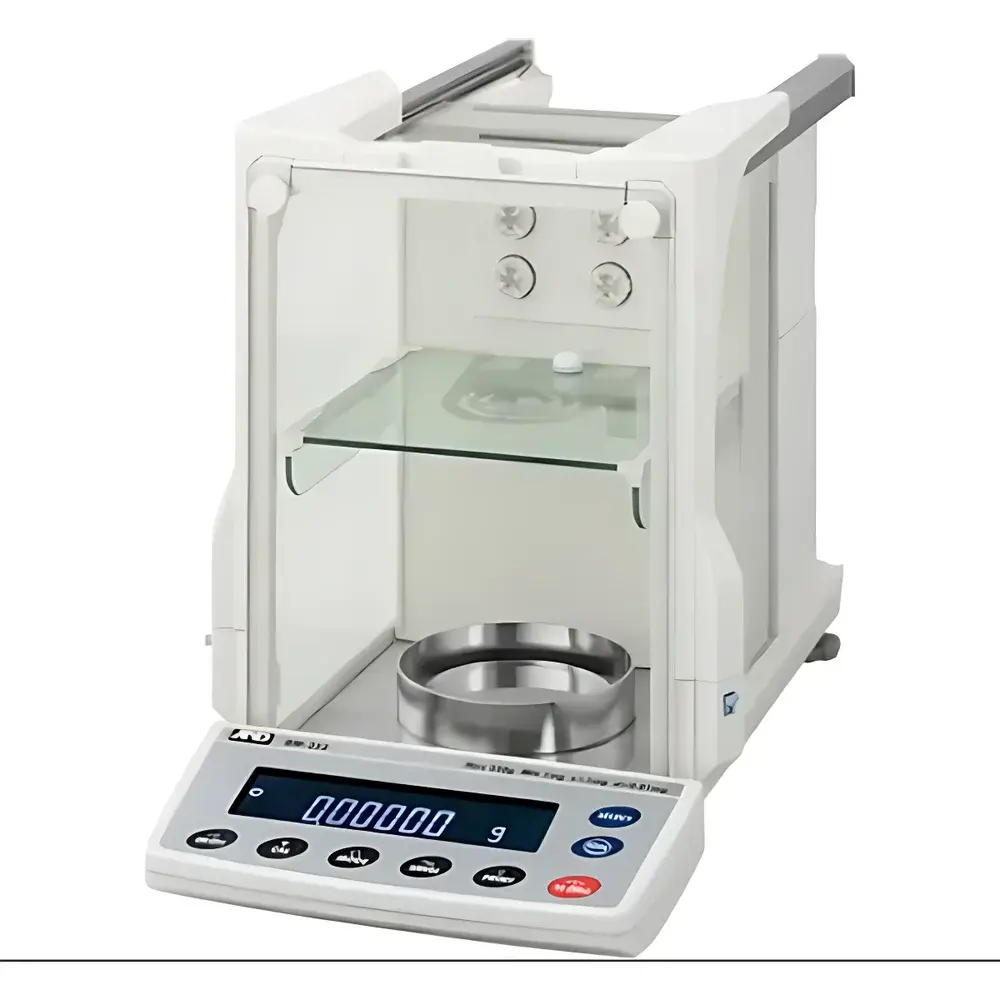
AND A&D BM-252 High-Precision Analytical Balance
| Brand | AND/A&D |
|---|---|
| Origin | Japan |
| Model | BM-252 |
| Capacity | 250 g |
| Readability | 0.01 mg |
| Repeatability (Std Dev) | 0.03 mg |
| Linearity | ±0.10 mg |
| Weighing Chamber Diameter | Φ90 mm |
| Stabilization Time | ~8 s (FAST mode) |
| Dimensions (W×D×H) | 259 × 466 × 326 mm |
| Net Weight | ~10 kg |
| Interfaces | USB (high-speed), RS-232C (9-pin D-Sub) |
| Electrostatic Control | Patented DC Ion Generator with Conductive Glass Draft Shield |
Overview
The AND A&D BM-252 is a high-precision analytical balance engineered for laboratories requiring trace-level mass measurement under stringent regulatory and operational conditions. Utilizing electromagnetic force compensation (EMFC) technology, the BM-252 delivers stable, reproducible readings at a readability of 0.01 mg across its 250 g capacity. Its design prioritizes metrological integrity in environments where electrostatic interference—common during powder handling or low-humidity operations—can compromise accuracy. The instrument integrates a patented, fanless DC ion generator that neutralizes static charge on samples and weighing vessels without introducing airflow turbulence, thereby eliminating drift caused by convective disturbances inside the draft shield. This architecture ensures compliance with ISO/IEC 17025 requirements for uncertainty control in mass calibration workflows and supports routine verification per USP , ASTM E898, and EURAMET cg-18 guidelines.
Key Features
- Patented static elimination system: DC ion generator embedded within conductive glass draft shield—no airflow, no particle displacement, no thermal convection artifacts.
- Dual sliding doors with cross-action mechanism: Right door operable by left hand and vice versa—enabling ergonomic, two-handed sample placement without compromising chamber integrity.
- Optimized weighing chamber: Φ90 mm internal diameter with removable partition; accommodates standard beakers, graduated cylinders, and tall containers without sacrificing resolution or stability.
- Internal motorized calibration: Built-in reference mass enables automated, temperature-compensated calibration—traceable to national standards and compliant with ISO 9001 and ISO/IEC 17025 internal audit protocols.
- Dual communication interfaces: Standard USB 2.0 (for fast data transfer and host PC control) and RS-232C (9-pin D-Sub) for legacy system integration, LIMS connectivity, and GLP/GMP-compliant audit trail export.
- User access control: Password-protected operation modes restrict parameter modification, calibration execution, and data export—supporting role-based accountability in regulated QA/QC environments.
Sample Compatibility & Compliance
The BM-252 is validated for use with powders, granules, liquids, and viscous suspensions commonly encountered in pharmaceutical formulation, food ingredient blending, polymer additive dosing, and fine chemical synthesis. Its electrostatic mitigation system ensures reliable weighing of insulating materials (e.g., APIs, excipients, ceramic precursors) without surface charge accumulation. The conductive glass draft shield meets IEC 61326-1 immunity requirements for electrostatic discharge (ESD) and electromagnetic compatibility (EMC). All firmware and data output functions comply with FDA 21 CFR Part 11 for electronic records and signatures when used with validated software clients. Instrument documentation includes full metrological traceability statements and factory calibration certificates aligned with JCSS (Japan Calibration Service System) accreditation.
Software & Data Management
Data acquisition and reporting are supported via AND’s AD-1688 Data Logger software (included), which captures timestamped weight values, environmental metadata (optional external sensor input), operator ID, and calibration logs. Export formats include CSV, TXT, and PDF—structured for direct ingestion into ELN systems or statistical process control (SPC) platforms. RS-232C output supports ASCII command protocols compatible with LabVIEW, MATLAB, and custom SCADA integrations. Audit trails record user login events, calibration actions, parameter changes, and data exports—with immutable timestamps and digital signature options enabled under GxP configurations. Firmware updates are delivered through secure HTTPS channels and require administrative authentication.
Applications
- Pharmaceutical R&D: Accurate dispensing of active pharmaceutical ingredients (APIs) and excipients during preformulation studies and analytical method development.
- Food & Beverage QA: Verification of ingredient batch weights, nutritional labeling compliance, and moisture content determination via gravimetric loss-on-drying protocols.
- Materials Science: Precise formulation of composite precursors, catalyst loading, and nanomaterial dispersion dosing.
- Reference Material Certification: Primary and secondary mass calibration against NIST-traceable standards in accredited reference labs.
- Industrial Process Validation: Integration into automated filling lines or dispensing stations where real-time weight feedback triggers PLC-controlled actuation.
FAQ
Does the BM-252 support automatic internal calibration under temperature fluctuation?
Yes—the built-in calibration mass is thermally coupled to the load cell assembly, enabling auto-calibration triggered by predefined ΔT thresholds or scheduled intervals.
Can the conductive glass draft shield be cleaned with ethanol or isopropyl alcohol?
Yes—conductive glass surfaces may be wiped with lint-free cloths dampened with ≤70% IPA; avoid abrasive cleaners or excessive pressure to preserve surface conductivity.
Is the USB interface suitable for GLP-compliant data export?
USB supports rapid data transfer but does not inherently provide audit trail integrity; for full GLP compliance—including electronic signature and change history—RS-232C with validated third-party software is recommended.
What is the maximum height of a container that fits inside the weighing chamber when the partition is removed?
With the partition fully retracted, the vertical clearance from pan surface to draft shield ceiling is 245 mm—accommodating standard 250 mL volumetric cylinders and tall reaction vessels.
How is repeatability verified during routine performance checks?
Repeatability testing follows ISO 17025 Annex C: ten consecutive weighings of a certified 100 g test weight under identical environmental conditions; standard deviation must remain ≤0.03 mg per manufacturer specification.



