
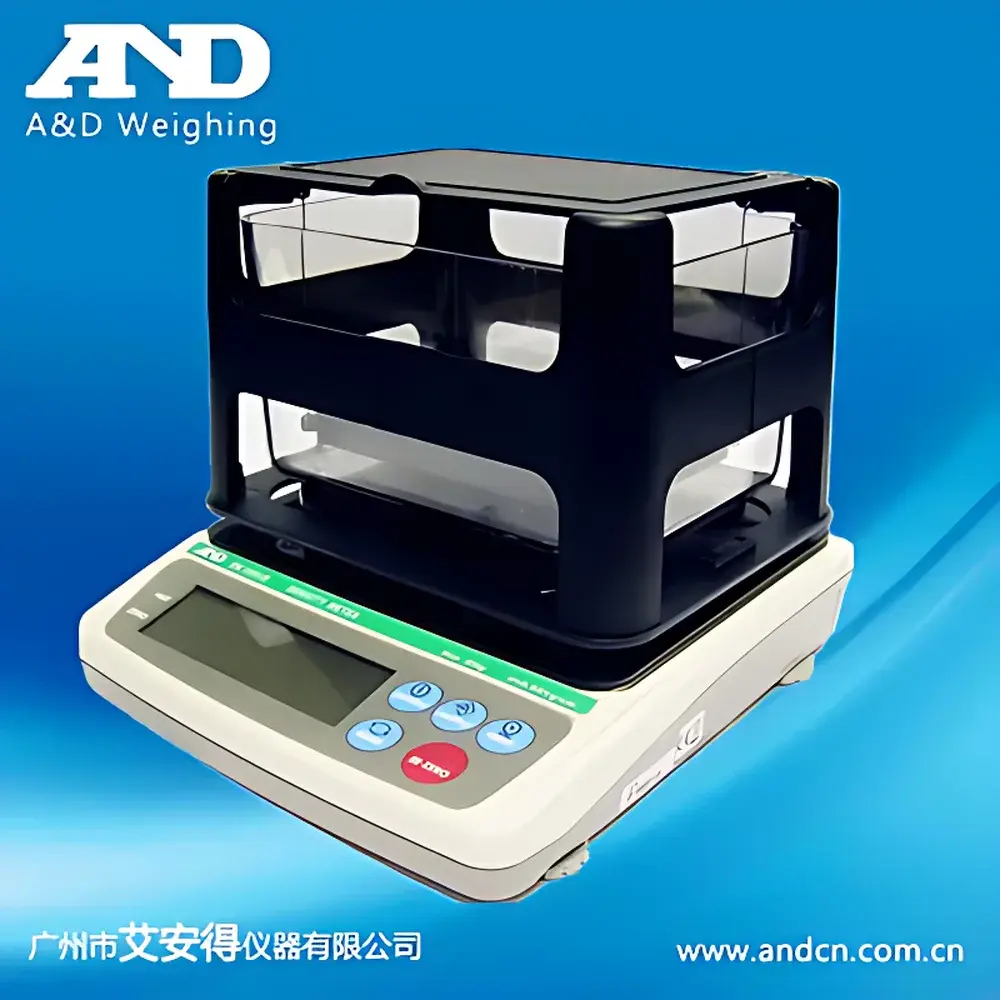
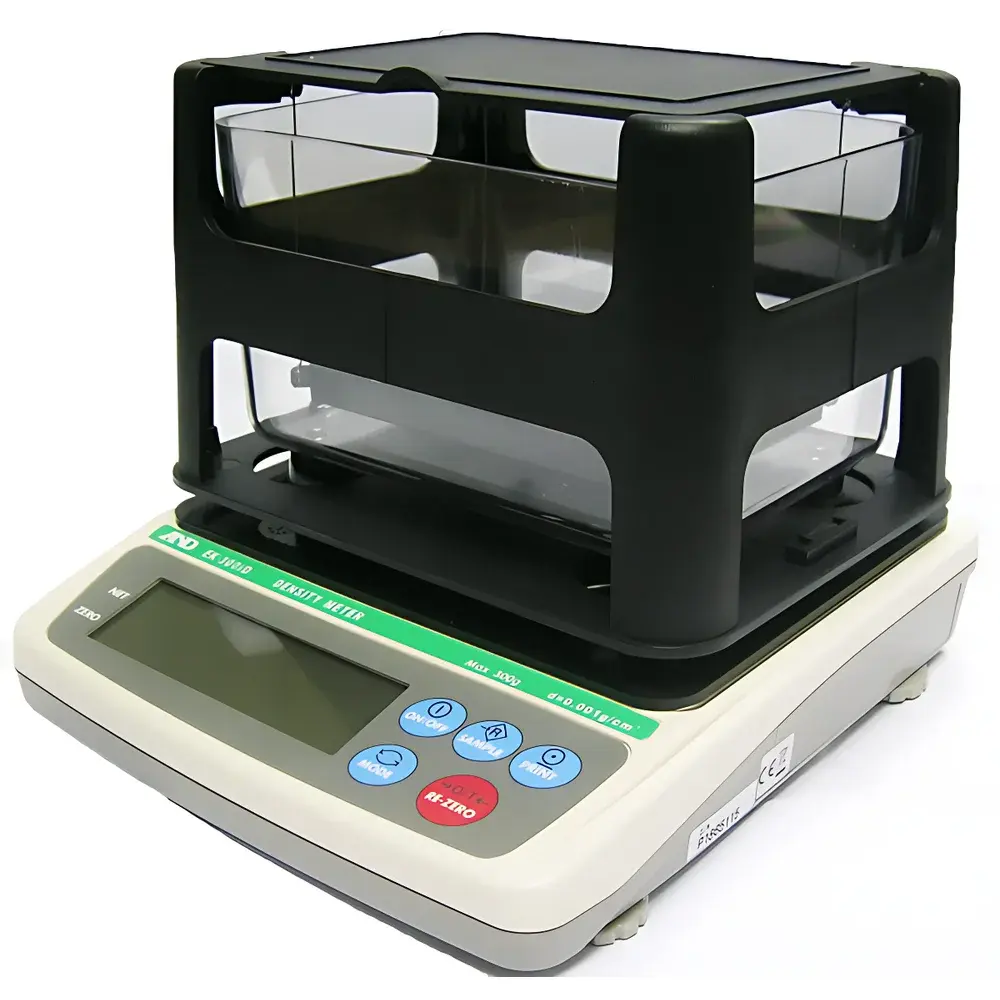
A&D EK-iD Series Digital Density Balance
| Brand | A&D |
|---|---|
| Origin | Japan |
| Model | EK-300iD / EK-3000iD |
| Instrument Type | Benchtop Solid Density Analyzer |
| Measurement Principle | Archimedean Buoyancy Method (Air Weight / (Air Weight − Immersed Weight) × Reference Liquid Density) |
| Density Range | 0–2.000 g/cm³ |
| Density Resolution | 0.001 g/cm³ (EK-300iD) / 0.01 g/cm³ (EK-3000iD) |
| Temperature Range | 0–100 °C |
| Minimum Sample Mass | 0.001 g |
| Reference Liquids | Water, Kerosene, or User-Defined Liquids (Density Input Range: 0.000–2.000 g/cm³) |
| Temperature Compensation | Automatic |
| Data Storage | 200 Records |
| Interface | RS-232 |
| Compliance | GLP/GMP/GCP Audit Trail Ready, ISO/IEC 17025 Support Enabled |
| Software | WinCT Data Acquisition Suite (Windows-compatible, Excel export, statistical analysis, graphing) |
Overview
The A&D EK-iD Series Digital Density Balance is a precision benchtop instrument engineered for rapid, direct-density determination of solid materials using the Archimedean buoyancy principle. Unlike conventional pycnometers or manual calculation-based methods, the EK-iD integrates high-resolution weighing mechanics with real-time fluid displacement computation to deliver density values directly on the display—eliminating transcription errors and reducing operator dependency. The system operates by measuring sample mass in air and submerged weight in a reference liquid (e.g., water or kerosene), then applying the standard buoyancy equation: ρsample = (mair / (mair − mimmersed)) × ρliquid. This physics-based approach ensures traceable, repeatable results aligned with ISO 1183-1, ASTM D792, and USP standards for solid density measurement. Designed for laboratory environments requiring regulatory compliance, the EK-iD supports temperature-controlled operation across 0–100 °C and accommodates low-mass samples down to 0.001 g—making it suitable for powders, granules, ceramics, polymers, and lightweight composites.
Key Features
- Direct digital density readout with automatic application of Archimedean correction—no manual calculation required
- Two model variants: EK-300iD (300 g capacity, 0.01 g readability, 0.001 g/cm³ density resolution) and EK-3000iD (3100 g capacity, 0.1 g readability, 0.01 g/cm³ density resolution)
- Programmable reference liquid density input (0.000–2.000 g/cm³), enabling use of water, kerosene, or custom calibration fluids
- Automatic temperature compensation and user-configurable liquid temperature setting to minimize thermal drift effects
- Dual-mode density comparison: fixed target value alerting with optional visual (red/green LED) or audible alarm outputs via accessory modules
- Full digital calibration capability—including zero-point and span adjustment with editable internal mass parameters
- GLP/GMP-compliant data handling: timestamped records, user ID assignment, and audit-ready output formatting per ISO/IEC 17025 and FDA 21 CFR Part 11 requirements
- RS-232 serial interface for seamless integration with LIMS, SPC systems, or external PCs
Sample Compatibility & Compliance
The EK-iD series accommodates a broad spectrum of solid geometries and physical states—including irregularly shaped parts, porous specimens, foams, and low-density floating materials (ρ < 1.0 g/cm³). Its immersion fixture design minimizes surface tension artifacts and allows consistent positioning during submerged weighing. For regulatory workflows, the instrument meets essential metrological requirements outlined in ISO 9001, ISO/IEC 17025, and pharmacopeial guidelines (USP , EP 2.2.5). All density calculations are internally validated against NIST-traceable reference standards, and calibration reports include uncertainty budgets compliant with EURAMET cg-18. Optional accessories—such as anti-static sample holders, temperature-stabilized liquid baths, and certified reference spheres—extend applicability to QA/QC labs operating under GxP frameworks.
Software & Data Management
WinCT software (included) provides full bidirectional communication with the EK-iD via RS-232. It enables automated data capture, batch-level metadata tagging (operator ID, sample ID, test date/time), and export to Microsoft Excel, CSV, or database formats. Statistical functions include mean, SD, CV%, min/max, trend charts, and histogram generation. Raw data logs retain full audit trail information—including calibration history, environmental parameters (temperature, humidity), and any parameter modifications—supporting 21 CFR Part 11 electronic signature readiness when deployed with appropriate IT infrastructure. Data files are timestamped and digitally signed to ensure integrity throughout the analytical lifecycle.
Applications
- Quality control of polymer pellets, resin beads, and injection-molded components
- Density verification of ceramic green bodies and sintered parts in advanced materials R&D
- Pharmaceutical excipient characterization per USP monographs
- Metal powder density profiling for additive manufacturing feedstock qualification
- Geological sample analysis (minerals, ores, sediment cores)
- Educational laboratories requiring reproducible Archimedes-based experiments
FAQ
Does the EK-iD require manual density calculation?
No. The instrument performs all Archimedean computations internally and displays final density values in g/cm³ without user intervention.
Can the EK-iD measure samples that float in water?
Yes. By selecting kerosene (ρ ≈ 0.8 g/cm³) or another lower-density reference liquid, the system accurately determines densities below 1.0 g/cm³.
Is temperature control built into the balance?
The EK-iD features automatic ambient temperature sensing and compensates for thermal expansion effects in both the load cell and reference liquid density input—but does not include an integrated heated bath; external thermostatic baths may be used for controlled immersion.
How many measurements can be stored internally?
Up to 200 complete measurement records—including air weight, immersed weight, calculated density, temperature, operator ID, and timestamp—are retained in non-volatile memory.
What regulatory documentation is provided with the instrument?
Each unit ships with a factory calibration certificate traceable to JCSS (Japan Calibration Service System), plus documentation supporting GLP/GMP implementation—including calibration log templates, SOP guidance, and WinCT validation protocols.



