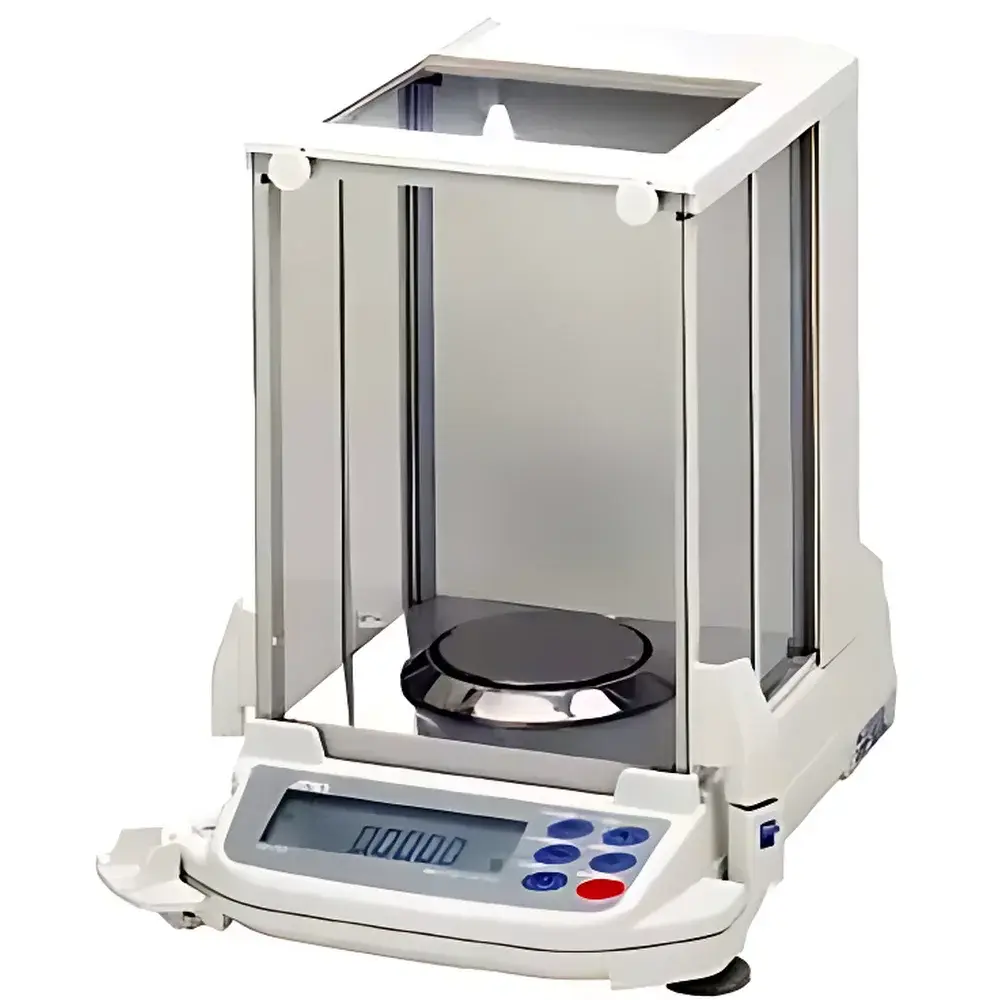
A&D GR-120 Advanced Analytical Balance with Internal Calibration
| Brand | A&D |
|---|---|
| Origin | Japan |
| Model | GR-120 |
| Type | Analytical Balance |
| Maximum Capacity | 120 g |
| Readability | 0.1 mg |
| Repeatability | 0.2 mg |
| Calibration | Internal motorized calibration with built-in reference weights |
| Compliance | GLP/GMP/ISO-compliant data output |
| Connectivity | RS-232C interface with Win-CT software |
| Weighing Units | 13 selectable units + counting, % weighing, density determination (with optional AD-1653 kit) |
Overview
The A&D GR-120 is a high-precision analytical balance engineered for laboratories requiring traceable mass measurement at the 0.1 mg readability level. Designed and manufactured in Japan, it employs electromagnetic force restoration (EMFR) technology — the industry-standard principle for modern analytical balances — to deliver stable, drift-compensated measurements under variable environmental conditions. Its core architecture integrates real-time environmental monitoring (temperature and humidity), enabling automatic internal recalibration triggered by thermal drift or ambient fluctuations. This ensures metrological continuity without manual intervention, making the GR-120 particularly suited for regulated environments where audit-ready documentation and procedural consistency are mandatory.
Key Features
- Internal motorized calibration system with integrated high-stability reference weights — activated via single-key press or scheduled auto-recalibration based on environmental shift detection.
- Auto-sensitivity adjustment: dynamically optimizes damping and filtering parameters in response to mechanical vibration, air currents, or bench instability — minimizing settling time and improving operational throughput.
- Ergonomic front-access folding door design: compact footprint (249 × 330 × 328 mm) with oversized weighing chamber (Ø85 mm pan diameter) for easy sample handling and reduced airflow interference.
- 13 programmable weighing units including g, mg, oz, ct, dwt, grain, and % mode; integrated piece counting and percent deviation functions for QC batch verification.
- RS-232C serial interface compliant with standard laboratory communication protocols; bundled Win-CT software enables bidirectional control, real-time data streaming, and direct export to Microsoft Excel, Word, or LIMS platforms.
- GLP/GMP-compliant data logging: timestamps, operator ID, balance serial number, calibration history, and environmental metadata are embedded in each exported record — fully traceable per FDA 21 CFR Part 11 requirements when used with validated software configuration.
Sample Compatibility & Compliance
The GR-120 accommodates solid, powder, and small-volume liquid samples within its 120 g capacity and 85 mm diameter stainless-steel weighing pan. Its sealed sensor housing and draft shield assembly meet ISO 9001 and ISO/IEC 17025 environmental robustness criteria. All calibration and measurement procedures align with ASTM E898, USP , and OIML R76 standards for analytical balance performance verification. Optional AD-1653 density determination kit extends functionality to solid density measurement (g/cm³) using Archimedean displacement method — results displayed directly without manual calculation.
Software & Data Management
Win-CT software provides full instrument control, customizable report templates, statistical analysis (mean, SD, CV%, min/max), trend charting, and automated pass/fail evaluation against user-defined tolerance limits. Data files are saved in CSV and XML formats, supporting integration into enterprise quality management systems (QMS). Audit trail features include immutable event logs recording calibration events, weight entries, parameter changes, and user logins — essential for regulatory inspections under ISO 13485, ICH Q7, or pharmaceutical GMP frameworks.
Applications
The GR-120 serves critical roles across pharmaceutical formulation (active ingredient dispensing), chemical synthesis (reagent quantification), materials science (powder density profiling), food safety testing (nutrient labeling compliance), and academic research (gravimetric analysis, titration endpoint verification). Its repeatability of ±0.2 mg and linearity error of ±0.2 mg support ISO/IEC 17025 accredited testing workflows where uncertainty budgets must be rigorously defined and controlled.
FAQ
Does the GR-120 support external calibration with traceable weights?
Yes — while optimized for internal calibration, the balance accepts external calibration via Class E2 or better reference weights through the dedicated CAL mode.
Is Win-CT software compatible with Windows 11 and 64-bit systems?
Yes — Win-CT v3.2+ supports Windows 10/11 (64-bit), with signed drivers and TLS 1.2-compliant secure data transmission.
Can the GR-120 be integrated into an automated lab workflow via PLC or SCADA?
Yes — RS-232C supports ASCII command protocol (A&D Standard Mode); custom scripting in Python, LabVIEW, or MATLAB enables seamless orchestration with robotic arms or dispensing systems.
What is the recommended warm-up time before first use?
Minimum 30 minutes at stable ambient temperature (20–25 °C, ≤50% RH) to stabilize thermal equilibrium of the EMFR sensor and internal reference mass.
How often should internal calibration be performed?
A&D recommends initiating internal calibration after power-on, following significant ambient temperature shifts (>2 °C), or at user-defined intervals (e.g., every 2 hours during continuous operation) — configurable via menu settings.