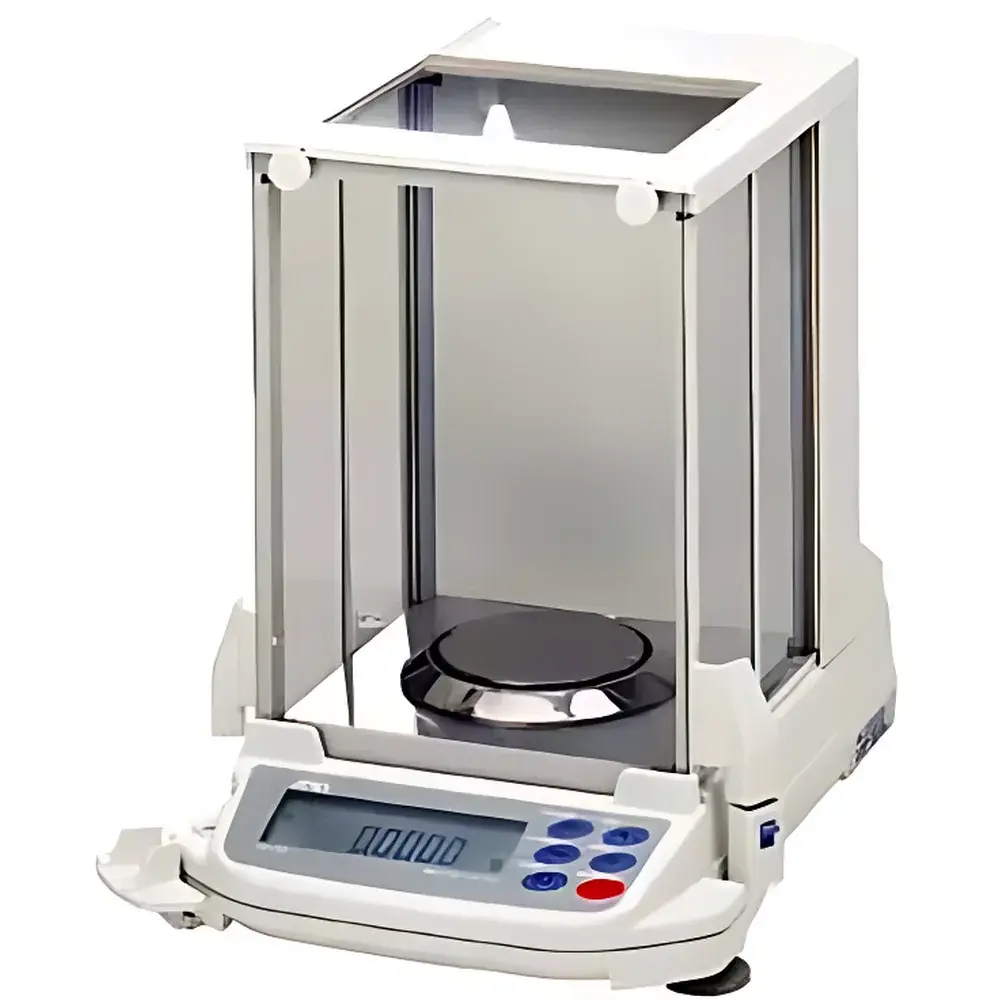
A&D GR-200 Advanced Analytical Balance with Internal Calibration (0.1 mg readability)
| Brand | A&D |
|---|---|
| Origin | Japan |
| Model | GR-200 |
| Readability | 0.1 mg |
| Max Capacity | 210 g |
| Repeatability | ±0.2 mg |
| Calibration | Internal motorized calibration with built-in reference weights |
| Compliance | GLP/GMP/ISO 9001-ready |
| Interface | RS-232C |
| Software | Win-CT (included) |
| Weighing Units | 13 selectable units + counting, % weighing, density determination (with optional AD-1653 kit) |
Overview
The A&D GR-200 is a high-precision analytical balance engineered for laboratories requiring trace-level mass measurement under regulated and routine quality control environments. Designed and manufactured in Japan, this 0.1 mg readability instrument operates on electromagnetic force compensation (EMFC) principle — the industry-standard method for high-stability, drift-resistant analytical weighing. Its 210 g maximum capacity and sub-milligram resolution make it suitable for pharmaceutical formulation, reference standard preparation, chemical synthesis monitoring, and materials science sample characterization. The GR-200 integrates real-time environmental adaptation logic, automatically detecting ambient temperature and humidity fluctuations to trigger internal recalibration — ensuring continuous metrological integrity without manual intervention.
Key Features
- Internal motorized calibration system with integrated high-stability reference weights — single-touch activation ensures rapid, operator-independent verification.
- Auto-sensitivity adjustment algorithm dynamically compensates for mechanical vibration and air current disturbances, maintaining stable readings in non-ideal lab environments.
- Ergonomic front-access folding glass draft shield — compact footprint (249 × 330 × 328 mm), large weighing chamber (Ø85 mm pan), and low-profile handle design optimize workflow efficiency and user accessibility.
- 13 programmable weighing units (g, mg, oz, ct, etc.), piece counting mode, percentage weighing, and net/gross/tare functionality support diverse operational protocols across R&D, QC, and production settings.
- RS-232C serial interface compliant with ANSI/EIA-232-F standards — enables bidirectional communication with PCs, printers (e.g., AD-8121B), and LIMS systems.
- Win-CT data acquisition software (supplied) supports automated timestamped data logging, statistical analysis (mean, SD, CV), trend charting, and direct export to Microsoft Excel and Word — fully traceable per FDA 21 CFR Part 11 requirements when configured with user authentication and audit trail.
Sample Compatibility & Compliance
The GR-200 accommodates standard laboratory vessels including weighing boats, crucibles, volumetric flasks, and small-diameter vials (up to Ø85 mm). Its draft shield meets ISO 17025:2017 clause 6.4.2 requirements for environmental isolation during precision weighing. The balance is factory-verified to ASTM E898–22 (Standard Guide for Selection and Use of Laboratory Balances) and conforms to ISO 9001, ISO/IEC 17025, and EU GMP Annex 11 principles. Built-in GLP/GMP reporting functions generate printable or digital records containing balance ID, operator code, calibration history, date/time stamps, and environmental metadata — essential for regulatory audits and quality system documentation.
Software & Data Management
Win-CT provides full compliance-ready data management: configurable user roles, electronic signature support, automatic data backup, and encrypted local storage. All weight events are time-stamped with millisecond precision and associated with operator ID and sample ID fields. Raw data files (.csv, .txt) retain full metadata headers, enabling seamless integration into ELN platforms or statistical process control (SPC) software. When paired with an AD-1653 density kit, the system performs direct solid-density calculation using Archimedes’ principle — outputting g/cm³ values with automatic buoyancy correction applied per ISO 1183-1:2019.
Applications
- Pharmaceutical: Active pharmaceutical ingredient (API) dispensing, excipient blending verification, dissolution tablet weight uniformity testing (USP <905>).
- Academic Research: Stoichiometric reagent weighing for synthetic chemistry, catalyst loading quantification, nanomaterial mass dosing.
- Materials Testing: Powder density profiling, coating thickness validation via mass-thickness correlation, thermal gravimetric analysis (TGA) sample preparation.
- Food & Beverage QA: Nutrient fortification accuracy checks, moisture content determination by loss-on-drying (LOD), allergen cross-contamination verification.
- Environmental Labs: Filter mass gain measurement for PM2.5/PM10 particulate analysis (EPA Method 201A).
FAQ
What calibration standards does the GR-200 comply with?
The GR-200 adheres to OIML R76-1:2021 (non-automatic weighing instruments) and is verified against NIST-traceable reference masses during factory certification.
Can the GR-200 be integrated into a networked LIMS environment?
Yes — via RS-232C to USB or Ethernet gateway adapters, the balance supports ASCII-based command protocols compatible with most LIMS middleware and custom API integrations.
Is the Win-CT software validated for 21 CFR Part 11 compliance?
Win-CT includes configurable audit trail, electronic signature, and role-based access controls; final validation must be performed by the end-user per their SOPs and risk assessment framework.
Does the GR-200 support external density measurement accessories?
Yes — the optional AD-1653 density determination kit enables direct solid-density readout with automatic air buoyancy compensation and temperature coefficient application.
How often does the internal calibration initiate automatically?
By default, the GR-200 triggers auto-calibration upon power-up, after 2-hour idle periods, and whenever ambient temperature shifts exceed ±1.5°C — all parameters are adjustable via administrator menu.