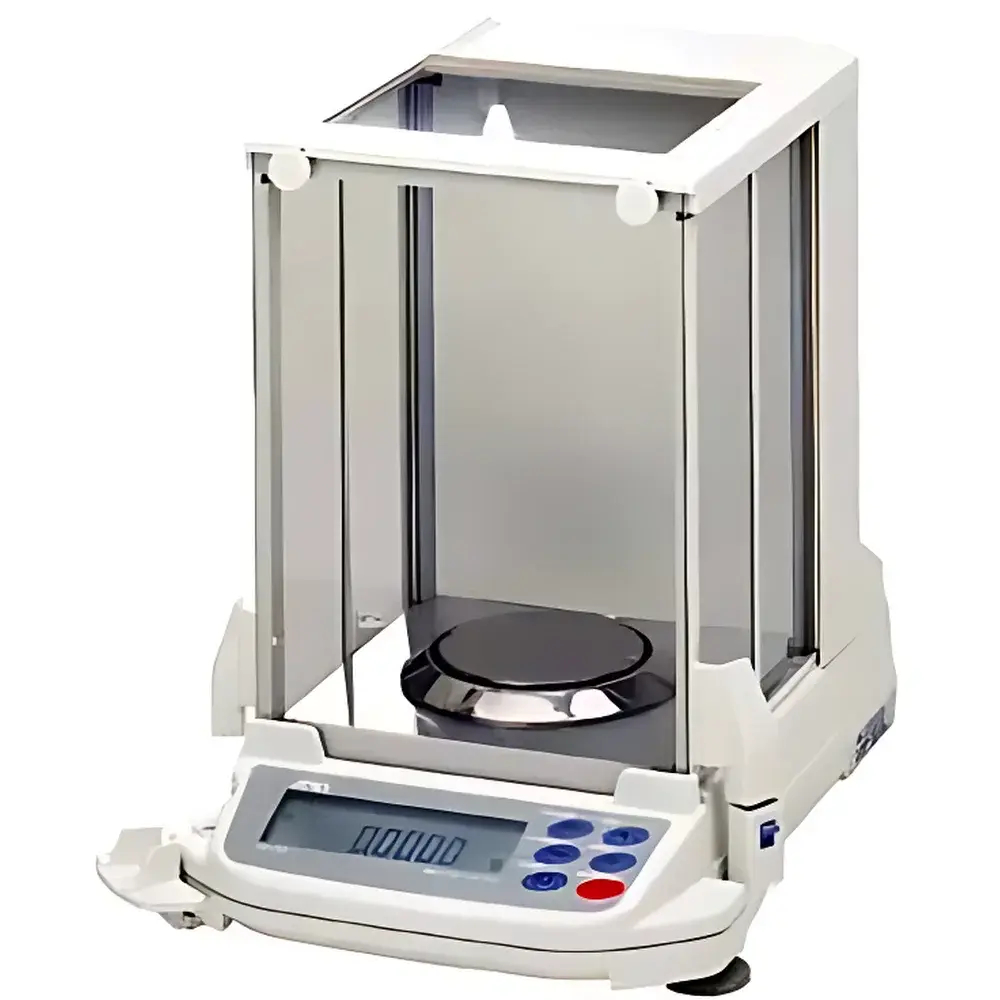
A&D GR-300 Advanced Analytical Balance with 0.1 mg Readability
| Brand | A&D |
|---|---|
| Origin | Japan |
| Model | GR-300 |
| Maximum Capacity | 310 g |
| Readability | 0.1 mg |
| Repeatability | ±0.2 mg |
| Weighing Pan Diameter | 85 mm |
| Dimensions (W×D×H) | 249 × 330 × 328 mm |
| Weight | ~6.0 kg |
Overview
The A&D GR-300 is a high-precision analytical balance engineered for laboratories requiring strict adherence to metrological integrity, regulatory traceability, and operational consistency. Designed and manufactured in Japan, this 0.1 mg readability balance operates on electromagnetic force compensation (EMFC) principle—ensuring stable, drift-resistant measurements under variable ambient conditions. Its core architecture integrates temperature-compensated load cell technology, real-time environmental monitoring (temperature & humidity), and adaptive sensitivity control to mitigate effects of air currents and floor vibrations. The GR-300 meets the performance criteria defined in ISO 9001, ISO/IEC 17025, and USP for analytical weighing, making it suitable for QC labs, pharmaceutical formulation units, academic research facilities, and contract testing organizations operating under GLP or GMP frameworks.
Key Features
- Internal calibration system with motorized, built-in reference weights—enabling one-touch automatic calibration without manual intervention.
- Auto-sensitivity adjustment: continuously monitors mechanical and thermal disturbances, dynamically optimizing response time and stability.
- Ergonomic front-access folding glass draft shield—featuring low-profile handles and optimized airflow design for rapid equilibration and minimal turbulence during weighing.
- 13 selectable weighing units (g, mg, oz, ct, etc.) plus counting, percentage, and checkweighing modes—supporting multi-standard workflows across R&D, production, and quality control.
- Integrated RS-232C serial interface compliant with ANSI/EIA-232-F standards—enabling bidirectional communication with PCs, printers (e.g., AD-8121B), and LIMS systems.
- GLP/GMP-compliant data output: automatically embeds balance ID, operator code, timestamp, calibration history, and environmental metadata in every exported record.
- Density measurement readiness: compatible with optional AD-1653 density kit for direct solid density calculation (g/cm³) without external computation.
Sample Compatibility & Compliance
The GR-300 accommodates samples up to 310 g on its 85 mm diameter stainless-steel weighing pan, with optimal performance maintained across ambient temperatures of 10–30 °C and relative humidity ≤80% RH (non-condensing). Its draft shield design complies with ASTM E898-22 recommendations for minimizing convective interference. All firmware and calibration routines are validated against NIST-traceable standards, and the device supports full audit trail generation per FDA 21 CFR Part 11 requirements when used with Win-CT software and appropriate user access controls. Certification documentation—including factory calibration report, conformity declaration (CE, JIS B 7721), and ISO/IEC 17025-accredited verification data—is supplied with each unit.
Software & Data Management
Win-CT, A&D’s proprietary Windows-based data acquisition and analysis software, provides seamless integration with Microsoft Office environments. It enables automated data logging, statistical process control (SPC) charting (X-bar/R, Cp/Cpk), trend visualization, and export to Excel, Word, or CSV formats. The software supports configurable user roles, electronic signatures, and encrypted local storage—fulfilling ALCOA+ principles (Attributable, Legible, Contemporaneous, Original, Accurate, Complete, Consistent, Enduring, Available). Raw measurement logs include timestamps with millisecond resolution, environmental sensor readings, and calibration event flags—ensuring full data lineage for internal audits or regulatory inspections.
Applications
- Pharmaceutical dosage form development: active pharmaceutical ingredient (API) quantification, excipient blending verification, and tablet weight uniformity testing per USP .
- Materials science: powder density profiling, catalyst loading accuracy assessment, and nanomaterial mass dosing in controlled-atmosphere gloveboxes.
- Environmental testing labs: gravimetric analysis of particulate matter (PM₂.₅/PM₁₀ filters), soil moisture content determination, and ash residue quantification.
- Food safety compliance: nutritional labeling verification, allergen cross-contamination screening via spiked recovery studies, and net content validation per FDA 21 CFR 101.105.
- Academic research: stoichiometric reagent preparation, polymer synthesis yield calculation, and isotopic tracer mass balancing in nuclear chemistry protocols.
FAQ
What is the difference between internal and external calibration on the GR-300?
Internal calibration uses a built-in, factory-adjusted weight driven by a precision stepper motor—requiring no user-handled standards. External calibration requires manual placement of certified weights and is typically performed during periodic verification or after transport-induced shock events.
Does the GR-300 support network connectivity (e.g., Ethernet or Wi-Fi)?
No—the GR-300 features only RS-232C serial communication. For networked deployment, integration via USB-to-serial adapters or dedicated serial servers is recommended, with Win-CT acting as the central data aggregation node.
Can the balance be used in a fume hood or laminar flow cabinet?
Yes—provided the draft shield remains fully closed and airflow velocity at the balance aperture does not exceed 0.2 m/s, as specified in ISO 17025 Clause 5.5.2 for weighing environment control.
Is the AD-1653 density kit included by default?
No—the AD-1653 is an optional accessory. When installed, it enables single-step density determination using Archimedes’ principle with air buoyancy correction applied per ISO 1183-1.
How frequently should internal calibration be performed?
A&D recommends initiating internal calibration at power-on, after significant ambient temperature shifts (>2 °C), and prior to critical measurements—though routine use may follow a risk-based schedule aligned with ISO/IEC 17025 clause 5.5.3 and laboratory SOPs.