
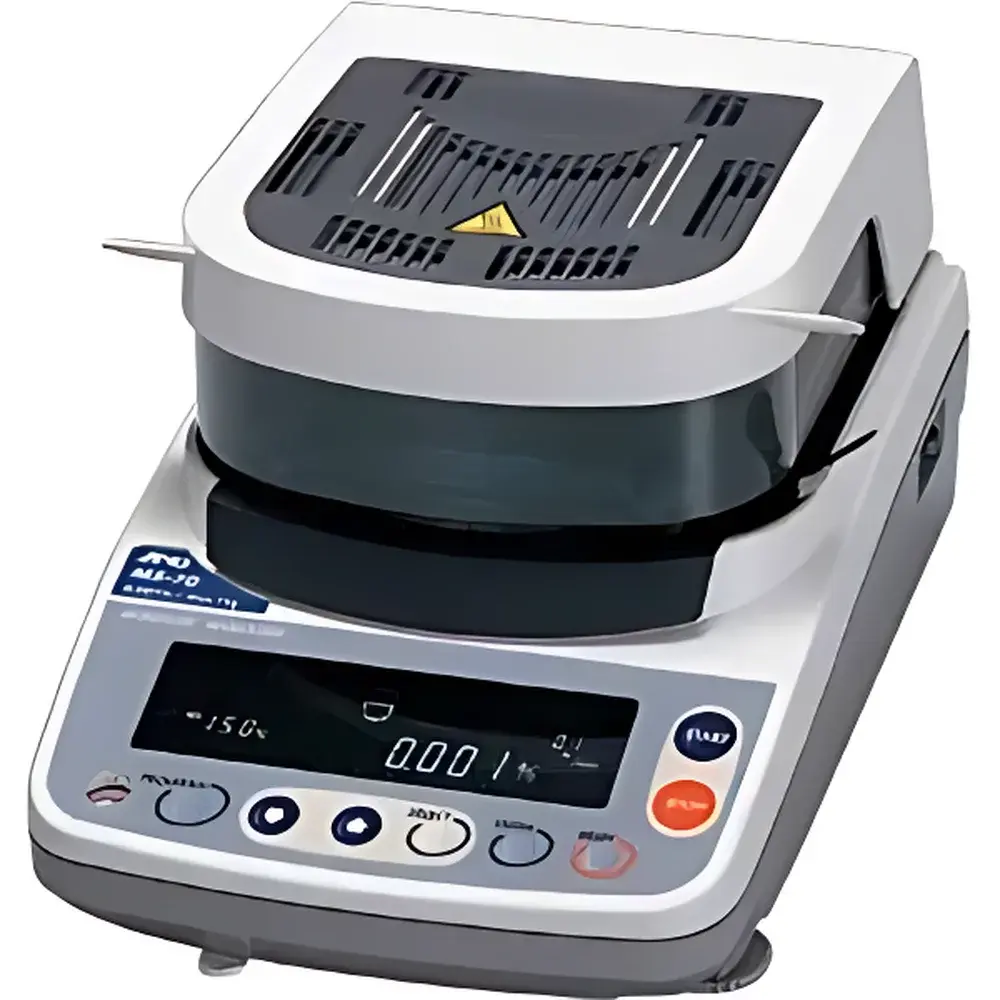
A&D MF-50 Halogen Moisture Analyzer
| Brand | A&D |
|---|---|
| Origin | Shanghai, China (Imported Japanese Design & Core Technology) |
| Heating Source | 400 W Halogen Lamp |
| Weighing Range | 51 g |
| Readability | 0.002 g |
| Moisture Content Accuracy | ±0.05 % / ±0.1 % / ±1.0 % (depending on sample mass and drying behavior) |
| Temperature Range | 50–200 °C |
| Sample Pan Diameter | 85 mm |
| Dimensions (W×D×H) | 215 × 320 × 173 mm |
| Weight | ~6.0 kg |
| Measurement Modes | Standard, Automatic, Timed, Manual |
| Drying Programs | Standard, Ramp, Step, Rapid |
| Data Storage | 10 measurement methods, 50 result records |
| Interface | RS-232 serial port |
| Compliance | GLP/GMP/ISO-compliant data logging with timestamp, operator ID, calibration history, and audit trail capability |
Overview
The A&D MF-50 Halogen Moisture Analyzer is an industrial-grade thermal gravimetric instrument engineered for rapid, reproducible determination of moisture content in solid, semi-solid, and powdered materials. Based on the principle of loss-on-drying (LOD), it employs a precisely controlled 400 W halogen heating source to drive off volatile components—primarily water—while continuously monitoring mass loss via a high-stability electromagnetic force restoration sensor. Unlike conventional infrared or convection ovens, the MF-50 integrates SRA (Secondary Radiation Assistance) technology: a proprietary reflector geometry surrounding the straight-tube halogen lamp ensures uniform radiant energy distribution across the sample surface, minimizing thermal gradients and accelerating equilibrium drying without charring or crust formation. This architecture delivers consistent LOD results in as little as 3–10 minutes—significantly faster than ASTM E1868 or ISO 4611 reference oven methods—while maintaining traceability to certified reference materials such as disodium tartrate dihydrate (certified moisture content: 15.66 % ±0.3/−0.1 %).
Key Features
- Halogen heating system with SRA reflector design for rapid, homogeneous sample heating and minimized measurement time
- Electromagnetic force compensation weighing mechanism with 0.002 g readability and optimized damping for stable readings under thermal load
- Five programmable measurement modes: Standard (adaptive endpoint detection), Automatic (based on %/min moisture loss rate threshold), Timed (user-defined duration), Rapid (200 °C preheat for first 3 min), and Manual (operator-initiated start/stop)
- Four drying profile options: Standard (instant ramp), Ramp (gradual temperature increase), Step (multi-stage temperature/time segments), and Rapid (200 °C burst followed by setpoint hold)
- Onboard storage for up to 10 user-defined methods and 50 measurement results, each tagged with date/time stamp, operator ID, and method identifier
- GLP/GMP-compliant reporting: All calibration events, zero checks, and measurement records include full metadata (e.g., firmware version, ambient temperature/humidity logs if external sensors are connected)
- Ergonomic wing-style lid handle and heat-resistant sample pan holder reduce operator exposure to thermal hazards during loading/unloading
- Modular halogen lamp design allows field replacement without system downtime; typical lamp service life exceeds 5,000 hours
Sample Compatibility & Compliance
The MF-50 accommodates diverse physical forms—including granules, pellets, powders, pastes, films, and suspensions—within its 85 mm diameter stainless-steel sample pan. Its 51 g capacity and 0.002 g resolution support both high-mass routine QC checks (e.g., polymer resin batches per ASTM D6980) and low-mass R&D samples (e.g., lyophilized pharmaceuticals). The instrument meets essential regulatory requirements for quality-controlled environments: all data outputs comply with FDA 21 CFR Part 11 principles (when used with WinCT software and appropriate IT controls), support ISO/IEC 17025 documentation workflows, and generate audit-ready reports conforming to GLP (OECD Series) and GMP (ICH Q5C, USP ) standards. Calibration verification using disodium tartrate dihydrate (Cat. No. AX-MX-33) provides documented traceability to NIST-traceable moisture reference materials.
Software & Data Management
The included WinCT software (MF edition) enables bidirectional RS-232 communication for real-time data streaming, method transfer, and report generation. It supports customizable graphical display of moisture loss kinetics (mass vs. time), enabling empirical optimization of drying profiles for challenging matrices—such as hygroscopic salts or thermally labile botanical extracts. All raw data files (.wct) store full metadata: instrument serial number, firmware revision, environmental conditions (if logged), calibration certificates, and user authentication tokens. Export formats include CSV (for LIMS integration), PDF (for QA sign-off), and XML (for enterprise ERP synchronization). Audit trail functionality records every parameter change, calibration action, and result export event with immutable timestamps and operator credentials.
Applications
The MF-50 serves as a primary moisture control tool across regulated and non-regulated sectors. In food manufacturing, it verifies compliance with Codex Alimentarius moisture limits for flour, spices, and dairy powders. In pharmaceutical production, it supports batch release testing of excipients per USP and stability-indicating assays for tablet granulations. Industrial users apply it to monitor slurry solids content in wastewater treatment, moisture in lithium-ion battery cathode precursors (per ISO 5725), and residual solvent levels in polymer extrusion feeds. Its robustness and repeatability make it suitable for ISO 17025-accredited laboratories performing contract testing for feed, fertilizer, and construction material suppliers.
FAQ
Is the MF-50 compliant with FDA 21 CFR Part 11?
Yes—when operated with WinCT software under validated IT infrastructure (including electronic signatures, access controls, and audit trail review protocols), the system satisfies electronic record and signature requirements.
Can I validate the halogen heater temperature accuracy?
While the MF-50 does not include built-in temperature probe calibration like the MS/MX series, external NIST-traceable thermocouple validation at the sample pan surface is recommended per ASTM E145 and documented in your laboratory’s IQ/OQ protocol.
What is the recommended maintenance schedule?
Perform daily zero calibration, weekly pan cleaning with isopropyl alcohol, and annual verification using disodium tartrate dihydrate; replace halogen lamp only upon output degradation or visible filament damage.
Does the instrument support network connectivity?
No native Ethernet or Wi-Fi; RS-232 remains the standard interface, though USB-to-RS232 adapters enable connection to modern PCs.
How does the MF-50 compare to the MX-50 in precision-critical applications?
The MX-50 offers 0.001 g readability and advanced temperature calibration options, making it preferred for R&D labs requiring sub-0.01 % moisture resolution; the MF-50 is optimized for high-throughput QC where ±0.05 % repeatability suffices.




