
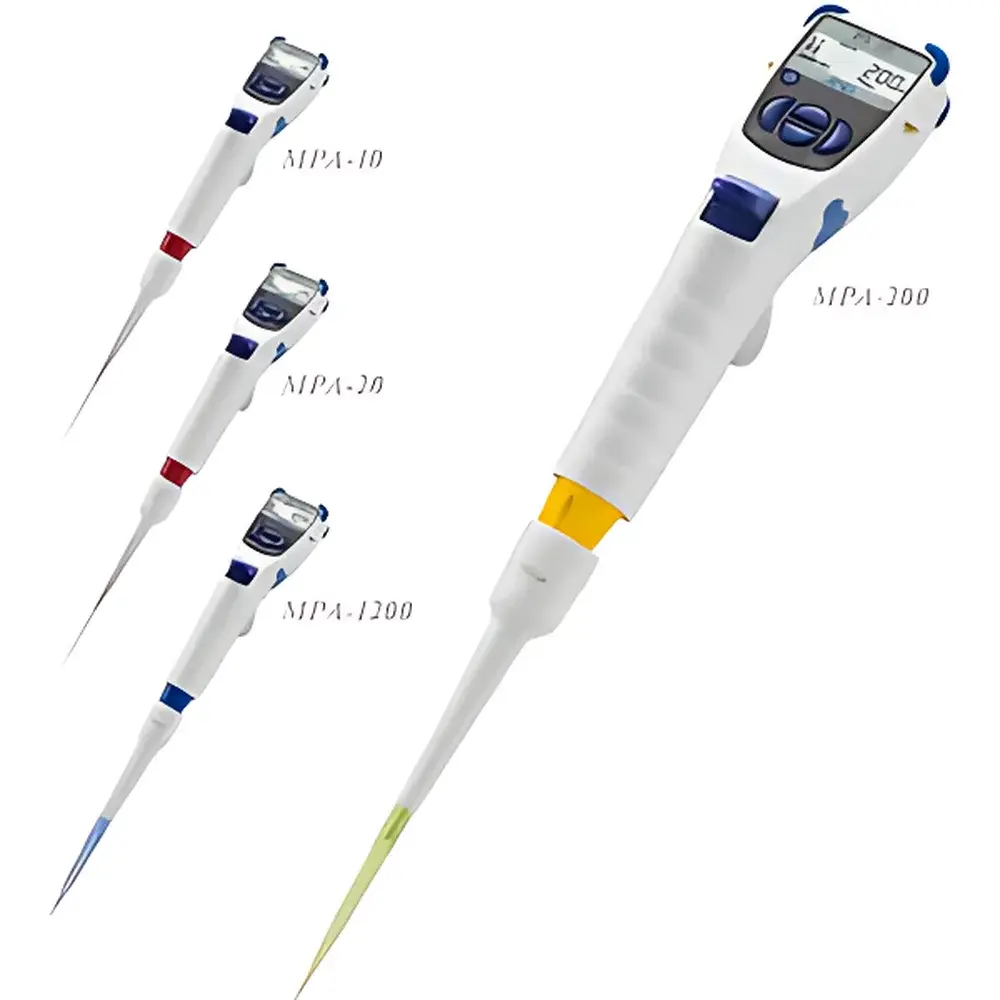
A&D MPA-10000 Electronic Single-Channel Pipette
| Brand | A&D |
|---|---|
| Origin | Japan |
| Manufacturer Type | Original Equipment Manufacturer (OEM) |
| Product Category | Imported Instrument |
| Model | MPA-10000 |
| Instrument Type | Single-Channel Electronic Pipette |
| Automation Level | Motorized |
| Channel Count | 1 |
| Volume Range | 0.1–10 mL |
| Maximum Capacity | 10 mL |
| Accuracy | ±2.5% (at 0.1 mL), ±1.0% (at 5.0 mL), ±0.5% (at 10.0 mL) |
| Precision (CV) | ≤0.6% (at 0.1 mL), ≤0.15% (at 5.0 mL and 10.0 mL) |
| Power Source | Rechargeable Lithium-ion Battery |
| Charging Interface | USB-C |
| Tip Attachment | Spring-assisted, leak-tight seal without manual compression |
| Calibration | User-accessible gravimetric and volumetric calibration routines |
Overview
The A&D MPA-10000 is a high-precision, motor-driven single-channel electronic pipette engineered for reproducible liquid handling across demanding laboratory environments—including clinical diagnostics, pharmaceutical QC, academic research, and biotechnology workflows. Unlike manually operated or basic semi-automated pipettes, the MPA-10000 employs closed-loop motor control with real-time torque feedback to ensure consistent aspiration and dispense forces across its full 0.1–10 mL volume range. Its measurement principle relies on precise displacement of an air-cushioned piston within a thermally stabilized chamber, minimizing evaporation-induced variability and thermal drift—critical for viscous, volatile, or temperature-sensitive samples. Designed and manufactured in Japan under ISO 9001-certified production facilities, the instrument meets stringent international performance benchmarks for volumetric accuracy and repeatability per ISO 8655-2 (2022) and ASTM E2758-19.
Key Features
- Four programmable dispensing modes: Standard Pipetting, Multiple Dispensing (up to 99 repeats), Mixing Dispensing (aspirate/dispense cycles within one tip), and Reverse Pipetting—optimized for high-viscosity or foaming liquids.
- Ergonomic design with tactile soft-touch buttons and low actuation force (≤0.8 N), significantly reducing risk of repetitive strain injury (RSI) during prolonged use—validated per ISO 10075-3 ergonomic assessment criteria.
- Tool-free, spring-loaded tip ejection and attachment system ensures rapid, consistent, and leak-tight sealing without manual thumb pressure—eliminating operator-dependent variability in tip fit.
- Impact-resistant, anti-glare LCD display with reinforced polycarbonate overlay and shock-absorbing internal mounting—tested to withstand 1.2 m drop onto concrete per IEC 60068-2-32.
- Integrated rechargeable lithium-ion battery supporting ≥8 hours of continuous operation (typical usage profile); USB-C port enables fast charging (<2 h to full capacity) and firmware updates via PC connection.
- User-accessible calibration suite supporting both gravimetric (weight-based) and volumetric (density-compensated) calibration protocols—fully compliant with GLP audit requirements and traceable to NIST-traceable reference standards.
Sample Compatibility & Compliance
The MPA-10000 accommodates standard conical polypropylene tips (10–1000 µL and 1–10 mL formats) and is compatible with low-retention, filtered, and sterile-filtered tip variants. It maintains accuracy when handling aqueous buffers, ethanol/water mixtures (up to 70% v/v), glycerol solutions (<25% w/w), and diluted protein formulations. The device conforms to electromagnetic compatibility (EMC) requirements per IEC 61326-1:2023 and electrical safety standards per IEC 61010-1:2010. All calibration data—including date, operator ID, ambient temperature/humidity, and deviation logs—are timestamped and stored internally with audit trail capability, satisfying FDA 21 CFR Part 11 electronic record integrity requirements when used with validated software interfaces.
Software & Data Management
While the MPA-10000 operates autonomously via onboard controls, optional A&D PipetteLink™ desktop software (Windows/macOS) enables remote configuration, method export/import, calibration report generation (PDF/CSV), and batch-level compliance documentation. All calibration events are digitally signed and include metadata required for ISO/IEC 17025 accreditation—e.g., uncertainty budgets, environmental conditions, and reference standard IDs. Firmware updates preserve user-defined methods and calibration history, ensuring continuity during regulatory inspections.
Applications
- Quantitative dilution series preparation for ELISA, qPCR, and cell culture media formulation.
- Accurate transfer of high-value reagents (e.g., antibodies, enzymes, radiolabeled compounds) where volume fidelity directly impacts assay sensitivity.
- Method transfer between labs requiring documented inter-instrument comparability (e.g., USP Analytical Instrument Qualification).
- Teaching laboratories requiring intuitive interface and built-in calibration training modules for student competency assessment.
- GMP-regulated environments where traceable, repeatable liquid handling supports process validation (ICH Q5C, Q7) and batch release testing.
FAQ
Does the MPA-10000 support multi-tip or multi-channel operation?
No—the MPA-10000 is strictly a single-channel electronic pipette. For parallel processing, A&D offers the MPA-8000 series (8- and 12-channel variants) with synchronized motor control.
Can calibration data be exported for internal QA review?
Yes—calibration reports, including raw weight measurements, calculated volumes, deviations, and uncertainty estimates, are exportable via USB-C or PipetteLink™ software in CSV and PDF formats.
Is the battery replaceable by the end user?
No—the lithium-ion battery is sealed and field-replaceable only by authorized A&D service centers to maintain IP54 ingress protection rating and calibration integrity.
What tip brands are certified for use with the MPA-10000?
A&D validates compatibility with universal-fit tips from major suppliers (e.g., Eppendorf, Gilson, Socorex, BRAND) meeting ISO 8655-3 dimensional tolerances; tip certification reports available upon request.
How often should user calibration be performed?
Per ISO 8655-5, daily verification is recommended before critical assays; full calibration is advised after 500 operations, tip type change, or environmental shift >5°C—configurable as automated reminders in PipetteLink™.



