
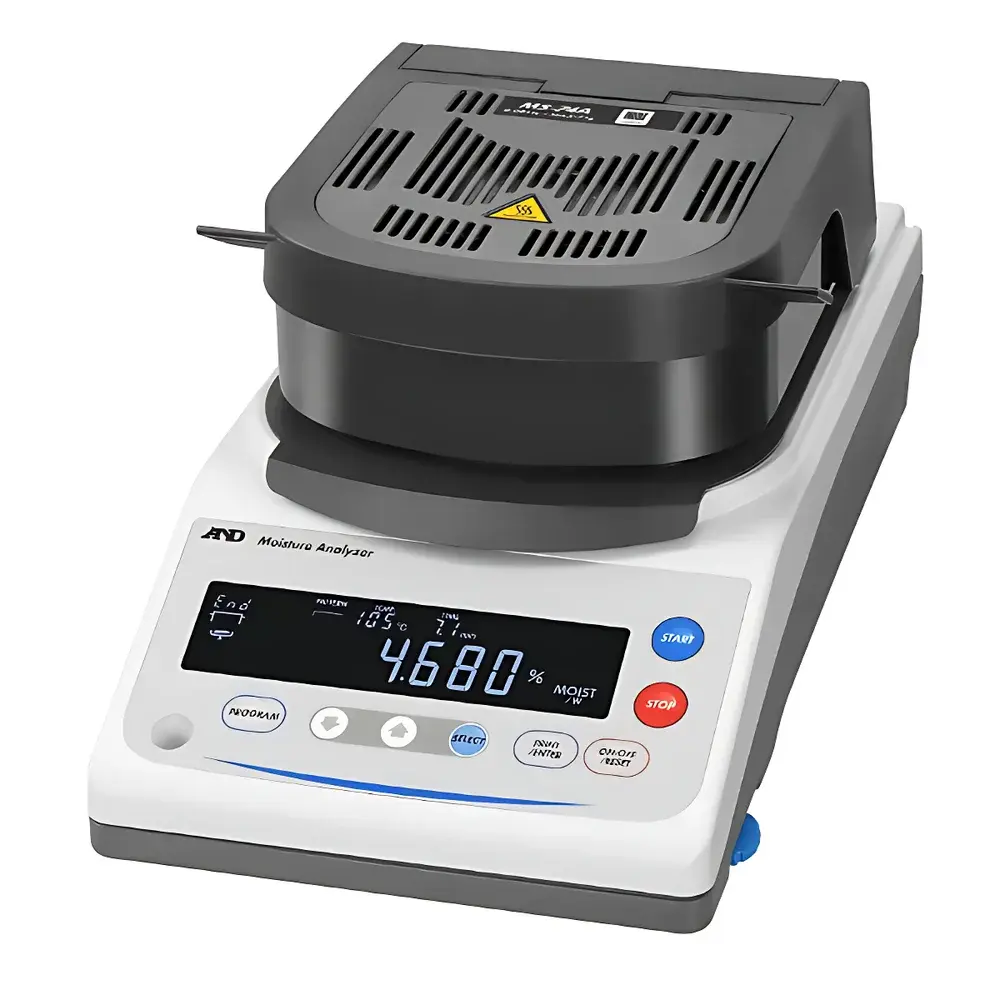
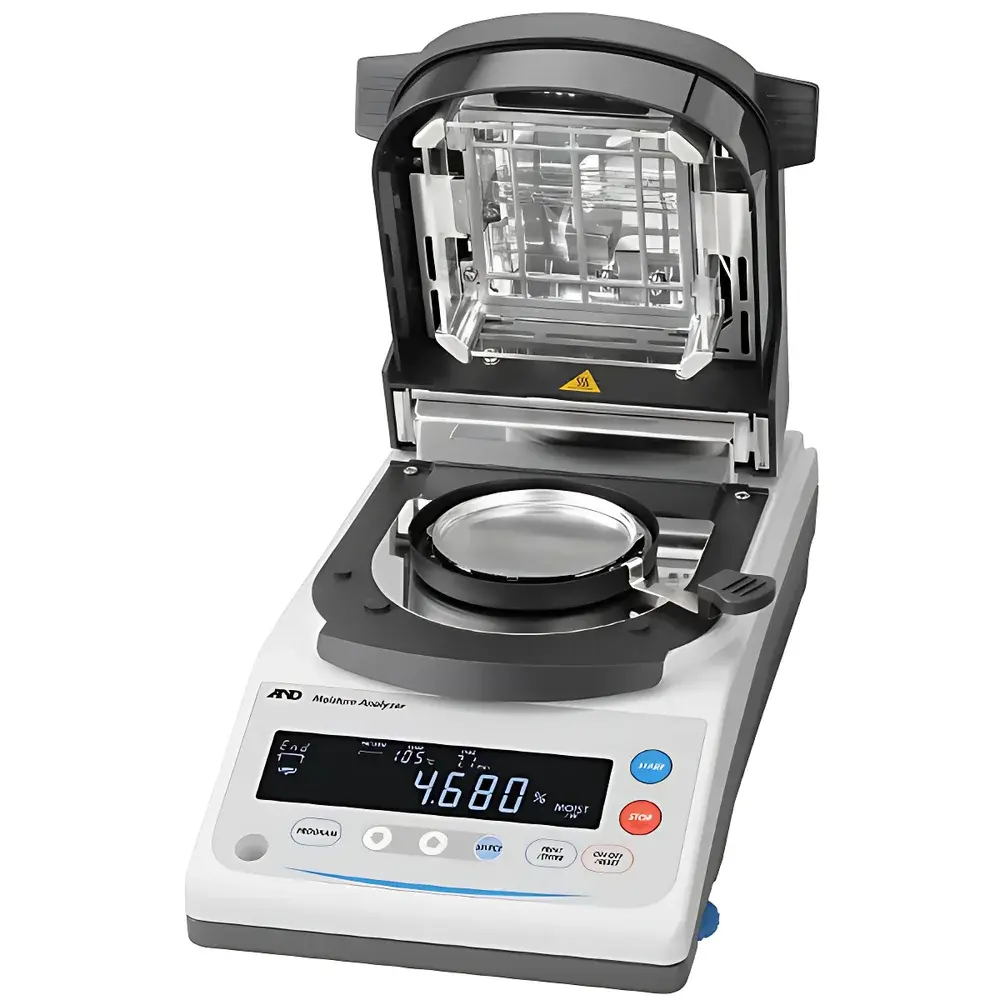
A&D MS74A Infrared Moisture Analyzer with LCD Display
| Brand | A&D |
|---|---|
| Origin | Japan |
| Manufacturer | A&D Co., Ltd. |
| Type | Imported Instrument |
| Model | MS74A |
| Heating Method | 400 W Linear Halogen Lamp |
| Moisture Resolution | 0.001% |
| Weighing Capacity | 71 g |
| Weighing Accuracy | 0.0001 g |
| Moisture Measurement Accuracy (≥5 g sample) | ±0.01% |
| Temperature Range | 30–200 °C |
| Sample Pan Diameter | φ90 mm |
| Display | High-Contrast LCD |
| Measurement Modes | Standard / Timed / Custom |
| Heating Profiles | Standard / Gradual / Step / Rapid |
| Predefined Methods | 100 templates |
| Stored Programs | Up to 300 |
Overview
The A&D MS74A Infrared Moisture Analyzer is a precision laboratory instrument engineered for rapid, reproducible moisture content determination in solid and semi-solid samples using halogen infrared heating combined with high-resolution analytical weighing. Based on the principle of loss-on-drying (LOD), the MS74A applies controlled thermal energy via a 400 W linear halogen lamp—optimized for uniform radiation distribution—and continuously monitors mass loss in real time using A&D’s proprietary SHS (Super Hybrid Sensor) weighing mechanism. Its core innovation lies in the SRA (Smart Radiation Adjustment) technology, which dynamically regulates radiant energy output to minimize thermal gradients across heterogeneous samples, thereby enhancing measurement repeatability and enabling reliable quantification down to 0.001% moisture (10 ppm). Designed for routine QC/QA environments in pharmaceuticals, polymers, food, chemicals, and materials science, the MS74A complies with fundamental method validation requirements aligned with ASTM E1064, USP , and ISO 5530-1 for gravimetric moisture analysis.
Key Features
- Integrated 400 W linear halogen lamp with SRA technology for uniform, controllable infrared heating and minimized edge overheating
- SHS dual-sensor weighing system delivering 0.0001 g readability and high stability under thermal load
- High-contrast monochrome LCD display with intuitive icon-driven interface—no touchscreen required, ensuring robustness in lab environments with gloves or ambient dust
- Three heating profile options: Standard (default ramp), Gradual (low-power pre-drying), Step (multi-stage temperature transitions), and Rapid (max power for fast volatiles)
- Daily verification function prompts users to perform built-in calibration checks—including zero tracking, span verification, and heater response test—prior to first use each day
- Plastic Moisture Guidance mode optimized for low-moisture polymer resins (<1% w/w), supporting user-defined parameters including initial sample mass (0.1–71 g), target temperature, and dwell time
- Real-time graphical display of mass vs. time and temperature vs. time curves during measurement, with automatic endpoint detection based on mass change rate thresholds
Sample Compatibility & Compliance
The MS74A accommodates a broad range of sample types including hygroscopic powders (e.g., APIs, excipients), thermally stable granules (catalysts, ceramics), foodstuffs (grains, dairy powders), and engineering plastics (PA6, PBT, PC). The φ90 mm stainless-steel sample pan ensures compatibility with both bulk and layered deposition. While not an automated GMP-compliant system per se, the instrument supports GLP/GMP-aligned workflows through its audit-ready features: full traceability of all measurement parameters (date/time stamp, operator ID placeholder, method name, temperature profile), non-editable raw data logs, and password-protected method editing. It meets mechanical and electrical safety standards IEC 61010-1 and is CE-marked for laboratory use within the EU.
Software & Data Management
All measurement data—including mass curves, final moisture %, drying rate profiles, and method metadata—are stored internally in non-volatile memory. Up to 300 user-defined methods can be saved with alphanumeric naming (e.g., “Lactose_USP_105C”), and each supports optional image annotation (via external USB camera integration, not included). Built-in search allows retrieval by sample name, date range, or moisture range. Export is supported via RS-232 serial interface to LIMS or Excel-compatible CSV files. No proprietary software installation is required; data transfer is handled via standard terminal emulation or simple ASCII dump protocols. Audit trail functionality records all method modifications, calibration events, and daily verification outcomes with timestamps—supporting compliance with FDA 21 CFR Part 11 when paired with appropriate networked documentation systems.
Applications
- Pharmaceutical: Quantification of residual solvents and hydrate water in active ingredients per ICH Q5C guidelines
- Plastics & Polymers: Pre-drying validation for injection molding feedstocks where <0.02% moisture is critical to prevent hydrolysis
- Food & Agriculture: Routine moisture testing of flour, coffee beans, and dried fruits per AOAC 950.46
- Chemicals & Catalysts: Monitoring hydration state of silica gels, molecular sieves, and metal oxides
- Academic Research: Method development for novel biomaterials and composite formulations requiring LOD-based moisture profiling
FAQ
What is the difference between SRA and conventional halogen heating?
SRA dynamically modulates lamp output intensity and spatial radiation distribution to maintain consistent surface temperature across irregular or layered samples—reducing charring and improving inter-run reproducibility compared to fixed-output lamps.
Can the MS74A comply with 21 CFR Part 11 requirements?
The device itself does not include electronic signatures or role-based access control; however, its immutable data logging, timestamping, and method traceability enable integration into validated Part 11–compliant laboratory networks when used with appropriate IT infrastructure and procedural controls.
Is calibration traceable to NIST or JCSS standards?
Yes—A&D provides optional factory calibration certificates traceable to JCSS (Japan Calibration Service System); users may also perform internal calibration using certified weights and reference moisture standards (e.g., sodium tartrate dihydrate).
How does the Plastic Moisture Guidance mode improve low-level moisture detection?
It applies a two-phase heating strategy: gentle pre-drying at lower temperatures to release surface moisture without melting, followed by precise ramping to higher setpoints to liberate bound water—while continuously monitoring mass derivative to avoid overshoot.
What maintenance is required for long-term accuracy?
Routine cleaning of the pan chamber and lamp reflector with lint-free cloth and isopropyl alcohol; annual verification of weighing sensor linearity and heater output stability using A&D-certified service kits or authorized service centers.





