
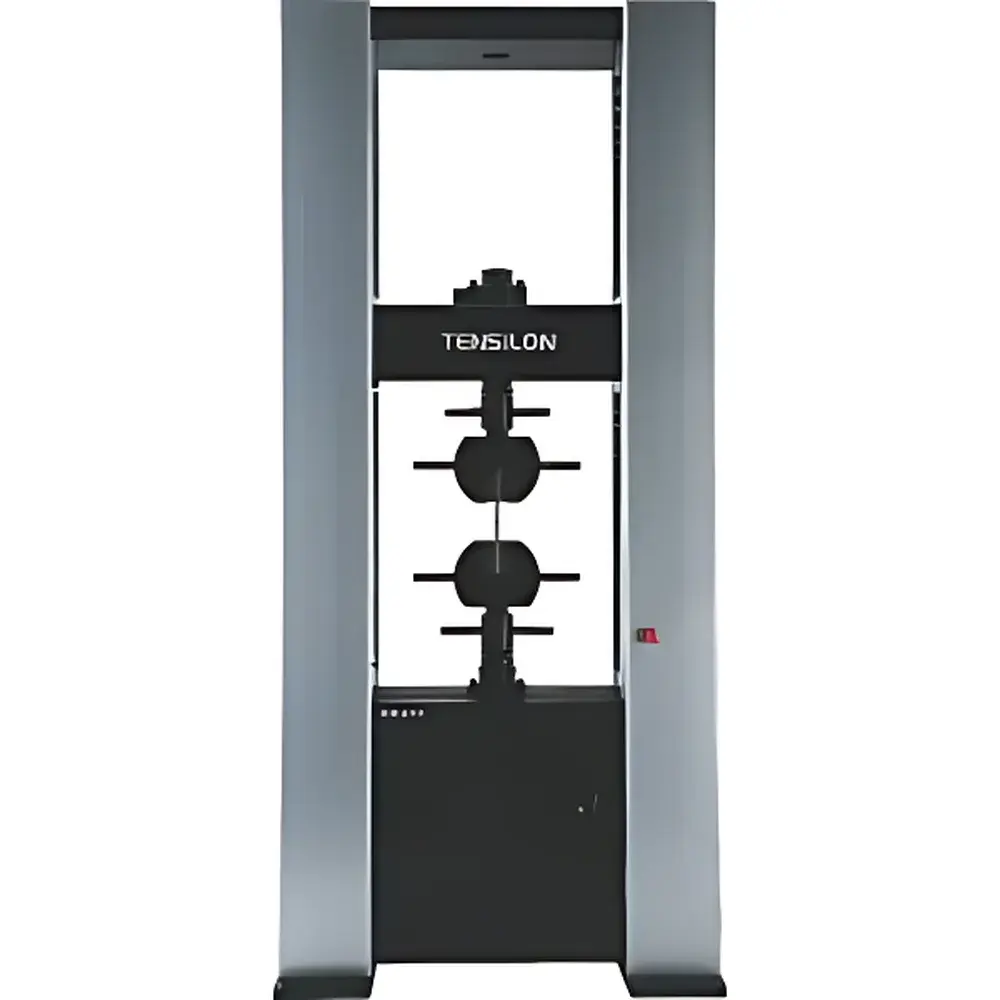
A&D RTF-2 Series Universal Tensile Testing Machine
| Brand | A&D |
|---|---|
| Origin | Japan |
| Model | RTF-2 Series |
| Load Capacity Range | 25 kN – 300 kN |
| Crosshead Speed Range | 0.0005 – 1000 mm/min |
| Speed Accuracy | ±0.2% |
| Load Measurement Accuracy | ±0.5% of reading (Class 0.5) |
| Sampling Rate | 1 ms |
| Input Channels | up to 13 |
| Control System | Closed-loop microcomputer-controlled brushless digital servo |
| Safety Features | Overload protection,行程 limit switches, sampling interruption |
| Calibration | One-touch automatic range calibration |
| Structural Rigidity | 30% higher than previous generation |
| Actuation | High-precision backlash-free ball screw |
| Force Sensor | ORIENTEC high-accuracy transducer |
| Optional | Full-color touch-screen interface |
Overview
The A&D RTF-2 Series Universal Tensile Testing Machine is a Class 0.5 precision mechanical testing system engineered for high-reproducibility static and quasi-static mechanical characterization of metallic, polymeric, composite, and elastomeric materials. Built upon A&D’s decades-long heritage in metrological instrumentation and compliant with ISO 7500-1:2018 (metallic materials — verification of static uniaxial testing machines), the RTF-2 integrates closed-loop microcomputer-controlled brushless digital servo actuation with ultra-low-noise force transduction and sub-millisecond data acquisition. Its structural architecture—featuring a reinforced load frame with 30% increased rigidity over prior generations—minimizes deflection under load, ensuring geometric stability during high-force tensile, compression, bend, peel, and shear tests. Designed for laboratories requiring traceable, audit-ready mechanical property data, the RTF-2 supports full compliance with ASTM E4, ASTM E8/E8M, ISO 6892-1, and JIS Z2241 standards.
Key Features
- Class 0.5 accuracy per ISO 7500-1:2018 — verified load measurement uncertainty of ±0.5% of reading across 1/1 to 1/500 of full scale
- Brushless digital servo motor drive — eliminates carbon dust contamination, prevents electrical arcing, and delivers >20,000-hour operational life without maintenance
- Backlash-free preloaded ball screw transmission — ensures positional repeatability better than ±0.005 mm over full stroke
- ORIENTEC-certified high-stability load cell — integrated temperature-compensated strain gauge technology with long-term zero drift <0.02% FS/month
- Real-time 1 ms sampling rate — captures transient yield events, necking onset, and fracture initiation with temporal fidelity required for ISO 10365-compliant dynamic modulus estimation
- 13-channel synchronized analog input capability — enables concurrent acquisition of extensometer displacement, environmental chamber signals, video correlation triggers, or acoustic emission outputs
- Optional high-visibility color touchscreen HMI — supports multi-language UI, intuitive test method templating, and on-device result review without external PC dependency
Sample Compatibility & Compliance
The RTF-2 accommodates specimens ranging from miniature biomedical sutures (diameter ≥0.1 mm) to structural steel coupons (width ≤590 mm, thickness ≤100 mm). Standard configurations include wedge-action grips, pneumatic clamps, and modular bending fixtures compatible with ASTM E292 and ISO 14577 indentation accessories. All mechanical components are manufactured in Japan using JIS G4051 S45C-grade structural steel and hardened anodized aluminum alloys. The system conforms to IEC 61000-6-2 (EMC immunity) and IEC 61000-6-4 (EMC emissions), and its firmware architecture supports 21 CFR Part 11-compliant electronic signatures and audit trails when paired with validated software modules. Calibration certificates are issued with NIST-traceable reference standards and include uncertainty budgets per ISO/IEC 17025 requirements.
Software & Data Management
Control and analysis are performed via A&D’s TENSILON TestSuite v4.x — a Windows-based application supporting GLP/GMP workflows. The software provides preconfigured test methods aligned with ASTM D638, ISO 527-2, and EN 10002-1, with customizable pass/fail criteria, real-time stress-strain curve overlay, and automated report generation in PDF/A-1b or Excel XML formats. Raw data is stored in vendor-neutral HDF5 format with embedded metadata (operator ID, environmental conditions, calibration timestamps). Audit logs record all user actions—including parameter edits, calibration events, and result exports—with immutable SHA-256 hashing. Optional integration with LIMS platforms is available via OPC UA or RESTful API endpoints.
Applications
- Tensile strength, yield point, elongation at break, and modulus determination for aerospace alloys (e.g., Ti-6Al-4V, AA7075-T6)
- Compression testing of pharmaceutical tablets per USP <1217> and ISO 13314
- Peel adhesion evaluation of pressure-sensitive tapes and laminates per ASTM D903 and ISO 8510-2
- Flexural property assessment of fiber-reinforced polymer composites (ASTM D7264/D7264M)
- Creep and stress-relaxation profiling under constant load or strain conditions
- Quality control validation for automotive gaskets, rubber bushings, and thermoplastic elastomers
FAQ
What international standards does the RTF-2 comply with for load cell verification?
The RTF-2 meets ISO 7500-1:2018 Class 0.5 requirements for static force verification and is supplied with factory calibration certificates traceable to NMIJ (National Metrology Institute of Japan) standards.
Can the system be integrated into an existing laboratory network with centralized data archiving?
Yes — TENSILON TestSuite supports domain-authenticated network deployment, automated daily backup to UNC paths or SFTP servers, and metadata tagging for enterprise search indexing.
Is manual calibration required after installation?
No — the system features one-touch automatic range calibration with built-in reference shunt resistors; only annual third-party verification is recommended per ISO/IEC 17025.
What safety interlocks are implemented in the mechanical design?
Dual independent limit switches (upper/lower), hardware-enforced emergency stop circuitry (EN 60204-1), and software-configurable overload cutoff thresholds prevent mechanical damage and operator hazard.
Does the RTF-2 support extensometer inputs for true strain measurement?
Yes — it accepts analog outputs from clip-on, video, or laser extensometers via dedicated differential input channels with programmable filtering and zero-reset functions.



