
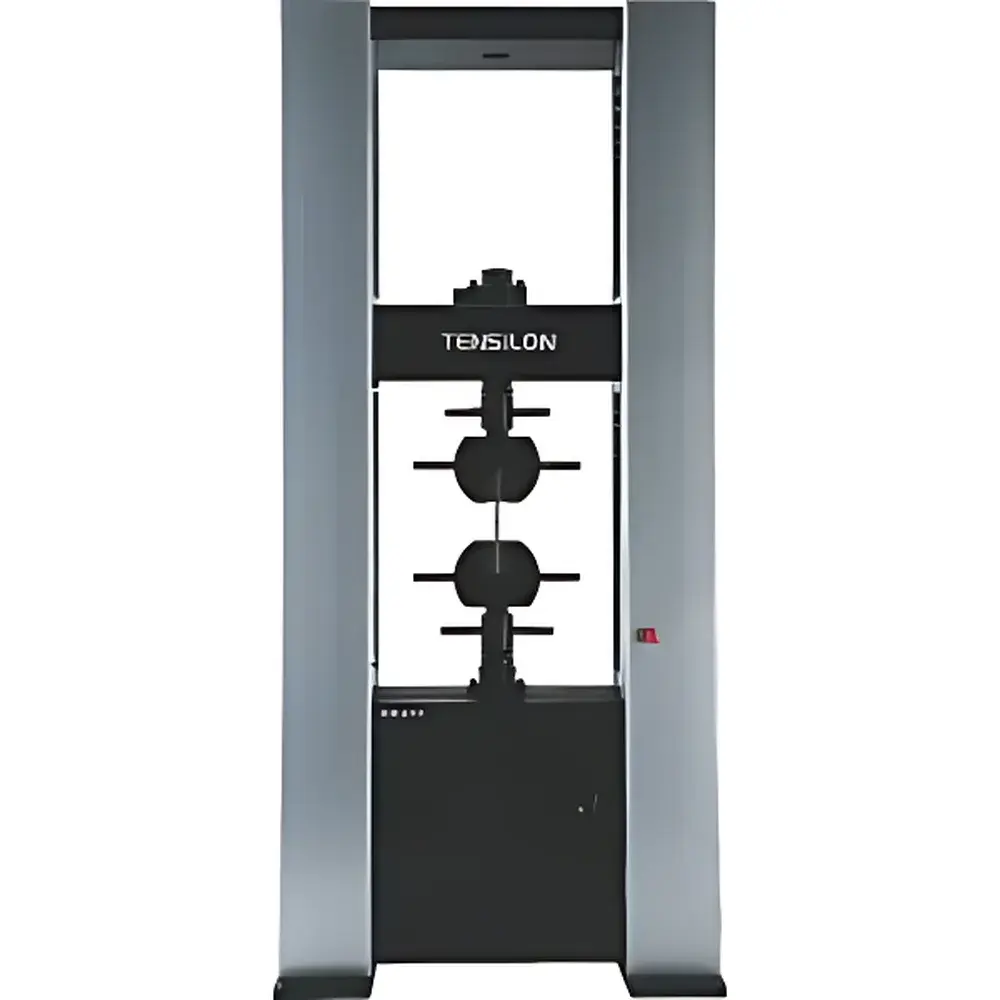
A&D RTF Series Universal Tensile Testing Machine
| Brand | A&D |
|---|---|
| Origin | Japan |
| Model | RTF Series |
| Load Capacity Range | 1 kN to 50 kN |
| Load Accuracy | ±0.5% of reading |
| Crosshead Speed Range | 0.0005–1000 mm/min |
| Speed Accuracy | ±0.1% |
| Sampling Interval | 1 ms |
| Load Frame Rigidity Increase | 30% vs. prior generation |
| Drive System | Brushless digital servo motor with closed-loop microcomputer control |
| Force Sensor | ORIENTEC high-precision transducer |
| Lead Screw | High-accuracy backlash-free ball screw |
| Input Channels | Up to 13 analog/digital signal inputs |
| Compliance | Meets JIS B 7721 Class 0.5 (equivalent to ISO 7500-1 Class 0.5 and ASTM E4) |
Overview
The A&D RTF Series Universal Tensile Testing Machine is a Class 0.5 precision mechanical testing system engineered for high-reproducibility static and quasi-static mechanical property characterization in R&D, quality assurance, and production environments. Based on JIS B 7721, ISO 7500-1, and ASTM E4 metrological standards, the RTF platform employs a closed-loop brushless digital servo drive architecture coupled with ORIENTEC-certified force transducers and zero-backlash ball screws to deliver traceable, repeatable load and displacement measurements across its full capacity range—from 1 kN to 50 kN. Its reinforced load frame—structurally optimized to increase rigidity by 30% over previous generations—minimizes deflection under load, ensuring geometric stability during high-force tensile, compression, flexural, peel, and cyclic tests. Designed for integration into GLP-compliant laboratories and ISO 17025-accredited testing facilities, the RTF series supports audit-ready data integrity through deterministic sampling at 1 ms intervals, automatic calibration traceability, and dual-channel real-time acquisition of force and displacement alongside up to 11 auxiliary signals (e.g., extensometer output, environmental sensor data, or custom analog inputs).
Key Features
- Class 0.5 accuracy per JIS B 7721 / ISO 7500-1: load measurement uncertainty ≤ ±0.5% of reading across 1/1–1/500 of full scale
- Brushless digital servo motor drive: eliminates carbon dust contamination, prevents electrical arcing, and ensures >20,000-hour operational life without maintenance
- Zero-backlash precision ball screw transmission: enables sub-micron positional resolution and eliminates hysteresis in displacement control
- ORIENTEC high-stability load cell: temperature-compensated, hermetically sealed, with built-in self-diagnostic circuitry
- 13-channel synchronized data acquisition: supports simultaneous recording of force, crosshead position, extensometer strain, thermal chamber feedback, pneumatic pressure, and user-defined analog inputs
- Configurable human-machine interface: optional 7-inch color touchscreen (OP-01) with intuitive icon-based navigation and multi-language support (English, Japanese, Chinese, Korean)
- Intelligent hand controller: ergonomic rotary knob for manual crosshead positioning; LED status indicators; mountable on top, bottom, left, or right of frame
- Auto-ranging force measurement: 128-step fully automatic range switching with seamless transition and no signal interruption
- One-touch calibration: internal reference load verification with electronic zeroing and span adjustment stored in non-volatile memory
- Mechanical overload protection: dual-stage hardware limit switches plus software-based emergency stop logic
Sample Compatibility & Compliance
The RTF Series accommodates specimens ranging from thin polymer films (<0.05 mm) to structural metallic coupons (up to 590 mm wide), with maximum test stroke up to 1100 mm. Standard fixture interfaces support ISO 204, ASTM E8/E21, JIS Z 2241, and ISO 6892-1 compliant test geometries. Optional accessories include pneumatic vise grips (RTF-PG), wedge-action clamps (RTF-WC), compression cages (RTF-CC), three-point bend fixtures (RTF-3PB), and axial extensometers—both contact-type (RTF-CE) and non-contact video-based (RTF-VX). Environmental compatibility extends to temperature-controlled chambers (−70°C to +300°C), humidity-controlled enclosures (10–95% RH), vacuum chambers (10⁻³ Pa), and liquid immersion fixtures. All configurations maintain compliance with ISO/IEC 17025 documentation requirements, including full audit trails for calibration history, operator login events, and parameter change logs—supporting FDA 21 CFR Part 11 readiness when used with MSAT software and Windows domain authentication.
Software & Data Management
The MSAT (Multi-Signal Analysis Testing) software suite serves as the primary control and analysis environment for the RTF system. Running on Windows XP or later (minimum 512 MB RAM, 800×600 display), MSAT provides preconfigured test methods aligned with ISO 6892-1 (tensile), ISO 178 (flexure), ISO 1133 (melt flow), ASTM D638/D790, and JIS K 7113. Each test method includes configurable ramp rates, hold durations, cycle counts, and failure criteria. Raw data is saved in binary format with embedded metadata (operator ID, timestamp, environmental conditions, calibration certificate IDs). Post-test analysis modules compute modulus, yield strength, elongation at break, Poisson’s ratio, creep compliance, and stress relaxation curves. Export options include CSV, Excel (.xlsx), PDF reports with embedded charts, and XML for LIMS integration. MSAT maintains full revision control, electronic signatures, and 21 CFR Part 11–compliant audit trails—including who changed what parameter, when, and why—enabling GMP/GLP validation.
Applications
The RTF Series is routinely deployed in materials science laboratories for mechanical property mapping of thermoplastics, elastomers, composites, thin films, adhesives, biomedical polymers, and metal alloys. In manufacturing QA/QC, it validates incoming raw material specifications against ASTM D3039 (composite tensile), ISO 527 (plastics), or ISO 13934-1 (textiles). Automotive suppliers use it for seatbelt webbing certification (FMVSS 209), while medical device firms perform suture tensile testing per ISO 10555-1 and balloon burst testing per ISO 10555-4. Academic users leverage its multi-channel capability for coupled thermo-mechanical experiments—e.g., synchronizing load-displacement data with thermocouple readings during dynamic mechanical analysis—or for real-time feedback control in servo-hydraulic hybrid setups. The system also supports long-term creep and stress relaxation studies under constant load, with automated data logging over periods exceeding 1000 hours.
FAQ
What international standards does the RTF Series comply with?
The RTF Series meets JIS B 7721 Class 0.5, ISO 7500-1 Class 0.5, and ASTM E4 requirements for force measurement accuracy. It supports test execution per ISO 6892-1, ASTM D638, ISO 178, and other widely adopted mechanical testing standards.
Is the system compatible with modern Windows operating systems?
Yes—MSAT software supports Windows 7, 10, and 11 (64-bit), provided minimum system requirements (2 GB RAM, 120 MB disk space, USB 2.0 port) are met. Legacy Windows XP support remains available for validated environments.
Can I integrate an external environmental chamber?
Absolutely. The RTF Series features analog voltage input channels and TTL-triggered I/O ports designed for direct synchronization with commercial temperature/humidity/vacuum chambers. Full environmental feedback logging is supported within MSAT.
How is calibration traceability maintained?
Each RTF unit ships with a factory calibration certificate traceable to NMIJ (National Metrology Institute of Japan). Internal one-touch calibration uses certified reference loads; all calibration events—including date, operator, and deviation values—are permanently recorded in the audit log.
What extensometer options are available for strain measurement?
Contact-type clip-on extensometers (RTF-CE series) and non-contact digital image correlation (DIC) systems (RTF-VX series) are supported. Both provide synchronized 1 ms sampling and auto-zeroing upon specimen mounting.



