
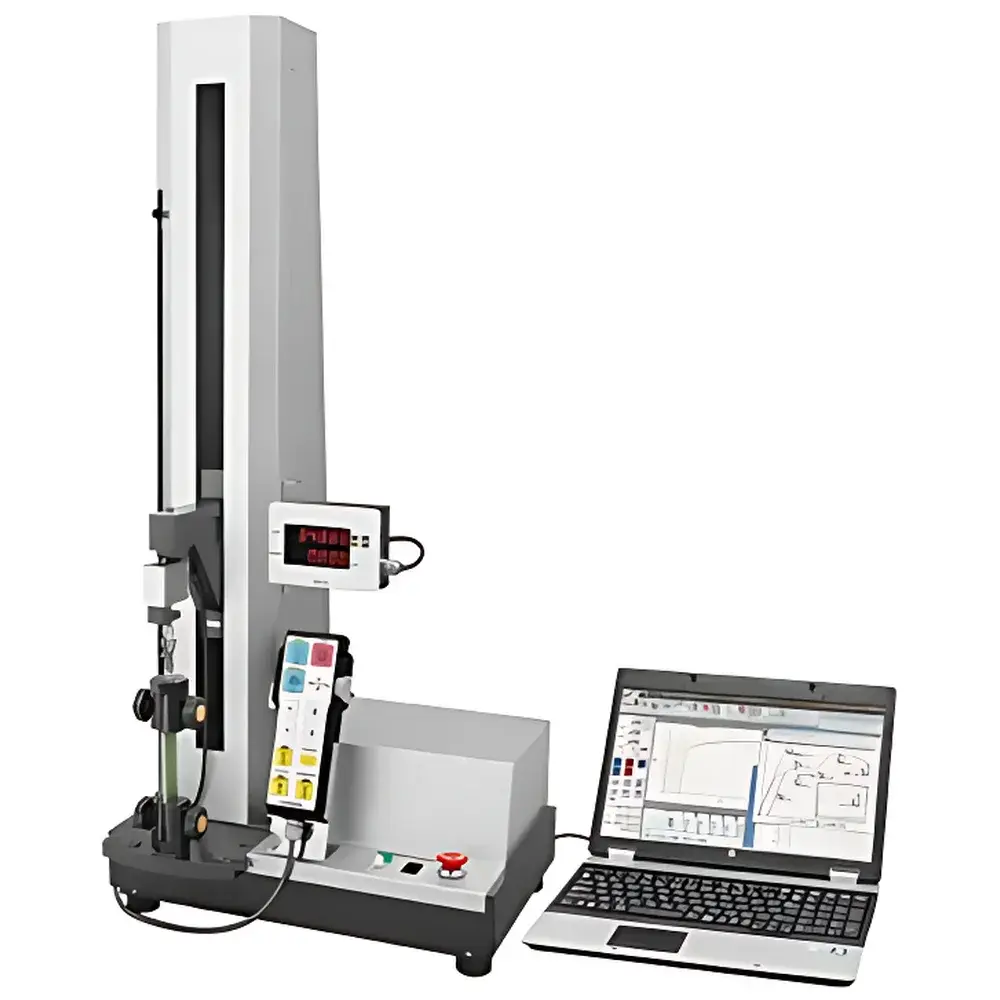
A&D STB-1225L / STB-1225S Universal Testing Machine
| Brand | A&D |
|---|---|
| Origin | Japan |
| Model | STB-1225L / STB-1225S |
| Max Load | 2.5 kN |
| Effective Stroke | 850 mm (STB-1225L) / 550 mm (STB-1225S) |
| Crosshead Speed Range | 0.05–1000 mm/min |
| Speed Resolution | 0.01 mm/min |
| Speed Accuracy | ±0.5% |
| Load Accuracy | ±1% of reading (within 1/1 to 1/500 of sensor rated capacity) |
| Auto Range Switching | up to 128× |
| Load Calibration | one-button sensor-integrated calibration with sensor identification |
| Overload Protection | yes |
| Travel Limiters | dual (upper/lower) |
| Dimensions (L×H×W) | 470×1450×335 mm (L) / 470×1050×335 mm (S) |
| Weight | 56 kg (L) / 43 kg (S) |
| Power Supply | AC 100 V, 1Φ, 50/60 Hz, 350 VA |
| Operating Environment | 5–40 °C, 20–80 %RH |
Overview
The A&D STB-1225L and STB-1225S are high-precision, microprocessor-controlled universal testing machines engineered for static mechanical property evaluation of metallic, polymeric, composite, and elastomeric materials in R&D, quality control, and production environments. Based on servo-controlled electromechanical actuation, these systems comply with fundamental principles of uniaxial tensile, compression, flexure, peel, and shear testing per ISO 6892-1, ASTM E4, ASTM D638, ASTM D790, and JIS Z2241 standards. The dual-model architecture—distinguished by effective stroke length (850 mm for STB-1225L; 550 mm for STB-1225S)—enables flexible integration into constrained laboratory spaces or extended-sample applications such as wire, cable, or textile testing. Structural rigidity is maintained through a reinforced C-frame design with precision-ground guide columns and preloaded ball screws, ensuring minimal deflection (<0.02 mm under full load) and high axial alignment reproducibility.
Key Features
- High-speed data acquisition at 0.2 ms sampling interval when used with optional TACT digital controller—enabling accurate capture of transient yield events and dynamic modulus transitions.
- Full PC-based test configuration: All parameters—including load rate, displacement ramp, hold duration, break detection thresholds, and cyclic profiles—are programmable via standard Ethernet or USB interface using A&D’s compliant test software suite.
- 128× fully automatic load cell range switching eliminates manual range selection errors and ensures optimal signal-to-noise ratio across the entire 2.5 kN capacity, from sub-newton preloads to maximum-rated force.
- Energy-efficient standby mode reduces power consumption by 30% relative to conventional operation—meeting IEC 62301 ed.2 standby power requirements without compromising system readiness.
- Optional multifunctional color touchscreen interface (7-inch, 800×480 resolution) supports intuitive drag-and-drop test sequence building, real-time curve overlay, and on-device result validation—reducing dependency on external PCs during routine QC checks.
- Integrated load calibration architecture embeds self-identification circuitry within each transducer, enabling automated sensor recognition, zero-point verification, and traceable one-button calibration—all logged with timestamp and operator ID for GLP/GMP audit compliance.
Sample Compatibility & Compliance
The STB-1225 series accommodates specimens ranging from thin films (≥0.05 mm thickness) to structural rods (≤25 mm diameter) using interchangeable grips—including pneumatic wedge, screw-action vise, and hydraulic clamping options (available separately). Standard configurations support ASTM E8/E8M-compliant tensile coupons, ISO 527-2 Type 1BA bars, and EN 13115-2 peel substrates. All mechanical and electrical subsystems conform to IEC 61000-6-2 (immunity) and IEC 61000-6-4 (emission) EMC directives. CE marking is affixed per Machinery Directive 2006/42/EC and Low Voltage Directive 2014/35/EU. Optional 21 CFR Part 11–compliant software modules provide electronic signatures, audit trails, and role-based access control for regulated pharmaceutical and medical device manufacturing.
Software & Data Management
A&D’s proprietary TestMaster Pro software (v5.2+) delivers ISO/IEC 17025-aligned reporting workflows, including automatic generation of stress–strain curves, modulus calculation (secant, tangent, chord), elongation-at-break, yield point determination (0.2% offset method), and statistical summaries (n ≥ 3). Raw data export is supported in CSV, XML, and ASTM E1434-compliant .tdf formats. Database integration enables direct linkage to LIMS platforms via ODBC drivers. All test sessions record metadata—including environmental conditions (via optional external sensor input), operator credentials, calibration history, and instrument firmware version—ensuring full traceability for internal audits or regulatory inspections.
Applications
- Tensile characterization of thermoplastic filaments (FDM/SLA additive manufacturing feedstock)
- Compression testing of biomedical hydrogels and soft tissue simulants per ISO 13314
- Flexural modulus determination of fiber-reinforced polymer laminates (ASTM D7264)
- Peel adhesion assessment of pressure-sensitive tapes and medical transdermal patches (ASTM D903)
- Cyclic fatigue evaluation of elastomeric seals under controlled strain amplitude (ISO 13384)
- Quality conformance verification of automotive fasteners and stamped metal components (VDA 238-100)
FAQ
What standards does the STB-1225 series support out-of-the-box?
The base firmware and software include preconfigured test methods for ISO 6892-1 (tensile metals), ASTM D638 (plastics), and JIS Z2241 (general mechanical testing), with additional templates available via A&D’s Application Library.
Is external environmental monitoring integrated into test reports?
Yes—when connected to optional temperature/humidity sensors via analog input or RS-485, ambient conditions are automatically embedded in the test header and PDF report footer.
Can the system perform closed-loop strain control?
Strain control requires an external extensometer (e.g., A&D ES-25 series) and is enabled via optional Advanced Control Module licensing—supporting constant strain rate, strain hold, and ramp-hold sequences.
How is metrological traceability maintained for load calibration?
Each load cell includes NIST-traceable calibration certificate (valid for 12 months); onboard calibration logs retain full audit trail including date, operator, reference standard ID, and deviation values against certified weights.
Does the STB-1225S meet the same accuracy specifications as the STB-1225L?
Yes—both models share identical force measurement accuracy (±1%), speed control fidelity (±0.5%), and data acquisition resolution; only mechanical envelope dimensions and stroke differ.



