
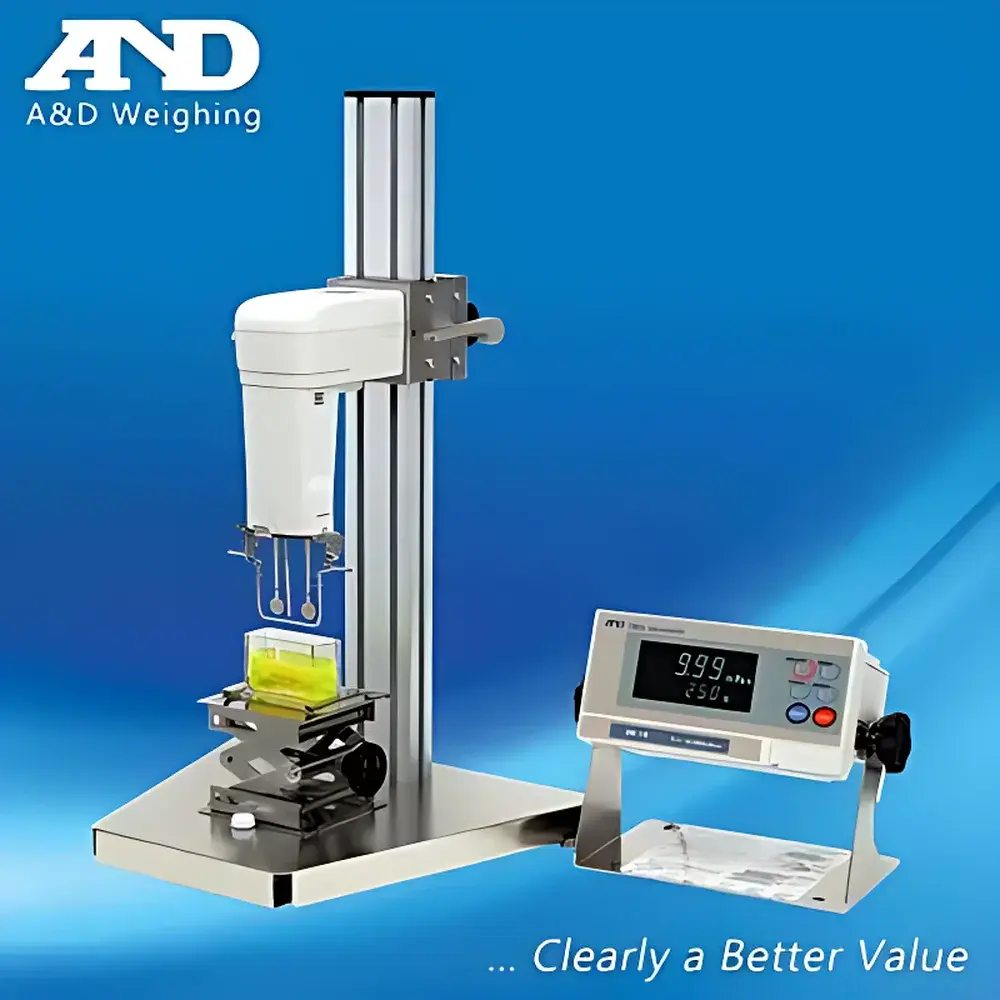
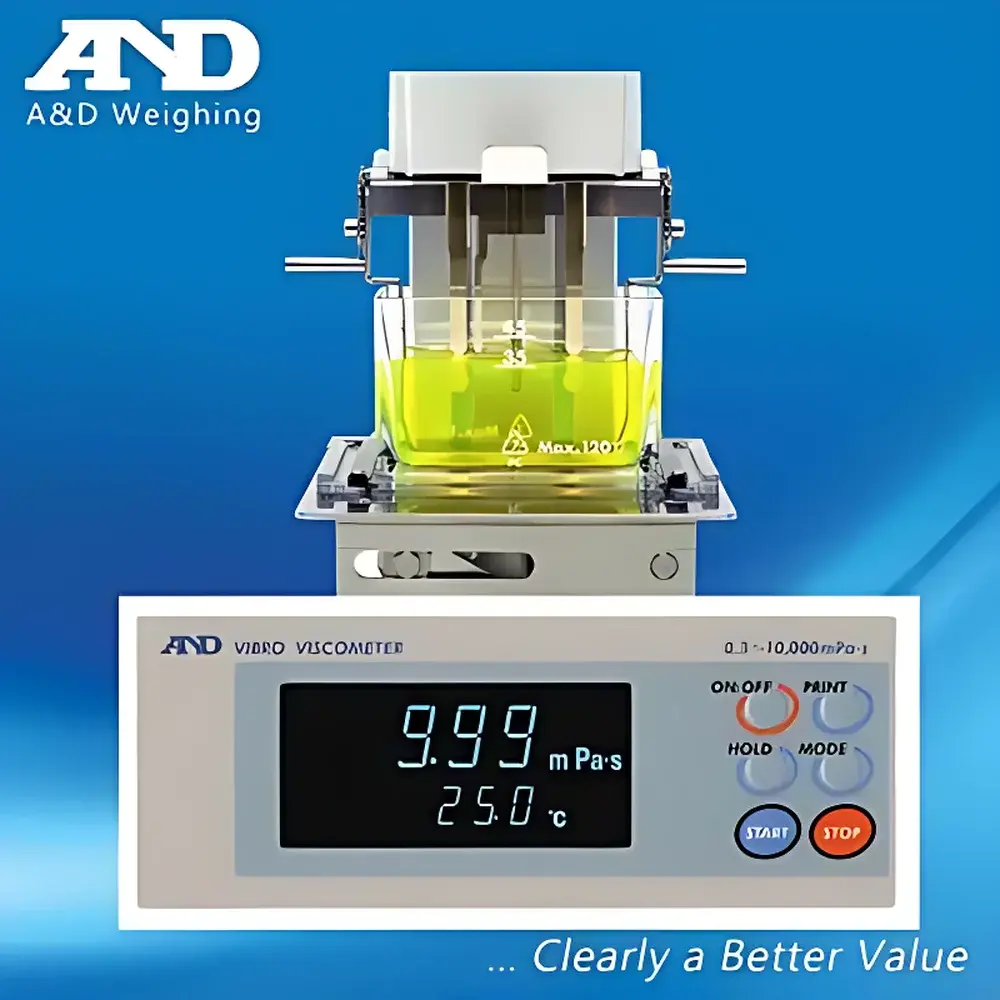
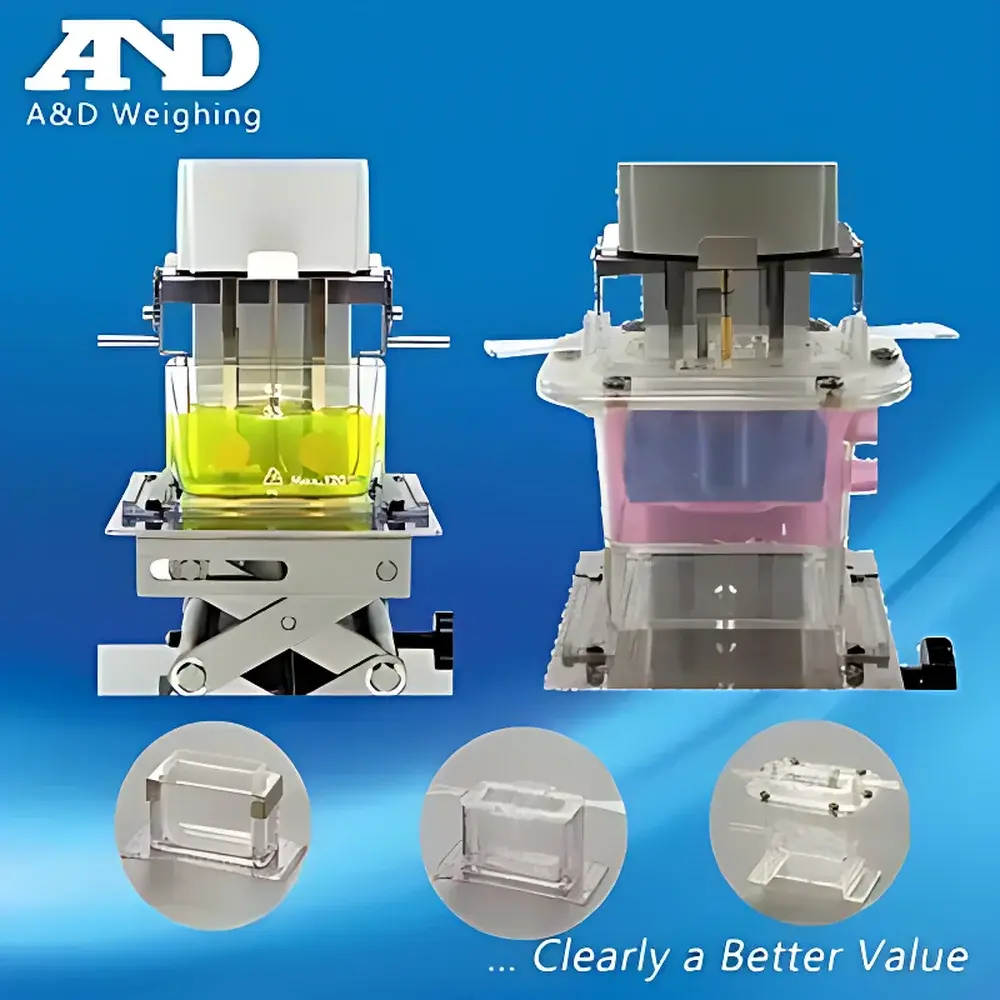
A&D SV-10 Sinusoidal Vibration Viscometer
| Brand | A&D |
|---|---|
| Origin | Japan |
| Manufacturer Type | Original Equipment Manufacturer (OEM) |
| Origin Category | Imported |
| Model | SV-10 |
| Instrument Type | Oscillatory Viscometer |
| Mounting Style | Benchtop Fixed |
| Operating Environment | High-Temperature Capable |
| Viscosity Range | 0.3 mPa·s to 10 Pa·s |
| Temperature Range | 0–160 °C |
| Temperature Accuracy | ±0.1 °C |
| Temperature Resolution | 0.1 °C |
| Heating Rate | 1 °C/min |
| Vibration Frequency | 30 Hz |
| Amplitude | 1 mm |
| Repeatability | ±1% of reading (std. dev.) |
Overview
The A&D SV-10 Sinusoidal Vibration Viscometer is an OEM-engineered benchtop instrument designed for precise, continuous viscosity measurement of liquids under controlled thermal conditions. It operates on the principle of sinusoidal oscillation—specifically, dual-sensor disc vibration at a fixed frequency of 30 Hz—generating shear stress within the sample via controlled mechanical resonance. Unlike rotational or capillary viscometers, this method imposes minimal hydrodynamic disturbance, enabling stable measurement of low-viscosity Newtonian fluids as well as complex non-Newtonian systems—including foamed, aerated, or shear-sensitive formulations—without structural breakdown or thermal artifact generation. The sensor geometry and low-amplitude (1 mm), low-frequency excitation ensure negligible viscous heating (<0.02 °C rise during 30-min continuous operation), making the SV-10 suitable for extended real-time monitoring in both laboratory and pilot-scale process environments.
Key Features
- Single-Sensor Platform with Wide Dynamic Range: Measures viscosity continuously from 0.3 mPa·s to 10 Pa·s (10,000 mPa·s) without sensor exchange—eliminating calibration drift associated with multi-range hardware switching.
- Integrated Dual-Function Sensing Architecture: Co-located platinum resistance thermometer (Pt100-class) positioned precisely between the two oscillating discs ensures representative bulk temperature sampling—critical for accurate temperature-dependent viscosity modeling per ASTM D445 and ISO 3104.
- Thermally Stable Real-Time Measurement: Low thermal mass of the sensing assembly enables rapid thermal equilibration (<90 s from setpoint change), supporting dynamic viscosity profiling across programmed temperature ramps (1 °C/min).
- Non-Destructive Sample Interaction: Sub-millimeter disc displacement and symmetrical counter-phase oscillation minimize flow-induced shear history, preserving foam integrity and enabling measurement of unstable, settling, or heterogeneous suspensions.
- Process-Compatible Design: Fixed-mount configuration with optional AX-SV-37 recirculating bath interface supports integration into jacketed reactors, inline blending stations, or QC lab workflows requiring traceable thermal control.
- JCSS-Validated Methodology: The sinusoidal vibration principle is certified by Japan Calibration Service System (JCSS) under reference standard JCSS-VM-001, ensuring metrological traceability to NMIJ (National Metrology Institute of Japan).
Sample Compatibility & Compliance
The SV-10 accommodates samples ranging from volatile solvents (e.g., ethanol, acetone) to high-boiling polymer melts (e.g., molten starch derivatives, pharmaceutical excipients). Its non-rotating, immersion-style sensor design avoids wall-slip errors common in cone-and-plate systems and eliminates air entrapment issues seen in falling-ball methods. Compatible with opaque, particulate-laden, and gas-saturated liquids—including chocolate slurries, emulsified cosmetics, biopolymer gels, and lubricant additives—the instrument meets functional requirements for GLP-compliant viscosity testing per USP and JP XVII General Tests. All firmware and calibration routines comply with FDA 21 CFR Part 11 data integrity provisions when used with WinCT-Viscosity v3.2+ and audit-trail-enabled PC configurations.
Software & Data Management
WinCT-Viscosity (v3.2, included on CD-ROM) provides native Windows-based acquisition, visualization, and export functionality. The software supports real-time dual-axis plotting (viscosity vs. time and viscosity vs. temperature), automatic curve fitting to Arrhenius or Williams-Landel-Ferry (WLF) models, and batch export to CSV, Excel, or XML formats compliant with LIMS ingestion protocols. RsVisco—a bundled sub-module—enables overlay comparison of up to eight independent test runs, facilitating inter-instrument correlation studies. Calibration data—including user-defined reference fluid entries and cross-validation against rotational viscometer outputs—is stored with timestamped metadata and operator ID fields, satisfying ALCOA+ principles for raw data archiving.
Applications
- Quality control of edible oils, syrups, and dairy concentrates in food manufacturing (ISO 21502, AOAC 962.03)
- Temperature-dependent rheological profiling of thermosetting resins and photoresist formulations in electronics materials R&D
- In-process monitoring of polymer solution viscosity during solvent casting or electrospinning
- Stability assessment of topical pharmaceutical gels and ointments under accelerated aging protocols (ICH Q5C)
- Batch release testing of industrial lubricants and metalworking fluids per ASTM D2983 and DIN 51562
- Formulation development of high-solids ceramic slips and pigment dispersions where sedimentation precludes rotational measurement
FAQ
What viscosity standards are recommended for routine calibration?
Standard silicone oils certified to ISO 12058-1 (e.g., Cannon N4, N10, N100) or NIST-traceable glycerol/water mixtures are recommended. Pure water may be used for zero-point verification only—not full-range calibration.
Can the SV-10 measure yield stress or thixotropy?
No. As a steady-state oscillatory device operating at fixed amplitude and frequency, it reports apparent viscosity under defined shear conditions. It does not provide storage/loss modulus or time-resolved structural recovery data required for thixotropic or viscoelastic analysis.
Is the instrument compatible with automated sample changers?
Not natively. The SV-10 requires manual sample loading and sensor immersion. However, its RS-232/USB interface supports external PLC-triggered start/stop commands for semi-automated sequences when integrated with third-party liquid handlers.
How is temperature uniformity verified across the measurement zone?
The integrated Pt100 sensor is calibrated against a NIST-traceable dry-block calibrator prior to shipment. Users may perform field verification using a calibrated immersion probe inserted adjacent to the sensor discs per ISO/IEC 17025 clause 6.4.3.
Does the software support 21 CFR Part 11 compliance out-of-the-box?
Yes—when deployed on a domain-joined Windows system with enabled Group Policy audit logging, WinCT-Viscosity v3.2+ generates electronic records with user authentication, immutable timestamps, and full audit trails for all calibration, measurement, and export events.



