
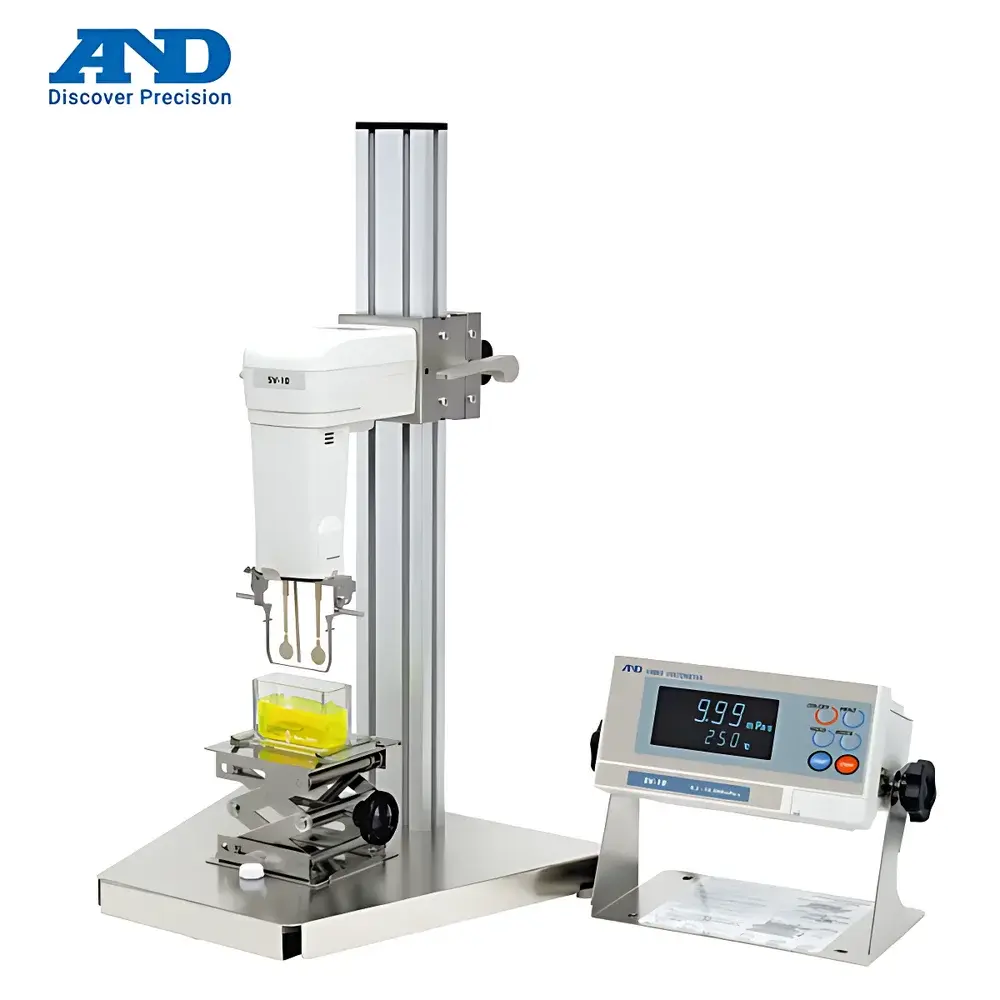
A&D SV10/SV-100 Sinusoidal Fork Vibration Viscometer
| Brand | A&D |
|---|---|
| Origin | Japan |
| Model | SV10 / SV-100 |
| Measurement Principle | Sinusoidal fork vibration method (30 Hz) |
| Viscosity Range | SV10: 0.3–10,000 mPa·s |
| SV-100 | 1,000–100,000 mPa·s |
| Repeatability | ±1% of reading (full scale, SD, 20–30 °C, no condensation) |
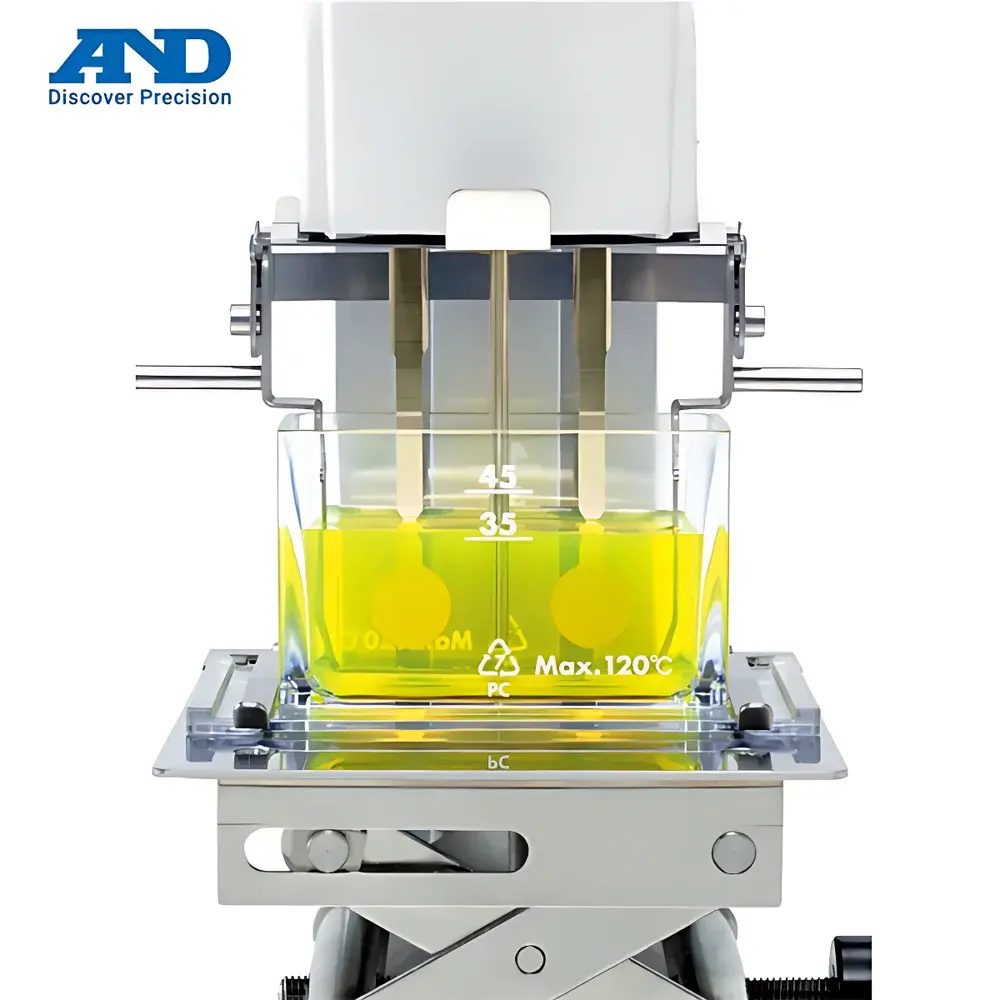
| Minimum Sample Volume | 35 mL |
| Display | Fluorescent LCD (large-character, high-contrast) |
| Interface | RS-232C standard |
| Temperature Control Option | Compatible with external circulating water bath |
| Software | WinCT-Viscosity (RsVisco) included |
| Compliance | Designed for GLP/GMP-aligned lab environments |
| Construction | Titanium-coated vibrating fork sensor (corrosion-resistant, easy-clean) |
| Form Factor | Benchtop fixed-unit system |
| Operating Environment | Ambient temperature (15–35 °C), non-condensing |
Overview
The A&D SV10 and SV-100 Sinusoidal Fork Vibration Viscometers are precision benchtop instruments engineered for reliable, real-time viscosity measurement of low- to high-viscosity liquids using the resonant frequency shift principle. Unlike rotational or capillary viscometers, these devices employ a titanium-coated tuning-fork sensor that vibrates at a stable sinusoidal frequency of approximately 30 Hz. When immersed in a sample, viscous drag dampens the oscillation amplitude and shifts the resonant frequency—this change is linearly correlated to dynamic viscosity (mPa·s) via factory-calibrated transfer functions. The method inherently eliminates mechanical shear history effects and offers intrinsic insensitivity to flow profile anomalies, making it especially suitable for fragile, shear-thinning, or foam-laden samples where conventional shear-rate-controlled methods may induce structural breakdown or yield inconsistent readings.
Key Features
- Two-range configuration: SV10 for low-viscosity applications (0.3–10,000 mPa·s); SV-100 optimized for high-viscosity fluids (1,000–100,000 mPa·s), enabling seamless coverage across diverse material classes without sensor swapping.
- High repeatability of ±1% of reading (full scale, SD, under controlled ambient conditions 20–30 °C), verified per ISO 2555 and ASTM D2196 protocols for oscillatory viscometry.
- Compact, mass-optimized fork sensor (35 mL minimum sample volume) ensures rapid thermal equilibration and enables accurate tracking of viscosity–temperature dependencies during ramped or isothermal experiments.
- Titanium-coated sensor surface provides chemical resistance against organic solvents, acids, bases, and surfactant systems—reducing carryover and simplifying cleaning validation.
- Integrated fluorescent LCD display with large-digit rendering minimizes parallax and misreading errors in shared laboratory environments.
- Standard RS-232C interface supports direct connection to PCs, LIMS, or thermal printers; optional analog output (4–20 mA) available via accessory module for process integration.
Sample Compatibility & Compliance
The SV10/SV-100 accommodates Newtonian and non-Newtonian fluids—including biological suspensions (e.g., blood plasma, protein solutions), polymer melts, pigment dispersions, cosmetic emulsions, and semiconductor slurries—without requiring rheological model assumptions. Its inertial measurement principle avoids wall-slip artifacts common in rotational geometries and tolerates particulates up to ~100 µm without clogging. The instrument meets essential design criteria for regulated environments: mechanical construction adheres to IEC 61010-1 safety standards; firmware architecture supports configurable user access levels and electronic signature workflows compatible with FDA 21 CFR Part 11 when paired with validated WinCT-Viscosity deployment. Data logs include timestamp, sensor ID, temperature (via optional Pt100 probe), and calibration status flags—enabling full traceability per GLP and ISO/IEC 17025 documentation requirements.
Software & Data Management
WinCT-Viscosity (RsVisco) software—supplied standard—is a Windows-based acquisition and analysis platform supporting real-time plotting of viscosity vs. time and viscosity vs. temperature profiles. It enables automated calculation of cloud points (e.g., nonionic surfactant turbidity transitions), gelation onset (via inflection detection in curing curves), and thermal hysteresis loops. Raw data exports to CSV or Excel-compatible formats include metadata headers compliant with FAIR (Findable, Accessible, Interoperable, Reusable) principles. Audit trail functionality records all parameter changes, calibration events, and user actions with immutable timestamps—critical for pharmaceutical QC labs operating under GMP Annex 11 or USP analytical instrument qualification frameworks.
Applications
- Rheological characterization of nanosuspensions and colloidal dispersions during formulation development.
- Stability assessment of biopharmaceutical formulations (monoclonal antibodies, vaccines) under accelerated temperature stress.
- In-process monitoring of polymerization reactions and thermoset curing kinetics (e.g., epoxy, acrylic adhesives).
- Quality control of industrial lubricants and engine oils across standardized temperature gradients (ASTM D445 equivalents).
- Cloud point determination of ethoxylated surfactants in detergent and agrochemical R&D.
- Viscosity profiling of food-grade hydrocolloids (xanthan, carrageenan) under shear-free conditions to preserve native conformation.
FAQ
Is the SV10/SV-100 suitable for measuring thixotropic or time-dependent fluids?
Yes—the oscillatory method captures instantaneous viscosity response without imposing defined shear history, allowing observation of recovery behavior when coupled with programmable pause intervals in WinCT-Viscosity.
Can the instrument be used with aggressive solvents such as THF or concentrated HCl?
The titanium-coated fork exhibits broad chemical compatibility; however, prolonged exposure to strong oxidizers (e.g., hot nitric acid) or HF-containing media is not recommended. Consult A&D’s chemical resistance guide for extended compatibility data.
Does the system support automatic temperature ramping?
No—the unit does not integrate a built-in Peltier or heater; however, it is fully compatible with external temperature-controlled baths (e.g., Julabo, Thermo Scientific) via RS-232 synchronization and third-party scripting.
What calibration protocols are supported?
Both single-point (one certified reference fluid) and two-point (span calibration across low/high range) procedures are implemented. Calibration constants are stored per sensor ID and digitally signed to prevent unauthorized modification.
Is 21 CFR Part 11 compliance inherent or requires additional validation?
The hardware and firmware provide foundational controls (audit trail, electronic signatures, role-based access); formal Part 11 compliance requires site-specific risk assessment, documented IQ/OQ/PQ, and qualified software configuration—services available through A&D’s global support network.



