
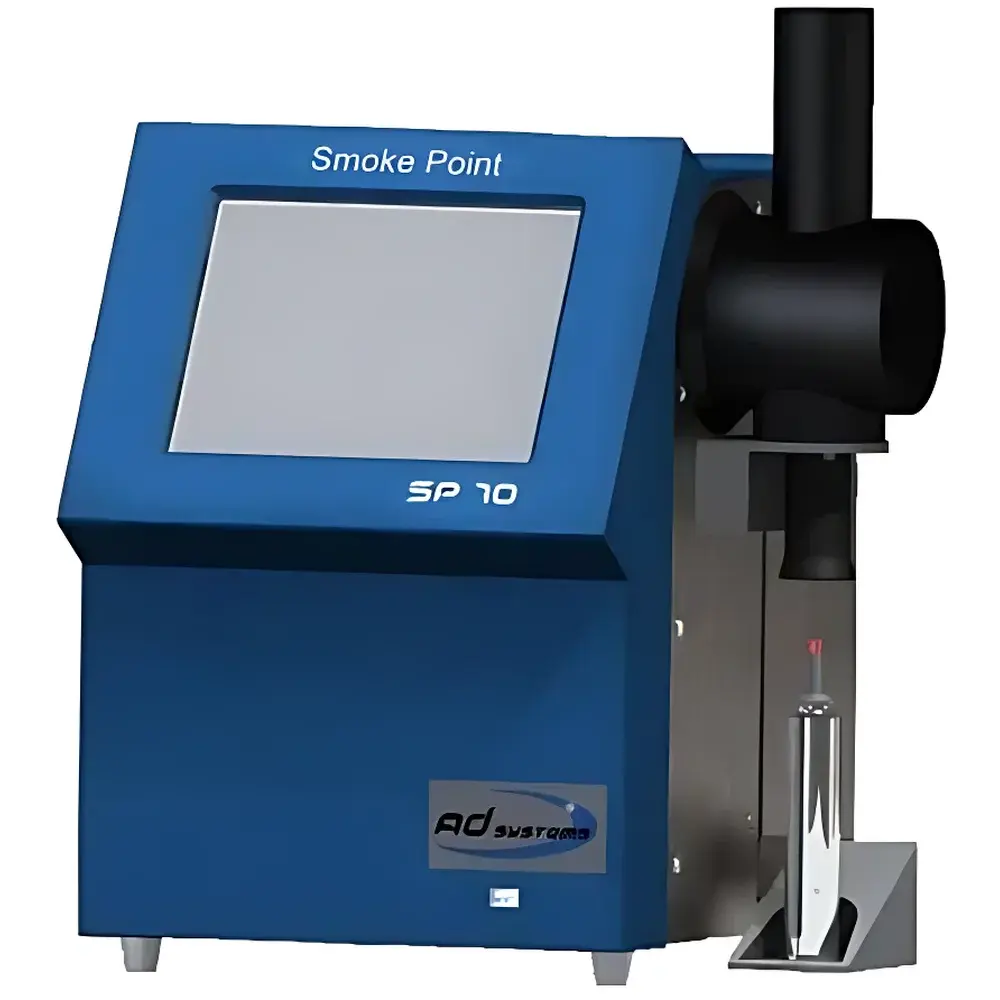
AD System SP10 Automated Smoke Point Analyzer
| Brand | AD System |
|---|---|
| Origin | France |
| Model | SP10 |
| Analysis Method | Three-Stage Expansion Method |
| Pressure Range | 1 kPa (typical ambient reference) |
| Temperature Control Resolution | 0.1 °C |
| Test Duration | <10 min |
| Flame Height Resolution | 0.1 mm |
| Connectivity | Ethernet (RJ45), USB (2 ports), Optional Printer via USB |
| Dimensions (W×D×H) | 330 × 390 × 413 mm |
| Weight | 10 kg |
Overview
The AD System SP10 Automated Smoke Point Analyzer is a fully compliant, ASTM D1322–23 and ISO 2718:2022–certified instrument engineered for precise, objective, and repeatable determination of the smoke point of kerosine and aviation turbine fuels. Unlike legacy manual methods—where visual flame assessment introduces high inter-operator variability and safety hazards—the SP10 implements a patented digital imaging and closed-loop flame control system grounded in fundamental combustion physics. It operates on the principle of identifying the maximum flame height at which no visible smoke is generated under standardized diffusion flame conditions, as defined by the three-stage expansion method. This approach directly correlates with radiant heat transfer potential in gas turbine combustors, making the smoke point a critical specification parameter for fuel qualification under OEM engine manufacturer requirements (e.g., Rolls-Royce RDE/10, GEK 105679) and civil aviation fuel standards (ASTM D1655 Annex A1).
Key Features
- Patented real-time video imaging system with high-resolution CMOS sensor and calibrated backlighting for unambiguous flame morphology capture
- Motorized needle valve actuator enabling precise, reproducible fuel flow modulation to dynamically adjust flame geometry per ASTM D1322 stepwise expansion protocol
- Automated flame height quantification at 0.1 mm resolution using edge-detection algorithms trained on reference smoke-free flame profiles
- Unattended operation with full thermal and flame-out safety interlocks—including automatic fuel shutoff, overtemperature cutoff, and flame extinction monitoring
- Compact benchtop architecture (330 × 390 × 413 mm; 10 kg) designed for integration into QC laboratories operating under ISO/IEC 17025 or AS9100-accredited environments
- Compliance-ready audit trail: timestamped raw image sequences, flame height logs, and environmental metadata (ambient temperature, barometric pressure) stored with immutable file attributes
Sample Compatibility & Compliance
The SP10 is validated for use with undiluted kerosine (Jet A, Jet A-1, TS-1) and aviation turbine fuels meeting ASTM D1655, DEF STAN 91-91, and GOST 10227 specifications. It accommodates sample volumes of 25–30 mL in standard ASTM D1322 brass wick cups. All operational parameters—including wick conditioning time, pre-heating ramp rate, and expansion stage dwell durations—are programmatically enforced to ensure strict adherence to method-defined procedural constraints. The system supports GLP/GMP-aligned workflows through configurable user access levels, electronic signature capability (per FDA 21 CFR Part 11 Annex 11), and exportable test reports compliant with LIMS ingestion formats (CSV, XML). Calibration verification is performed using NIST-traceable reference fuels with certified smoke point values (e.g., NIST SRM 2722), with results logged in the internal calibration registry.
Software & Data Management
The embedded SP10 Control Suite (v3.2+) provides intuitive workflow navigation via a 7-inch capacitive touchscreen interface. All measurement data—including synchronized video clips (H.264, 30 fps), flame height vs. time curves, and expansion stage transition markers—are archived locally on an industrial-grade microSD card and simultaneously mirrored to network storage via Ethernet (TCP/IP). Dual USB 2.0 ports enable direct connection to label printers (Zebra ZD420, Brother QL-820NWB) or external mass storage devices for offline backup. Data export supports comma-separated values (CSV) with column headers aligned to ASTM D1322 reporting conventions, facilitating automated import into statistical process control (SPC) platforms such as Minitab or JMP. Audit logs record operator ID, login/logout timestamps, parameter modifications, and firmware update history—retained for ≥36 months per ISO 17025 clause 7.10.2.
Applications
- Final quality release testing of jet fuel batches prior to dispatch from refineries and blending facilities
- Monitoring hydroprocessing catalyst performance through trend analysis of smoke point shifts across feedstock cuts
- Research and development of synthetic paraffinic kerosine (SPK) blends to quantify aromatic suppression efficacy
- Investigation of fuel thermal stability degradation during long-term storage or simulated aircraft tank residence
- Supporting root-cause analysis of combustor liner sooting incidents via correlation with historical smoke point data
- Regulatory submission packages for alternative fuel certification (e.g., ASTM D7566 Annex A2, SAF pathways)
FAQ
Does the SP10 require operator intervention during the test cycle?
No. Once the sample is loaded and the start command is issued, the SP10 executes the full ASTM D1322 procedure—including wick pre-conditioning, flame establishment, three-stage expansion, and endpoint detection—without human input.
Can the SP10 be integrated into a centralized laboratory information management system (LIMS)?
Yes. Native support for ASTM E1394-compliant data exchange and configurable REST API endpoints allow bidirectional integration with major LIMS platforms (LabWare, Thermo Fisher SampleManager, STARLIMS).
Is routine calibration traceable to national metrology institutes?
Calibration verification uses NIST SRM 2722 reference fuels, and all calibration events are documented with uncertainty budgets conforming to ISO/IEC 17025:2017 clause 6.6.
What maintenance is required to ensure long-term measurement stability?
Annual optical path cleaning (lens, mirror, backlight diffuser) and quarterly validation with certified reference fuel are recommended. No consumables beyond standard ASTM brass wicks are required.
How does the SP10 handle ambiguous flame morphologies—e.g., transient smoke pulses or flicker-induced edge noise?
The image processing algorithm applies temporal filtering across 5 consecutive frames and enforces a minimum smoke-free dwell time of 2 seconds before accepting a flame height reading, eliminating false positives from transient instabilities.






