
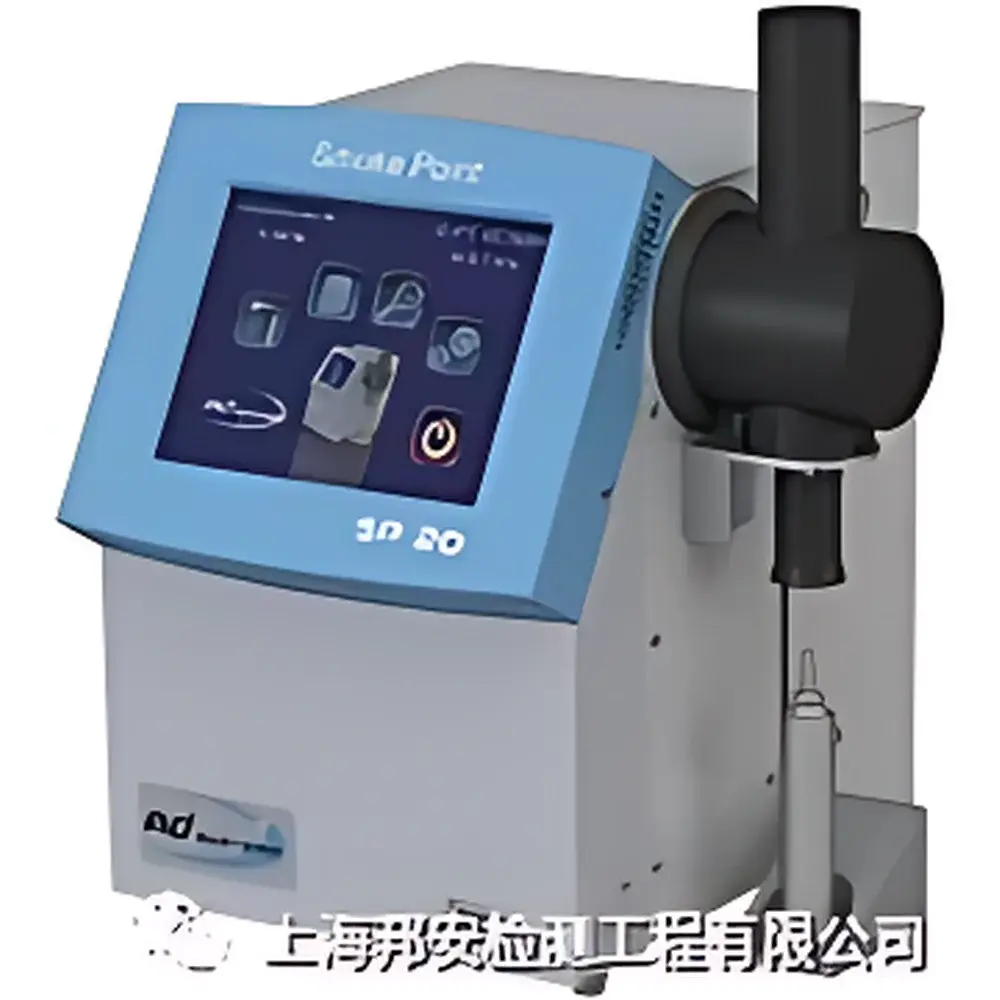
AD System SP20 Automatic Smoke Point Analyzer
| Brand | AD System |
|---|---|
| Origin | France |
| Model | SP20 |
| Compliance | ASTM D1322, GB/T 3822 |
| Measurement Principle | Optical flame morphology detection with real-time height quantification |
| Test Duration | < 10 min per sample |
| Height Resolution | 0.1 mm |
| Data Storage Capacity | Up to 1,000,000 results |
| Connectivity | Ethernet, RS-232, USB |
| Display | 8-inch full-color touchscreen |
| Dimensions (L×W×H) | 330 × 390 × 413 mm |
| Integrated Sensors | Barometric pressure, ambient temperature, relative humidity |
| Fuel Calibration | Pre-loaded standard fuel database with auto-compensated smoke point correction |
Overview
The AD System SP20 Automatic Smoke Point Analyzer is an engineered solution for precise, repeatable, and fully automated determination of the smoke point of petroleum distillates—primarily aviation turbine fuels (e.g., Jet A, Jet A-1), kerosene, and related hydrocarbon fractions. Unlike manual or semi-automated methods, the SP20 implements a validated optical measurement principle based on ASTM D1322: it captures high-resolution video of the test flame using a calibrated industrial camera system, analyzes flame morphology in real time, and identifies the critical smoke point—the temperature at which a continuous, visible smoke trail first appears above the wick—by detecting the onset of luminous soot formation and quantifying flame height with ±0.1 mm resolution. The instrument replicates the visual judgment criteria of trained human operators while eliminating inter-operator variability, subjective interpretation, and exposure to open-flame hazards. Its design adheres to the fundamental thermodynamic and combustion behavior requirements defined in ASTM D1322 and Chinese national standard GB/T 3822, ensuring regulatory acceptability in quality control laboratories operating under ISO/IEC 17025, API RP 4200, or IATA fuel specification frameworks.
Key Features
- Fully automated smoke point determination with no manual flame adjustment or visual endpoint judgment required
- Integrated barometric pressure, ambient temperature, and relative humidity sensors—enabling real-time atmospheric compensation without external input or manual entry
- Pre-loaded, traceable standard fuel calibration database; automatic selection and application of smoke point correction factors based on measured environmental conditions
- High-fidelity flame imaging system with adjustable illumination and dynamic contrast optimization for consistent detection across varying fuel compositions
- 8-inch capacitive touchscreen interface with intuitive workflow navigation, multilingual support (English, French, Chinese), and on-device result review
- Robust mechanical architecture compliant with CE, EMC, and RoHS directives; designed for continuous operation in refinery QC labs and third-party testing facilities
Sample Compatibility & Compliance
The SP20 is validated for use with transparent, non-viscous liquid petroleum products meeting the volatility and distillation range requirements of ASTM D1322—including aviation turbine fuels, lamp oils, and light distillate fractions. It is not intended for residual fuels, biodiesel blends exceeding 5% v/v, or highly aromatic solvents that deviate from the reference combustion behavior assumed in the standard. All firmware and measurement algorithms are developed and verified in accordance with ASTM D1322 Annex A1 (Instrumentation Requirements) and ISO/IEC 17025:2017 clause 7.2.2 (Method Validation). The system supports audit-ready documentation: each test record includes timestamp, environmental sensor readings, raw flame height data, operator ID (if configured), and digital signature metadata—facilitating GLP/GMP alignment and FDA 21 CFR Part 11 readiness when deployed with networked user authentication and electronic record management.
Software & Data Management
Data handling is implemented via embedded Linux-based firmware with dual-layer storage: internal flash memory retains up to 1,000,000 test records with full metadata (including environmental parameters and flame height profiles), while external export is supported via USB mass storage or Ethernet-based file transfer (SFTP or HTTP POST). The instrument provides native CSV export with configurable field delimiters and column headers compliant with LIMS ingestion standards (e.g., ASTM E1469, ISO 15143-1). Optional RS-232 serial output enables direct integration with legacy SCADA systems or programmable logic controllers. No proprietary software installation is required for basic operation; advanced configuration, firmware updates, and batch report generation are accessible through a secure web interface (HTTPS) or local USB drive provisioning.
Applications
- Quality assurance of aviation turbine fuels prior to dispatch or acceptance at airports and military depots
- In-process monitoring during kerosene fractionation and hydrotreating operations
- Contractual compliance verification against ASTM D1655, DEF STAN 91-91, or MIL-DTL-83133 specifications
- Research and development of alternative jet fuels (SAF), where smoke point serves as a key indicator of sooting tendency and combustion efficiency
- Third-party certification laboratories accredited to ISO/IEC 17025 conducting routine smoke point testing for regulatory submission
FAQ
Does the SP20 require periodic recalibration using certified reference fuels?
No—calibration is maintained through the pre-loaded, factory-verified standard fuel database. Only verification with a traceable reference material (e.g., NIST SRM 2720) is recommended annually or after major maintenance.
Can the SP20 operate unattended for sequential testing?
Yes—batch mode supports up to 99 samples with auto-start triggers, pass/fail flagging, and email/SNMP alerts upon completion or anomaly detection.
Is the instrument compatible with laboratory information management systems (LIMS)?
Yes—CSV export, HTTP API endpoints, and RS-232 ASCII protocol enable seamless integration with major LIMS platforms including LabWare, Thermo Fisher SampleManager, and STARLIMS.
What safety certifications does the SP20 hold?
It carries CE marking per Directive 2014/30/EU (EMC) and 2014/35/EU (LVD), and complies with IEC 61010-1:2010 for electrical safety in laboratory equipment.
How is traceability ensured for environmental compensation?
The integrated barometer and hygrometer are NIST-traceable at time of manufacture; drift correction is performed automatically using dual-sensor cross-validation and firmware-based compensation algorithms.






