
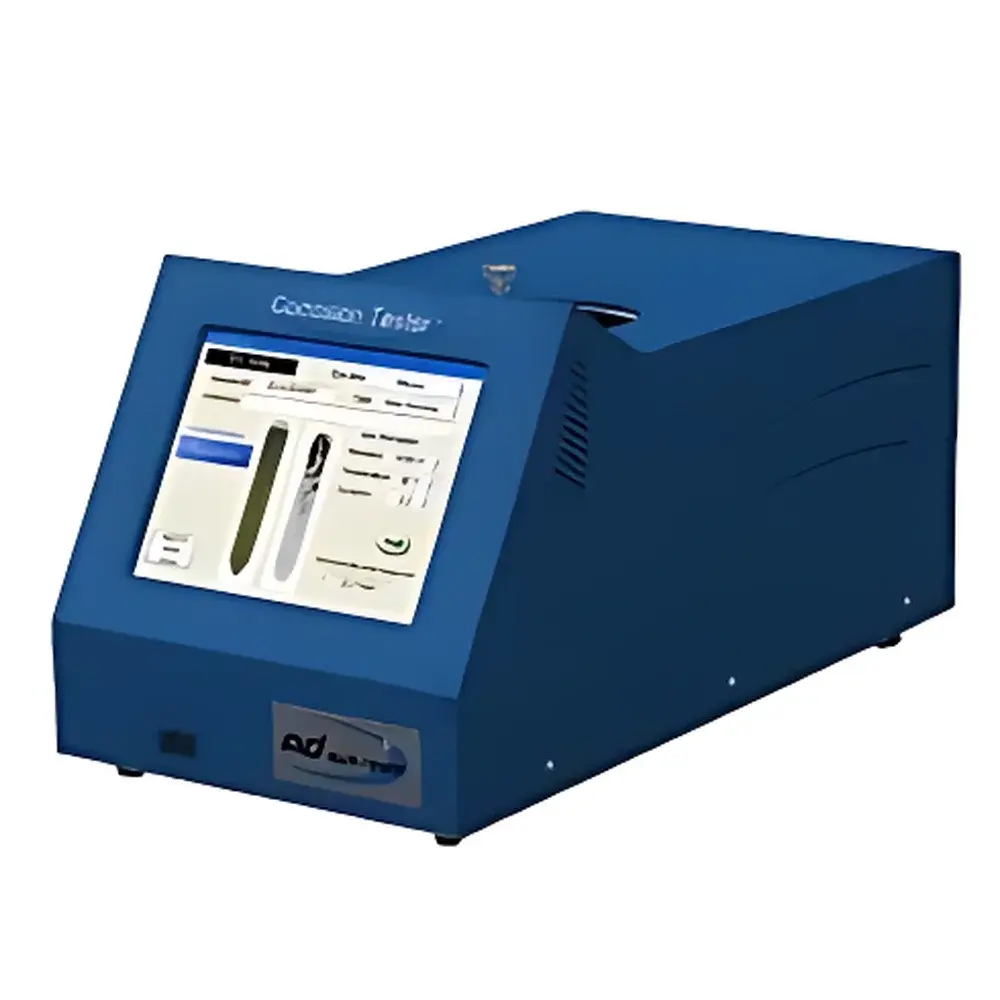
AD Systems CT10 Automated Rust Performance Test Rod Grading Instrument
| Brand | AD Systems |
|---|---|
| Origin | France |
| Model | CT10 |
| Compliance | NACE TM0172, ASTM D665, ASTM D7548, IP 135, ISO 7120, JIS K2510 |
| Display | 8-inch color touchscreen |
| Connectivity | Ethernet (RJ45), USB (2×), optional USB printer support |
| Data Storage | External storage-dependent |
| Dimensions (W×D×H) | 330 × 390 × 413 mm |
| Weight | 10 kg |
| Power Supply | 110–230 V AC, 2 A, 50/60 Hz |
Overview
The AD Systems CT10 Automated Rust Performance Test Rod Grading Instrument is a dedicated benchtop system engineered for objective, reproducible assessment of rust-inhibiting performance in lubricants and industrial fluids. It implements the standardized immersion-and-rotation methodology defined in key international corrosion testing protocols—including NACE TM0172 (Evaluation of Rust-Inhibiting Characteristics of Lubricating Oils), ASTM D665 (Rust-Preventing Characteristics of Inhibited Mineral Oil in the Presence of Water), ASTM D7548 (Standard Test Method for Determining Rust Inhibition of Automotive Engine Oils), IP 135, ISO 7120, and JIS K2510. The instrument automates the critical variables of test duration, rod rotation speed, temperature control (via ambient or optional thermostatic bath integration), and visual endpoint evaluation—eliminating subjective human grading bias while ensuring strict adherence to procedural fidelity required for regulatory submission and interlaboratory comparison.
Key Features
- Automated rod rotation and timing sequence compliant with NACE TM0172 and ASTM D665 protocols, minimizing operator intervention and procedural drift.
- Integrated 8-inch high-resolution color touchscreen interface enabling intuitive test setup, real-time status monitoring, and immediate access to run history without external software.
- Compact footprint (330 × 390 × 413 mm) and lightweight design (10 kg) optimized for QC laboratories with constrained bench space and frequent reconfiguration needs.
- Dual USB ports and Ethernet (RJ45) connectivity supporting direct data export to networked file servers, LIMS integration, and remote firmware updates—fully compatible with ISO/IEC 17025 documentation workflows.
- Electrical architecture rated for universal input (110–230 V AC, 50/60 Hz), certified to IEC 61010-1 for laboratory equipment safety, with reinforced insulation and overcurrent protection aligned with GLP-compliant facility requirements.
- Optional USB printer interface enables on-demand hardcopy generation of test reports with embedded timestamp, operator ID, and parameter traceability—supporting 21 CFR Part 11 audit readiness when paired with validated electronic signature modules.
Sample Compatibility & Compliance
The CT10 accommodates standard ASTM/ISO-specified test rods (typically 25.4 mm diameter × 76.2 mm length, low-carbon steel per ASTM A29/A29M Grade 1018), pre-cleaned and weighed per D665 Annex A1. It supports aqueous emulsions, mineral oils, synthetic lubricants, hydraulic fluids, and turbine oils across viscosity ranges up to ISO VG 150. All operational parameters—including immersion depth, agitation rate (programmable within 0–60 rpm), and total exposure time (1–24 h)—are configurable to match method-specific requirements. Full compliance documentation—including Declaration of Conformity (CE), RoHS 2011/65/EU certification, and traceable calibration records for timing and temperature subsystems—is supplied with each unit to facilitate internal audit and external accreditation (e.g., ISO/IEC 17025:2017 Clause 6.4.10).
Software & Data Management
The embedded firmware provides native data logging with automatic timestamping, operator identification (via alphanumeric login), and full parameter archiving per test cycle. Export formats include CSV and PDF, both retaining metadata such as environmental conditions (if externally logged), rod lot number, fluid batch ID, and pass/fail classification per NACE visual rating scale (0–4). Data integrity safeguards include write-once storage mode, immutable audit trails, and configurable user roles (admin/operator/viewer) to meet ALCOA+ principles. When connected to enterprise networks, the CT10 supports scheduled automated backups and API-based synchronization with validated LIMS platforms—enabling seamless alignment with GxP quality systems and FDA 21 CFR Part 11 electronic record requirements.
Applications
- Quality control of rust-inhibitive additives in engine oils, gear oils, and circulating lubricants during R&D and production release testing.
- Comparative evaluation of alternative corrosion inhibitors under standardized conditions for formulation optimization.
- Supplier qualification and incoming material verification against contractual rust-prevention specifications (e.g., OEM Daimler MB 229.31, Ford WSS-M2C913-B).
- Regulatory dossier preparation for EPA Safer Choice, REACH SVHC screening, and EU Ecolabel submissions requiring documented corrosion performance data.
- Troubleshooting field failures linked to water ingress or additive depletion by correlating lab-grade CT10 results with in-service oil analysis trends.
FAQ
Does the CT10 perform quantitative corrosion rate measurement?
No—the CT10 delivers qualitative/semi-quantitative grading per standardized visual scales (e.g., NACE TM0172’s 0–4 rating), not electrochemical corrosion rate (mm/y) or mass loss (mg/cm²). For quantitative kinetics, complementary techniques such as ASTM G102 or electrochemical impedance spectroscopy are recommended.
Is temperature control built into the instrument?
The base CT10 model operates at ambient laboratory temperature; precise thermal regulation requires integration with an external thermostatic bath meeting ASTM D665 Section 7.1 requirements. Optional PT100 probe input enables external temperature feedback logging.
Can test rods be reused across multiple runs?
Per ASTM D665 Section 8.2 and NACE TM0172 Section 5.4, rods must be discarded after single use to prevent carryover contamination and surface conditioning effects that compromise result validity.
What validation documentation is provided?
Each unit ships with Factory Calibration Certificate (traceable to NIST standards), IQ/OQ protocol templates, and a complete set of method-specific operating instructions aligned with ISO/IEC 17025 Clause 7.2.2 for method verification.
Is remote diagnostics supported?
Yes—via secure Ethernet connection, authorized service engineers can initiate diagnostic routines, review error logs, and verify firmware version remotely, reducing instrument downtime and supporting predictive maintenance planning.
Related Products



