
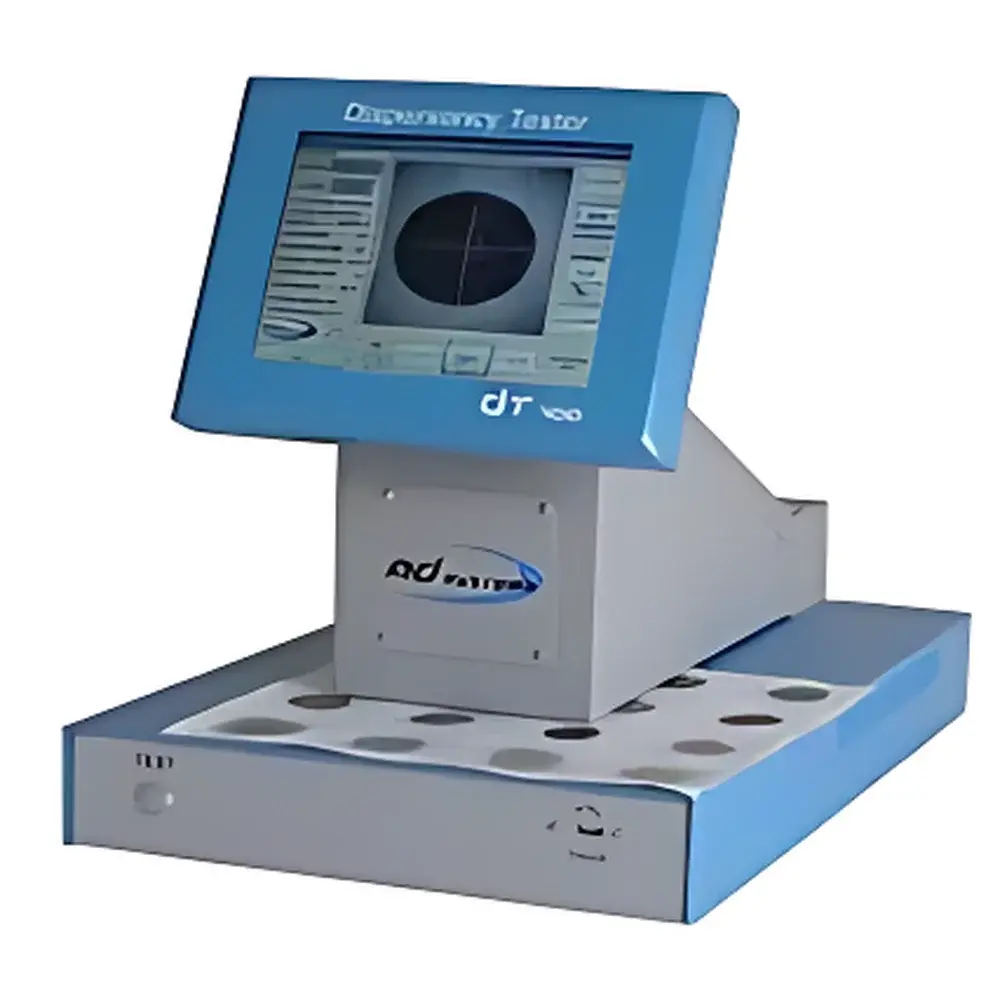
AD Systems DT100 Diesel Engine Oil Dispersancy and Soot Analysis Instrument
| Brand | AD Systems |
|---|---|
| Origin | France |
| Model | DT100 |
| Operating Principle | Digital Spot Test Image Analysis |
| Measurement Parameters | IC (0.1–5%), MD (0–100), DP (0–200) |
| Spot Acquisition Time | ~3 min per spot |
| Max Spots per Filter Paper | 16 |
| Imaging System | CCD digital camera with LED backlighting |
| Calibration | On-site using included calibration kit |
| Data Storage | USB drive, LAN network, or local printer (optional) |
| Interface | USB 2.0, RJ45 Ethernet |
| Dimensions | 305 × 487 × 390 mm |
| Weight | 20 kg |
| Power Supply | 230 V, 2 A, 50/60 Hz |
Overview
The AD Systems DT100 is a dedicated digital image analysis instrument engineered for objective, quantitative assessment of dispersancy performance and soot contamination in diesel engine lubricants—specifically formulated for on-vehicle and marine applications. Unlike conventional visual spot test interpretation, the DT100 employs a standardized, automated optical methodology grounded in the physical principles of capillary-driven radial migration and differential particle retention on quantitative filter paper (Grade 122). When a defined volume of used oil is deposited and thermally developed (at 80 °C), insoluble species—including soot agglomerates, oxidation byproducts, and water-induced sludge precursors—migrate radially under controlled flow conditions. Their spatial distribution forms concentric zones whose contrast, density, and geometry correlate directly with additive depletion, colloidal stability, and contaminant loading. The DT100 captures high-resolution images of these developed spots via a calibrated CCD sensor and applies algorithmic segmentation to extract three traceable, dimensionless indices: the Contamination Index (IC), Dispersancy Metric (MD), and Degradation Parameter (DP). This approach replaces subjective visual grading with metrologically traceable, repeatable outputs compliant with internal laboratory quality protocols and aligned with ASTM D2270 (viscosity index) and ISO 4406 (particulate contamination) conceptual frameworks.
Key Features
- Fully automated digital spot test analysis eliminating inter-operator variability and qualitative bias
- Integrated CCD imaging system with uniform LED backlighting and real-time focus adjustment via on-screen spot centering
- On-site calibration capability using manufacturer-supplied reference tools—no external service required
- Simultaneous quantification of three independent parameters: IC (soot mass fraction, 0.1–5%), MD (dispersancy capacity, 0–100), and DP (composite degradation indicator, 0–200)
- Configurable data handling: local USB storage, networked LAN archiving (via standard TCP/IP), or direct print output (printer optional)
- Robust benchtop architecture designed for routine use in ISO/IEC 17025-accredited oil condition monitoring (OCM) laboratories
- Compliant with GLP documentation requirements: full audit trail of image acquisition timestamps, operator ID, calibration history, and parameter revision logs
Sample Compatibility & Compliance
The DT100 is validated for SAE 10W–40, 15W–40, and 20W–50 diesel engine oils meeting API CK-4, FA-4, CJ-4, and ACEA E9 specifications. It accommodates samples containing up to 5% soot by weight and remains functional in the presence of co-contaminants including glycol (≥500 ppm), water (≤0.5 vol%), and metallic wear debris. All measurements adhere to a documented method equivalent to ASTM D4310 (Standard Test Method for Determining Oxidation Stability of Lubricating Oils by the Thin-Film Oxygen Uptake Test) in its emphasis on early-stage degradation detection. The instrument’s firmware supports 21 CFR Part 11-compliant electronic signatures when deployed in regulated environments requiring FDA-aligned validation. Filter paper compatibility is restricted to certified Grade 122 cellulose membranes (diameter 110 mm, pore size 15 µm), ensuring consistent wicking kinetics across batches.
Software & Data Management
The embedded DT100 software suite runs on a Linux-based real-time OS and provides dual-mode operation: standalone mode (local USB storage only) and networked mode (integrated into existing LIMS or CMMS platforms via RESTful API). Each acquired image is stored with EXIF metadata including exposure time, gain setting, ambient temperature, and user-defined sample ID. Quantitative results are exported in CSV format with ISO 8601 timestamps and may be mapped to custom fields in enterprise systems. Audit logging records all parameter modifications, calibration events, and user logins—supporting full traceability for ISO 9001 and ISO/IEC 17025 accreditation audits. Software updates are delivered via signed firmware packages verified through SHA-256 checksums.
Applications
- Trend-based predictive maintenance for heavy-duty diesel fleets (mining trucks, municipal buses, rail locomotives)
- Validation of dispersant package efficacy during OEM engine oil development
- Field-deployable assessment of lube oil health in marine auxiliary engines where onboard lab space is constrained
- Correlation studies between MD decay and piston ring wear rates measured via ferrography or ICP-OES
- Supporting root-cause analysis of premature filter plugging or valve train deposits in stationary power generation units
- Training tool for laboratory personnel to standardize spot test interpretation across global service centers
FAQ
What sample preparation is required prior to analysis?
A 50 µL aliquot of homogenized used oil is dispensed onto Grade 122 filter paper using the supplied precision micropipette. The paper is then conditioned at 80 °C for 15 minutes in a convection oven to develop the spot morphology.
Can the DT100 distinguish between soot and other insolubles such as oxidation sludge or glycol degradation products?
No—IC reflects total non-volatile insolubles. However, MD degradation in the absence of elevated IC strongly suggests dispersant exhaustion due to non-soot contaminants (e.g., water/glycol), enabling differential diagnosis when combined with FTIR or elemental analysis.
Is method validation documentation available for regulatory submissions?
Yes—AD Systems provides a complete IQ/OQ/PQ protocol package, including repeatability studies (n=30, RSD < 2.1% for MD), linearity verification (R² ≥ 0.992), and interference testing reports.
Does the instrument require annual recalibration by the manufacturer?
No—field calibration using the included reference kit satisfies ISO/IEC 17025 Clause 6.5.2; only periodic verification against traceable standards is mandated.
How does DP differ from traditional TAN/TBN trending?
DP integrates both physical (MD) and compositional (IC) failure modes into a single trendable metric, offering earlier indication of additive depletion than acid number alone—particularly valuable for low-SAPS formulations where TBN drop lags significantly behind dispersant loss.





