
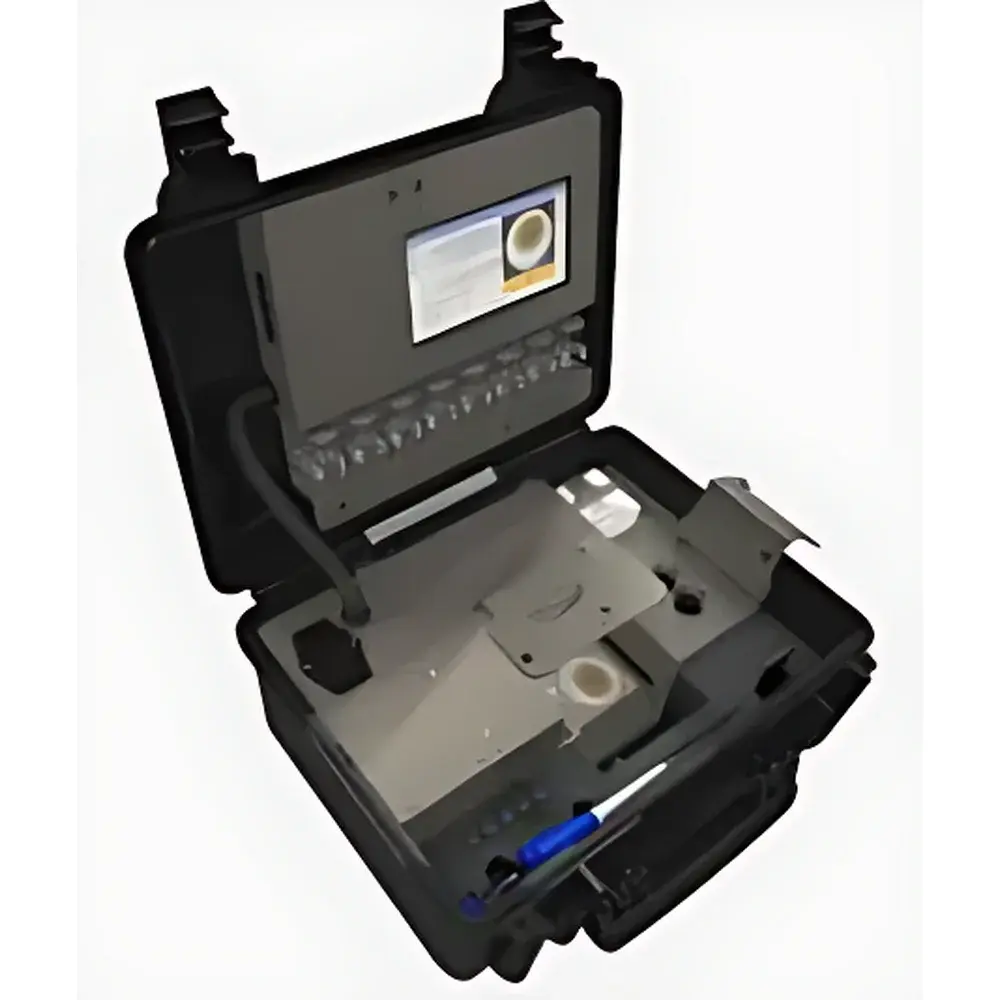
AD Systems ST10 Portable Residual Fuel Stability and Compatibility Analyzer
| Brand | AD Systems |
|---|---|
| Origin | France |
| Model | ST10 |
| Compliance | ASTM D4740 |
| Operating Temperature | Filter Paper 100 °C ±0.2 °C, Fuel Sample 93 °C ±0.2 °C |
| Display | 7-inch capacitive touchscreen |
| Data Storage | Up to 100,000 test records with full image metadata |
| Connectivity | RJ45 Ethernet port, 4× USB 2.0 ports |
| Dimensions (W×D×H) | 420 × 350 × 222 mm |
| Weight | 9 kg |
| Power Supply | 230 V AC, 2 A, 50 Hz |
| Sample Handling | Manual droplet deposition via supplied micro-pipette |
Overview
The AD Systems ST10 is a fully automated, portable analyzer engineered for quantitative assessment of residual fuel oil stability and blend compatibility in accordance with ASTM D4740 — the Standard Test Method for Spot Test for Oxidation Stability of Residual Fuel Oils. Unlike conventional manual spot testing, the ST10 eliminates operator subjectivity by integrating controlled thermal conditioning, time-resolved digital imaging, and algorithmic grayscale-to-binary image analysis into a single self-contained unit. Its core measurement principle relies on the oxidative degradation behavior of asphaltene-rich heavy fuel fractions under standardized thermal stress: unstable or incompatible fuels form visible insoluble asphaltenic precipitates on filter paper, producing characteristic halo patterns that correlate directly with colloidal instability. The ST10 quantifies this phenomenon through pixel-based pattern recognition, assigning an objective numerical rating from 1 (highly stable) to 5 (severely unstable), enabling predictive maintenance of fuel handling systems and early detection of incompatibility risks prior to bunkering or blending.
Key Features
- Complete ASTM D4740 compliance: All critical test parameters—including precise temperature control of both filter paper (100 °C ±0.2 °C) and fuel sample (93 °C ±0.2 °C), fixed 60-minute drying duration, and standardized droplet volume application—are enforced automatically.
- Integrated high-resolution imaging system: Captures time-synchronized macroscopic images of the developed spot at defined intervals, with automatic focus calibration and ambient light compensation.
- Embedded image processing engine: Applies adaptive thresholding, noise reduction, and radial symmetry analysis to generate reproducible binary masks; calculates spot morphology metrics (e.g., halo radius, core density gradient, edge sharpness) for classification.
- Ruggedized field deployment design: Housed in an IP54-rated transport case with shock-absorbing foam inserts; operates reliably across ambient temperatures from 5 °C to 45 °C and relative humidity up to 85% non-condensing.
- No consumables beyond standard ASTM-grade filter paper (Whatman No. 1 or equivalent) and certified micro-pipette tips; zero requirement for solvents, reagents, or calibration standards.
Sample Compatibility & Compliance
The ST10 accepts all residual fuel oils meeting ISO 8217:2017 specifications (RMG, RMK, RMA grades) as well as blended marine fuels (e.g., VLSFO/ULSFO mixtures), biofuel blends (FAME, HVO), and refinery off-spec streams. It is validated for use with fuels containing up to 5.0 % sulfur mass fraction and kinematic viscosity up to 700 mm²/s at 50 °C. Regulatory alignment includes full traceability per ISO/IEC 17025:2017 requirements for testing laboratories, support for audit-ready electronic records compliant with FDA 21 CFR Part 11 (when used in GLP environments), and documented equivalence to ASTM D4740–22 procedural clauses. Each test record embeds timestamp, operator ID (optional), GPS coordinates (if enabled via external module), environmental sensor readings, and raw + processed image files.
Software & Data Management
The ST10 runs proprietary firmware v3.2+ with a Linux-based real-time OS. Data is stored locally in encrypted SQLite3 databases with SHA-256 hashing of image hashes and test metadata. Export options include CSV (tabular results only), PDF (full report with annotated images), and DICOM-compliant image bundles. Remote access is supported via secure SSH tunneling or HTTPS REST API (optional license); integration with LIMS platforms (e.g., LabWare, Thermo Fisher SampleManager) is achieved using ASTM E1384-compliant data exchange templates. Audit trails log every user action—including parameter modification, result override, and database purge—with immutable timestamps and role-based access controls.
Applications
- Bunker quality assurance: On-site verification of delivered fuel stability prior to tank entry, reducing risk of sludge formation in storage tanks and fuel lines.
- Blend compatibility screening: Rapid assessment of compatibility between two or more residual fuels prior to mixing—critical for dual-fuel vessel operations and inventory optimization.
- Engine room diagnostics: Correlation of spot test ratings with observed injector coking, turbocharger fouling, and exhaust valve deposits during root cause analysis.
- Refinery and terminal QA/QC: Monitoring stability trends across production batches and feedstock changes; supporting ISO 8217 Annex B compliance documentation.
- Class society and P&I club investigations: Providing court-admissible digital evidence in disputes related to fuel-related machinery failure.
FAQ
Does the ST10 require annual recalibration?
No. The instrument employs factory-traceable NIST-calibrated temperature sensors and fixed-focus optical geometry; periodic verification using ASTM D4740 reference oils (available from AD Systems) is recommended every 12 months.
Can the ST10 be used without mains power?
It requires 230 V AC input; however, operation via certified 230 V inverters powered by shipboard batteries or portable generators (with stable ±5% voltage regulation) is validated and documented in the user manual.
Is image analysis algorithm performance validated against expert human grading?
Yes. Multi-laboratory intercomparison studies (n=12 labs, 2022–2023) demonstrated κ = 0.91 agreement between ST10 scores and consensus grading by ASTM-certified fuel analysts.
How are test results protected against accidental deletion or tampering?
All records are write-once, append-only; database integrity is verified at boot via cryptographic checksums. Administrative deletion requires dual-factor authentication and generates an immutable log entry.
Does the ST10 support languages other than English?
UI language is configurable in English, French, Spanish, German, Japanese, and Chinese (Simplified); all regulatory documentation and export formats remain English-only to ensure international acceptance.



