
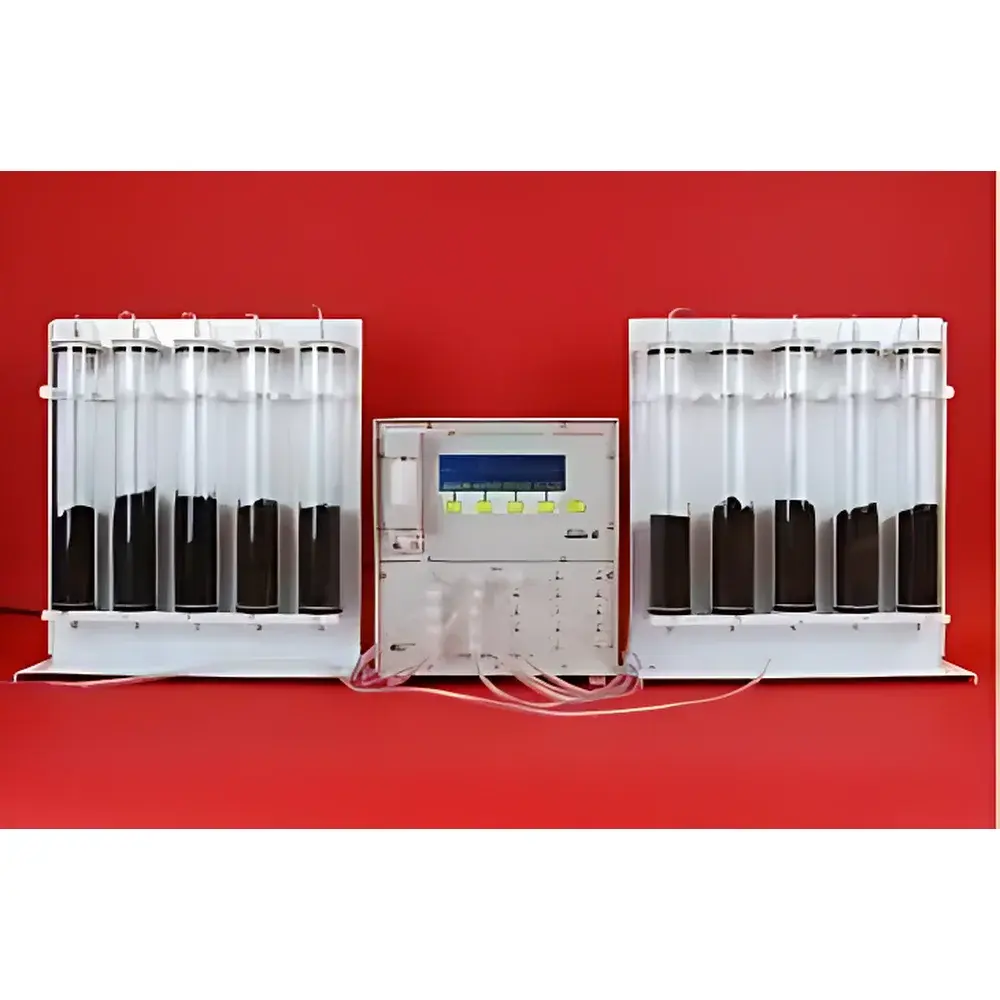
ADC Bio EGA60 Multi-Channel Soil Respiration Measurement System
| Brand | ADC Bio |
|---|---|
| Origin | United Kingdom |
| Model | EGA60 |
| CO₂ Measurement Range | 0–2000 ppm |
| H₂O Vapor Pressure Range | 0–75 mbar |
| O₂ Measurement (Optional) | 0–50% (0–23 mg/L) |
| Flow Rate per Channel | 0–500 mL/min |
| Resolution | CO₂ = 1 ppm, H₂O = 0.1 mbar, O₂ = 0.05% @ 20% O₂ |
| Accuracy | CO₂ (temperature & pressure compensated), O₂ = ±0.2% @ 20% O₂ |
| Response Time (O₂) | <1 s |
| Data Storage | Removable SD card (up to 16 million data points) |
| Display | 240 × 64 pixel monochrome LCD |
| Operating Temperature | 5–45 °C |
| Dimensions | 27 × 25 × 15 cm |
| Weight | 7.5 kg |
| Interfaces | RS232, USB Mini-B, 7-channel analog input (0–5 V / 0–20 mA) |
Overview
The ADC Bio EGA60 Multi-Channel Soil Respiration Measurement System is an engineered solution for high-throughput, long-term quantification of soil carbon flux under controlled or semi-field laboratory conditions. It operates on the principle of dynamic closed-chamber gas exchange, where CO₂ and H₂O concentrations are measured in real time using non-dispersive infrared (NDIR) spectroscopy and dual-laser balanced hygrometry, respectively. Each measurement channel independently controls gas flow, monitors chamber headspace composition, and computes net CO₂ efflux rates (µmol CO₂ m⁻² s⁻¹) based on slope analysis of concentration-time curves, corrected for temperature, pressure, and flow dynamics. The system supports both continuous and cyclic measurement protocols across up to 24 parallel samples, enabling statistically robust replication in studies of microbial respiration kinetics, substrate-induced respiration (SIR), and temperature sensitivity (Q₁₀) of soil organic matter decomposition.
Key Features
- Modular multi-channel architecture: Configurable for 10, 15, 20, or 25 measurement channels — with one dedicated CO₂ scrubber reference channel — supporting concurrent analysis of up to 24 soil cores or microcosms.
- Integrated gas handling: All pneumatic components — mass flow controllers, solenoid valves, IRGA optics, and humidity sensors — are housed within a single compact chassis (27 × 25 × 15 cm), minimizing dead volume and cross-channel interference.
- High-stability NDIR CO₂ analyzer: Factory-calibrated, auto-zeroing IRGA with 1 ppm resolution and drift < ±2 ppm over 24 h; incorporates real-time temperature and barometric pressure compensation per ASTM D6196 and ISO 8573-1 traceability frameworks.
- Dual-laser H₂O sensor: Provides vapor pressure measurements from 0 to 75 mbar at 0.1 mbar resolution, critical for normalizing CO₂ flux to moisture-corrected soil respiration rates.
- Optional fluorescence-based optical O₂ sensing: Fiber-optic probe enables simultaneous O₂ depletion profiling with sub-second temporal resolution and ±0.2% accuracy at ambient O₂ levels — essential for distinguishing aerobic vs. anaerobic respiration pathways.
- Onboard data acquisition and visualization: 240 × 64 pixel high-contrast LCD displays live CO₂/H₂O traces, calculated flux values, and system status; intuitive 3-page menu navigation via five tactile buttons eliminates dependency on external computers during setup.
Sample Compatibility & Compliance
The EGA60 accommodates standard cylindrical soil cores (e.g., 5–10 cm diameter × 5–15 cm depth), intact monoliths, or custom-designed incubation chambers. Its modular design allows rapid reconfiguration for alternative biological matrices including detached plant roots, insect pupae, fruit tissue, and microbial biofilms. All hardware and firmware comply with CE marking requirements for electromagnetic compatibility (EN 61326-1) and safety (EN 61010-1). Data integrity adheres to GLP principles: timestamped records include environmental metadata (T, P, RH), instrument diagnostics (flow error, zero drift), and user-defined experiment IDs. When connected to validated LIMS environments, the RS232/USB interface supports audit-trail generation compliant with FDA 21 CFR Part 11 for regulated ecotoxicology or carbon credit verification workflows.
Software & Data Management
Data are stored natively on removable industrial-grade SD cards capable of logging >16 million discrete records — sufficient for uninterrupted operation over 12 months at 10-second sampling intervals. Files follow standardized CSV structure with headers indicating channel ID, timestamp (ISO 8601), raw CO₂ (ppm), H₂O (mbar), T (°C), P (kPa), flow (mL/min), and derived flux (µmol m⁻² s⁻¹). Optional PC software (EGAControl v4.x) provides batch processing, outlier detection, Arrhenius model fitting, and export to MATLAB, R, or Excel-compatible formats. Analog inputs accept external sensors (e.g., soil thermistors, PAR meters), enabling multivariate regression of respiration against microclimate drivers. No proprietary file encryption or vendor-locked formats are employed — all data remain fully accessible without license renewal.
Applications
- Soil carbon cycling research: Quantifying basal respiration, priming effects, and carbon use efficiency (CUE) across land-use gradients (e.g., forest-to-agriculture conversion).
- Climate change simulation: Assessing temperature and moisture response functions of heterotrophic respiration under IPCC-relevant warming scenarios.
- Ecological restoration monitoring: Tracking functional recovery of microbial communities post-remediation using short-term incubation assays.
- Toxicology screening: Measuring inhibition of respiratory activity in OECD 217-compliant soil toxicity tests.
- Root physiology: Coupling with root chamber modules to partition autotrophic vs. heterotrophic contributions to total ecosystem respiration.
- Post-harvest physiology: Evaluating respiration climacteric in fruits and vegetables under modified atmosphere storage conditions.
- Method validation: Serving as a bench-scale reference platform for field-deployable eddy covariance or gradient-based soil CO₂ flux systems.
FAQ
Can the EGA60 operate unattended for extended periods?
Yes — it supports autonomous operation for >30 days with stable power supply and SD card capacity; internal clock maintains accurate timestamps even during brief power interruptions.
Is calibration required before each experiment?
The IRGA performs automatic zeroing using an internal CO₂ scrubber channel; span calibration with certified gas standards is recommended every 3–6 months or after sensor replacement.
What is the minimum detectable CO₂ flux?
At typical soil respiration rates (0.5–5 µmol m⁻² s⁻¹) and 2-minute chamber closure, the system achieves a detection limit of ~0.1 µmol m⁻² s⁻¹ (95% confidence) based on signal-to-noise ratio and slope uncertainty propagation.
How does the system handle condensation in high-humidity samples?
The dual-laser H₂O sensor is immune to condensation artifacts; integrated Peltier cooling in the sample line prevents dew formation upstream of the IRGA optical path.
Can third-party sensors be integrated?
Yes — seven analog inputs (0–5 V / 0–20 mA) support OEM integration of soil redox probes, pH electrodes, or isotopic CO₂ analyzers for δ¹³C-respiration studies.







